Departamento de Mejora Genética Animal, INIA, 28040 Madrid, Spain.
Leibniz-Institute for Farm Animal Biology (FBN) Institute for Genome Biology, 18196 Dummerstorf, Germany.
Genes (Basel). 2019 Aug 4;10(8):589. doi: 10.3390/genes10080589.
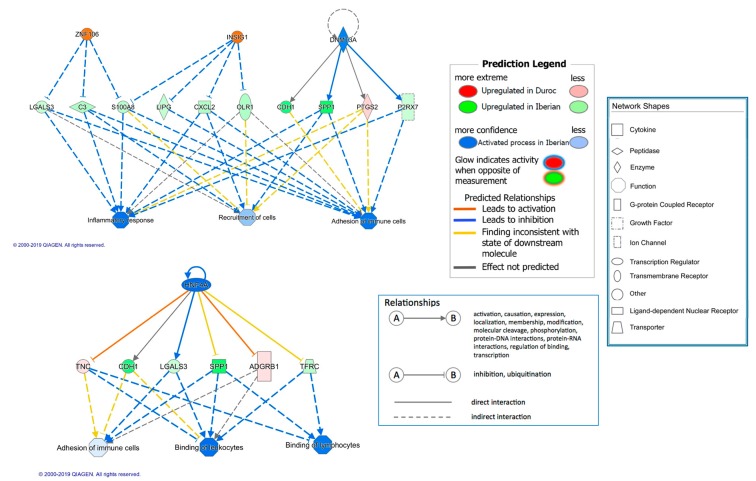
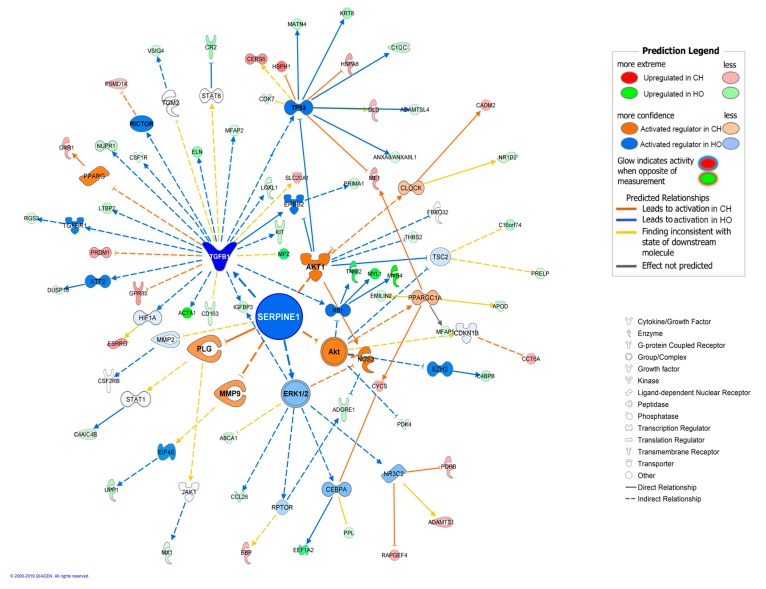
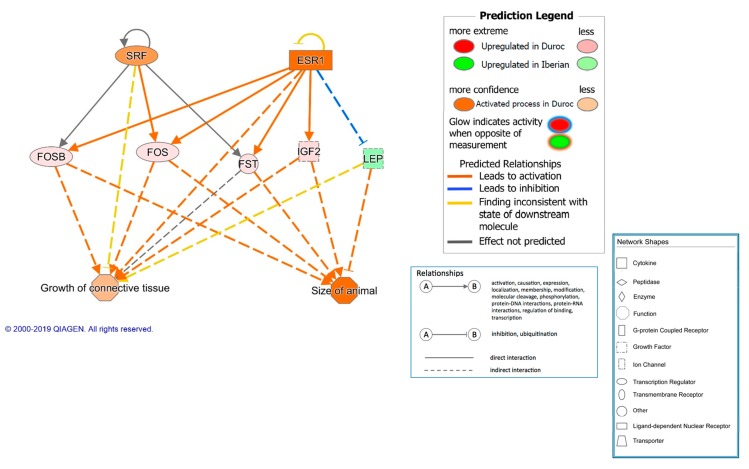
In this study, we analyzed the effects of breed, diet energy source, and their interaction on adipose tissue transcriptome in growing Iberian and Duroc pigs. The study comprised 29 Iberian and 19 Duroc males, which were kept under identical management conditions except the nutritional treatment. Two isoenergetic diets were used with 6% high oleic sunflower oil (HO) or carbohydrates (CH) as energy sources. All animals were slaughtered after 47 days of treatment at an average live weight of 51.2 kg. Twelve animals from each breed (six fed each diet) were employed for ham subcutaneous adipose tissue RNA-Seq analysis. The data analysis was performed using two different bioinformatic pipelines. We detected 837 and 1456 differentially expressed genes (DEGs) according to breed, depending on the pipeline. Due to the strong effect of breed on transcriptome, the effect of the diet was separately evaluated in the two breeds. We identified 207 and 57 DEGs depending on diet in Iberian and Duroc pigs, respectively. A joint analysis of both effects allowed the detection of some breed-diet interactions on transcriptome, which were inferred from RNA-Seq and quantitative PCR data. The functional analysis showed the enrichment of functions related to growth and tissue development, inflammatory response, immune cell trafficking, and carbohydrate and lipid metabolism, and allowed the identification of potential regulators. The results indicate different effects of diet on adipose tissue gene expression between breeds, affecting relevant biological pathways.
在这项研究中,我们分析了品种、日粮能量来源及其相互作用对生长中的伊比利亚和杜洛克猪脂肪组织转录组的影响。该研究包括 29 头伊比利亚猪和 19 头杜洛克猪,它们在除营养处理外的相同管理条件下饲养。使用两种等能量日粮,其能量来源分别为 6%高油酸葵花籽油(HO)或碳水化合物(CH)。所有动物在处理 47 天后,以平均活重 51.2 公斤进行屠宰。每个品种(每个日粮 6 头)各有 12 头动物用于火腿皮下脂肪组织 RNA-Seq 分析。数据分析使用两种不同的生物信息学管道进行。根据管道的不同,我们检测到了 837 个和 1456 个差异表达基因(DEG),分别与品种和日粮有关。由于品种对转录组的强烈影响,因此在两个品种中分别评估了日粮的影响。在伊比利亚猪和杜洛克猪中,我们分别根据日粮鉴定了 207 个和 57 个 DEG。两个效应的联合分析可以检测到一些与转录组有关的品种-日粮互作,这些互作是从 RNA-Seq 和定量 PCR 数据中推断出来的。功能分析显示,与生长和组织发育、炎症反应、免疫细胞迁移以及碳水化合物和脂质代谢相关的功能富集,并且可以鉴定出潜在的调控因子。结果表明,日粮对品种间脂肪组织基因表达有不同的影响,影响了相关的生物学途径。