Teaching Hospital, Anuradhapura, Sri Lanka.
Teaching Hospital, Kandy, Sri Lanka.
BMC Nephrol. 2019 Aug 5;20(1):298. doi: 10.1186/s12882-019-1477-9.
Chronic Kidney Disease in certain part of Sri Lanka and increasing burden of CKD in some other countries is a global public health problem. While the underlying causes of majority of cases are unknown, effective control and prevention strategies are yet to be taken. Though the disease has been identify more than decade ago, baseline data on renal function are not available. This study reports the age and sex disaggregated data of renal functions among screening participants of the Anuradhapura, the district with the highest disease burden in Sri Lanka.
The screening prorgramme was done as a part of CKD control programme of Anuradhapura. All screening centers were visited and information and urine sample collection tubes were distributed before the screening date. A serum and urine sample was taken from all participants. In a subsample, urine sulfosalicylic acid test (SSA Test), urine dipstick test, urine albumin to creatinine ratio (UACR) and urine protein to creatinine ratio (UPCR) was done.
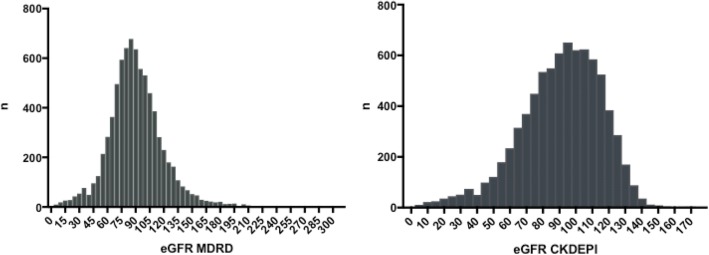
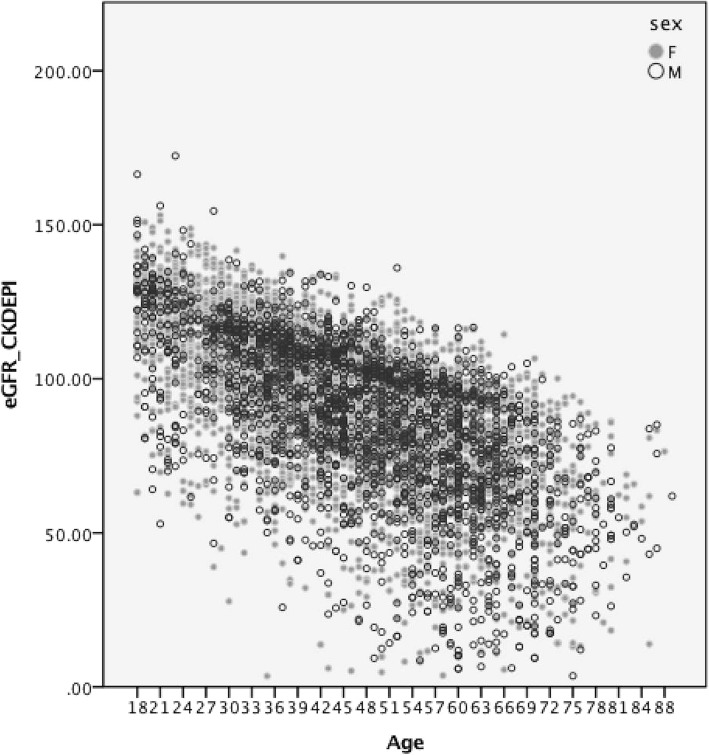
The study sample included 7768 apparently healthy people aging 18 to 93 years and females (n = 5522) accounted for 71.1% of the sample. Mean age of the participants was 45.9 (SD 14.1) years. Mean eGFR in this population was 90.8 mL/min/1.73m(SD 24.6) with a significantly lower eGFR (88.1 mL/min/1.73m) among males compared to female (92.8 mL/min/1.73m). Mean eGFR was 115 mL/min/1.73m (SE .5) among participants aging less than 30 and this value drastically reduced to 59.1 mL/min/1.73m (SE 1.2) among people aging more than 70 years. Proportion of people having reduction of eGFR compatible with mild, moderate, severe and kidney failure categories was 33.9(32.7-34.8), 8.4(7.8-9.0), 1.5(1.2-1.7) and 0.7(0.5-0.9). The age and sex adjusted prevalence of eGFR less than 60 mL/min/1.73 m2 in a single sample in this population was 10.6%. Bayesian Latent Class model analysis shows that UPCR> 150 has the highest sensitivity to detect those who are with eGFR less than 60 mL/min/1.73 m2. UACR, the usual recommended test as a screening test was having a sensitivity of 35.3% in this population.
UPCR and UACR should be use as a screening tests in areas with high proportion of CKDu patients. More research are required to investigate the use of age and sex specific cut off values to diagnose CKD.
在斯里兰卡的某些地区,慢性肾脏病以及在其他一些国家不断增加的 CKD 负担是一个全球性的公共卫生问题。尽管大多数病例的根本原因尚不清楚,但尚未采取有效的控制和预防策略。尽管该疾病在十多年前就已被发现,但目前仍缺乏肾功能的基线数据。本研究报告了斯里兰卡疾病负担最高的地区——阿努拉达普拉的筛查参与者的按年龄和性别细分的肾功能数据。
该筛查项目是阿努拉达普拉 CKD 控制项目的一部分。在筛查日期之前,所有筛查中心都进行了访问,并分发了信息和尿液样本收集管。从所有参与者中采集血清和尿液样本。在亚样本中,进行了尿液磺基水杨酸试验(SSA 试验)、尿液试纸条试验、尿白蛋白与肌酐比值(UACR)和尿蛋白与肌酐比值(UPCR)。
本研究样本包括 7768 名年龄在 18 至 93 岁之间的看似健康的人,女性(n=5522)占样本的 71.1%。参与者的平均年龄为 45.9(SD 14.1)岁。该人群的平均 eGFR 为 90.8mL/min/1.73m(SD 24.6),男性的 eGFR(88.1mL/min/1.73m)明显低于女性(92.8mL/min/1.73m)。年龄小于 30 岁的参与者的平均 eGFR 为 115mL/min/1.73m(SE.5),而年龄大于 70 岁的参与者的 eGFR 则急剧降至 59.1mL/min/1.73m(SE 1.2)。具有轻度、中度、重度和肾衰竭类别的 eGFR 降低比例分别为 33.9(32.7-34.8)、8.4(7.8-9.0)、1.5(1.2-1.7)和 0.7(0.5-0.9)。在该人群的单次样本中,eGFR 小于 60mL/min/1.73m2 的年龄和性别调整患病率为 10.6%。贝叶斯潜在类别模型分析显示,UPCR>150 对检测 eGFR 小于 60mL/min/1.73m2 的患者具有最高的敏感性。UACR,通常作为筛查试验推荐的检测方法,在该人群中的敏感性为 35.3%。
在 CKDu 患者比例较高的地区,应使用 UPCR 和 UACR 作为筛查试验。需要更多的研究来调查使用年龄和性别特异性截断值来诊断 CKD。