Agampodi Suneth Buddhika, Agampodi Thilini Chanchala, Amarasinghe Gayani Shashikala, Warnasekara Janith Niwanthaka, Hettiarachchi Ayesh Umeshana, Jayasinghe Imasha Upulini, Koralegedara Iresha Sandamali, Abeyrathna Parami, Srimantha Shalka, de Silva Farika Nirmani, Gunarathne Sajaan Praveena, Wickramasinghe Nuwan Darshana
Department of Community Medicine, Faculty of Medicine and Allied Sciences, Rajarata University of Sri Lanka, Mihintale, Sri Lanka.
Department of Anatomy, Faculty of Medicine and Allied Sciences, Rajarata University of Sri Lanka, Mihintale, Sri Lanka.
PLOS Glob Public Health. 2023 Jan 26;3(1):e0000443. doi: 10.1371/journal.pgph.0000443. eCollection 2023.
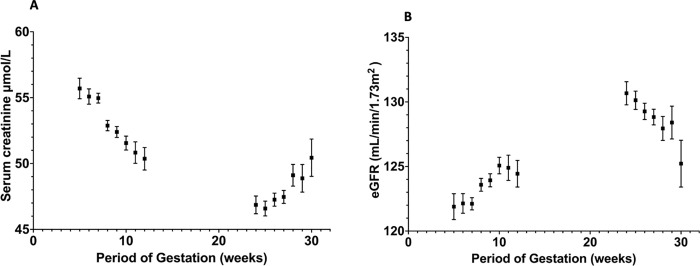
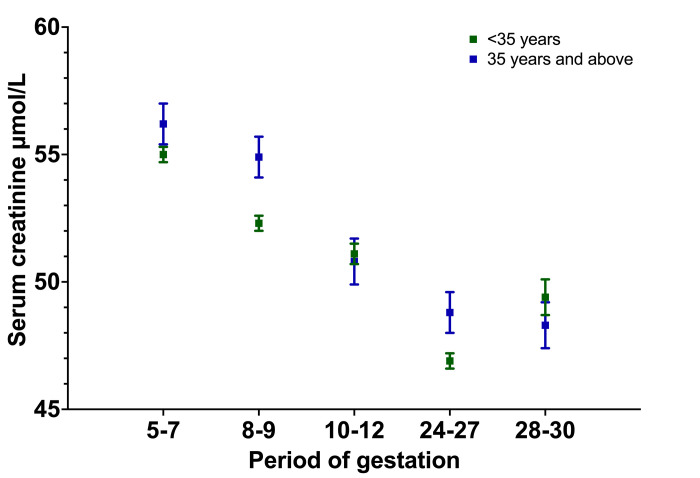
Renal functions in pregnancy undergo rapid changes, and the thresholds for normal values are a major research gap and are still debatable. The lack of prospective population-based studies with early pregnancy recruitment hampered the decision-making process on the best thresholds to be used in clinical practice. We present the serum creatinine (sCr) and sCr-based estimated glomerular filtration rates (eGFR) in early pregnancy with changes over the gestational period in a large prospective, community-based cohort, the Rajarata Pregnancy Cohort (RaPCo). We carried out a community-based prospective cohort study with 2,259 healthy pregnant women with a gestation period of less than 13 weeks and without pre-existing medical conditions. Gestational period-specific sCr and sCr-based eGFR were calculated for different age strata, and the participants were followed up until the second trimester. Renal functions of pregnant women were compared with 2.012 nonpregnant women from the same geographical area. The mean (SD) sCr of the 2,012 nonpregnant women was 62.8(12.4) μmol/L, with the 97.5th percentile of 89.0 μmol/L. Among the pregnant women, mean (SD) sCr was 55.1(8.3), 52.7(8.1), 51.1(9.1), 47.1(7.2), and 49.3 (9.9), while the 97.5th percentile for sCr was 72.4, 69.1, 70.0, 63.6, and 66.0 μmol/L respectively during the 4-7, 8-9, 10-12, 24-27 and 28-30 weeks of gestation. The average sCr value was 84.7% and 76.4% of the nonpregnant group, respectively, in the first and second trimesters. The mean eGFR was 123.4 (10.7) mL/min/1.73 m2 in the first trimester and increased up to 129.5 mL/min/1.73 m2 in the 24th week of gestation. The analysis of cohort data confirmed a significant reduction in sCr with advancing pregnancy (p<0 .001). This study provides thresholds for renal functions in pregnancy to be used in clinical practice. Clinical validation of the proposed thresholds needs to be evaluated with pregnancy and newborn outcomes.
孕期肾功能会发生快速变化,正常数值的阈值是一个重大研究空白,且仍存在争议。缺乏早期招募孕妇的基于人群的前瞻性研究阻碍了临床实践中最佳阈值的决策过程。我们在一个大型前瞻性社区队列——拉贾拉塔妊娠队列(RaPCo)中,展示了孕早期血清肌酐(sCr)以及基于sCr的估计肾小球滤过率(eGFR)及其在孕期的变化情况。我们开展了一项基于社区的前瞻性队列研究,纳入了2259名妊娠期小于13周且无既往病史的健康孕妇。针对不同年龄层计算了特定孕周的sCr和基于sCr的eGFR,并对参与者进行随访直至孕中期。将孕妇的肾功能与来自同一地理区域的2012名非孕妇进行了比较。2012名非孕妇的平均(标准差)sCr为62.8(12.4)μmol/L,第97.5百分位数为89.0 μmol/L。在孕妇中,孕4 - 7周、8 - 9周、10 - 12周、24 - 27周和28 - 30周时sCr的平均(标准差)分别为55.1(8.3)、52.7(8.1)、51.1(9.1)、47.1(7.2)和49.3(9.9)μmol/L,而sCr的第97.5百分位数分别为72.4、69.1、70.0、63.6和66.0 μmol/L。孕早期和孕中期的平均sCr值分别是非孕妇组的84.7%和76.4%。孕早期平均eGFR为123.4(10.7)mL/min/1.73 m²,在孕24周时增至129.5 mL/min/1.73 m²。队列数据分析证实,随着孕周增加sCr显著降低(p<0.001)。本研究提供了可用于临床实践的孕期肾功能阈值。所提议阈值的临床验证需要通过妊娠和新生儿结局进行评估。