Laboratory of Cell and Molecular Biology, Graduate School of Life Science, University of Hyogo, 3-2-1 Kouto, Kamigori-Cho, Ako-Gun, Hyogo, 678-1297, Japan.
Institute for Integrated Cell-Material Sciences (iCeMS), Kyoto University, Yoshida-Honmachi, Sakyo-Ku, Kyoto, 606-8501, Japan.
Sci Rep. 2019 Aug 5;9(1):11309. doi: 10.1038/s41598-019-47721-4.
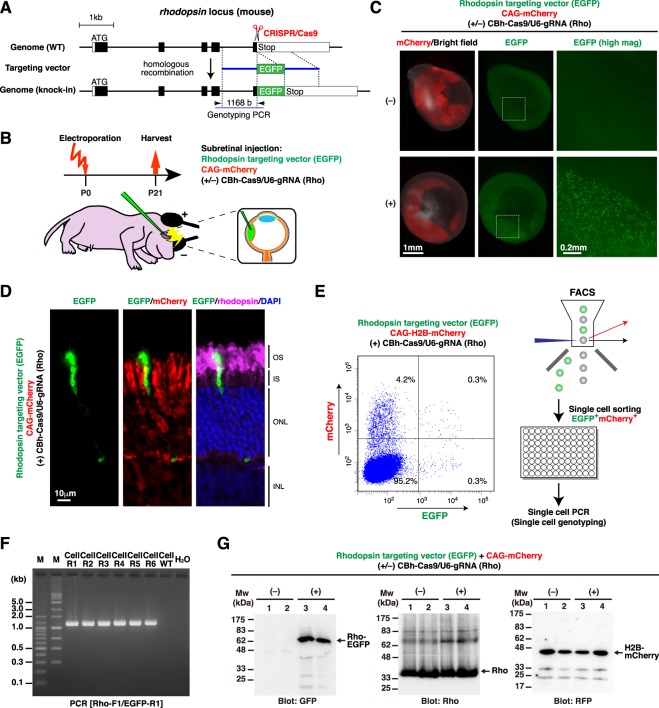
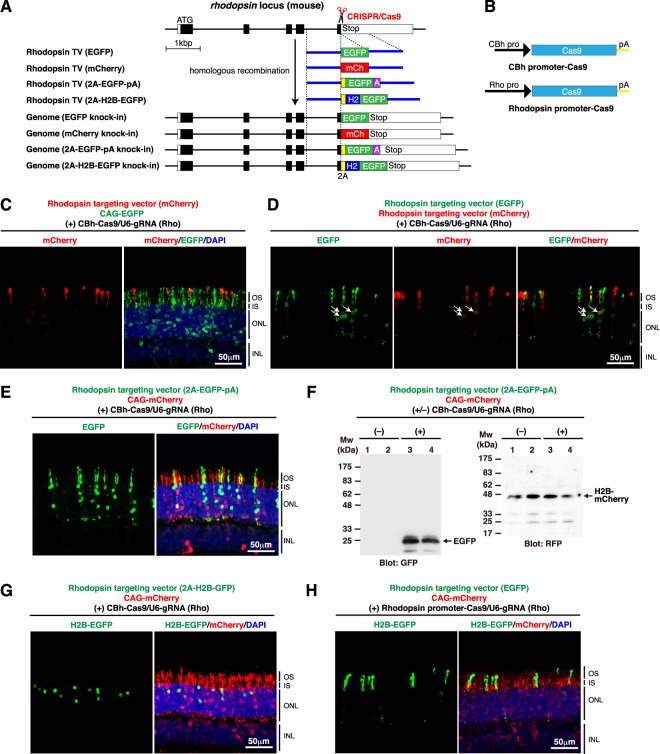
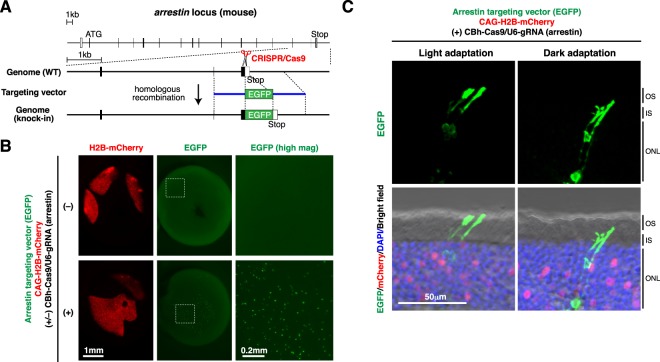
To analyze the expression, localization, and functional dynamics of target proteins in situ, especially in living cells, it is important to develop a convenient, versatile, and efficient method to precisely introduce exogenous genes into the genome, which is applicable for labeling and engineering of the endogenous proteins of interest. By combining the CRISPR/Cas9 genome editing technology with an electroporation technique, we succeeded in creating knock-in alleles, from which GFP (RFP)-tagged endogenous proteins are produced, in neurons and glial cells in vivo in the developing mouse retina and brain. Correct gene targeting was confirmed by single-cell genotyping and Western blot analysis. Several gene loci were successfully targeted with high efficiency. Moreover, we succeeded in engineering the mouse genome to express foreign genes from the endogenous gene loci using a self-cleaving 2A peptide. Our method could be used to monitor the physiological changes in localization of endogenous proteins and expression levels of both mRNA and protein at a single cell resolution. This work discloses a powerful and widely applicable approach for visualization and manipulation of endogenous proteins in neural tissues.
为了分析目标蛋白质在原位(尤其是在活细胞中)的表达、定位和功能动态,开发一种方便、通用和高效的方法将外源性基因精确引入基因组中非常重要,这对于标记和工程感兴趣的内源性蛋白质很有用。通过将 CRISPR/Cas9 基因组编辑技术与电穿孔技术相结合,我们成功地在发育中的小鼠视网膜和大脑的神经元和神经胶质细胞中创建了 knock-in 等位基因,从这些等位基因中产生 GFP(RFP)标记的内源性蛋白质。通过单细胞基因分型和 Western blot 分析证实了正确的基因靶向。我们以高效率成功靶向了多个基因座。此外,我们还成功地利用自切割 2A 肽将小鼠基因组工程化以从内源性基因座表达外源基因。我们的方法可用于监测内源性蛋白质定位和 mRNA 及蛋白质表达水平的单细胞分辨率的生理变化。这项工作揭示了一种强大且广泛适用于神经组织中内源性蛋白质可视化和操作的方法。