Chireh Batholomew, D'Arcy Carl
School of Public Health, University of Saskatchewan, 104 Clinic Place, Saskatoon, SK, S7N 2Z4, Canada.
School of Public Health and Department of Psychiatry, University of Saskatchewan, Saskatoon, SK, Canada.
Ther Adv Endocrinol Metab. 2019 Jul 25;10:2042018819865828. doi: 10.1177/2042018819865828. eCollection 2019.
The objective of this study was to examine shared and unique risk factors for incident depression and diabetes mellitus in a national longitudinal population-based survey.
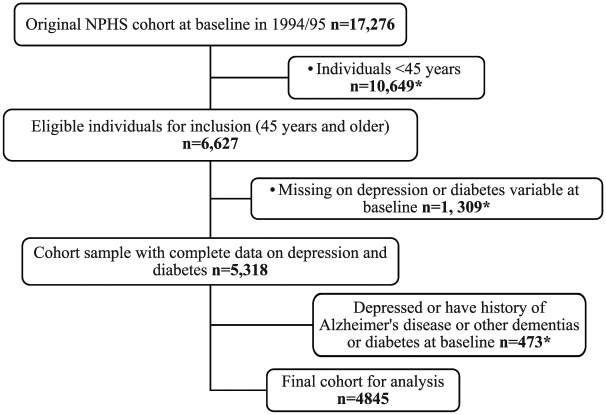
Canadian National Population Health Survey (NPHS) longitudinal study was used. A subsample of the initial NPHS sample ( = 4845), free of depression or diabetes mellitus at baseline was tracked over a 10-year period. Univariate and multivariate modified Poisson regression models were used to estimate the relative risk (RR). Stratified analyses by sex were conducted to measure its moderating role. The goodness-of-fit of the various models was tested.
The cumulative incidence rate of major depressive disorder and incident diabetes mellitus at 10-year follow-up were 4.1% and 10.1% respectively. Hypertension, daily smoking, physical inactivity and being overweight or obese were shared risk factors for major depressive episode and diabetes mellitus. Being female, family stress, traumatic events, having any chronic disease or heart disease were uniquely associated with depression while increasing age and ethnicity (non-white) were unique risk factors for diabetes mellitus. Also, underweight, family stress, chronic disease, and heart disease were risk factors for major depressive disorder in both sexes. Six risk factors, age, ethnicity (non-white), high blood pressure, daily smoking, physical inactivity, and body mass index were associated with incident diabetes mellitus in both sexes.
We found common risk behaviors/conditions not specific to either diabetes mellitus or depression. These risks have also been implicated in the development of a variety of chronic diseases. These findings underline the importance of public health prevention programs targeting generic risk behaviors.
本研究的目的是在一项基于全国纵向人群的调查中,探究新发抑郁症和糖尿病的共同及独特风险因素。
采用加拿大全国人口健康调查(NPHS)纵向研究。对初始NPHS样本中的一个子样本(n = 4845)进行为期10年的跟踪,该子样本在基线时无抑郁症或糖尿病。使用单变量和多变量修正泊松回归模型来估计相对风险(RR)。进行按性别分层分析以衡量其调节作用。对各种模型的拟合优度进行了检验。
在10年随访时,重度抑郁症和新发糖尿病的累积发病率分别为4.1%和10.1%。高血压、每日吸烟、缺乏身体活动以及超重或肥胖是重度抑郁发作和糖尿病的共同风险因素。女性、家庭压力、创伤性事件、患有任何慢性病或心脏病与抑郁症有独特关联,而年龄增长和种族(非白人)是糖尿病的独特风险因素。此外,体重过轻、家庭压力、慢性病和心脏病是男女患重度抑郁症的风险因素。六个风险因素,即年龄、种族(非白人)、高血压、每日吸烟、缺乏身体活动和体重指数,与男女新发糖尿病均相关。
我们发现了并非特定于糖尿病或抑郁症的常见风险行为/状况。这些风险也与多种慢性病的发生有关。这些发现强调了针对一般风险行为的公共卫生预防项目的重要性。