Chireh Batholomew, Li Muzi, D'Arcy Carl
University of Saskatchewan School of Public Health, 104 Clinic Place, Saskatoon, SK S7N 2Z4, Canada.
The Douglas Hospital Research Centre, 6875 boulevard LaSalle, Montreal H4H 1R3, Canada.
Prev Med Rep. 2019 Feb 10;14:100822. doi: 10.1016/j.pmedr.2019.100822. eCollection 2019 Jun.
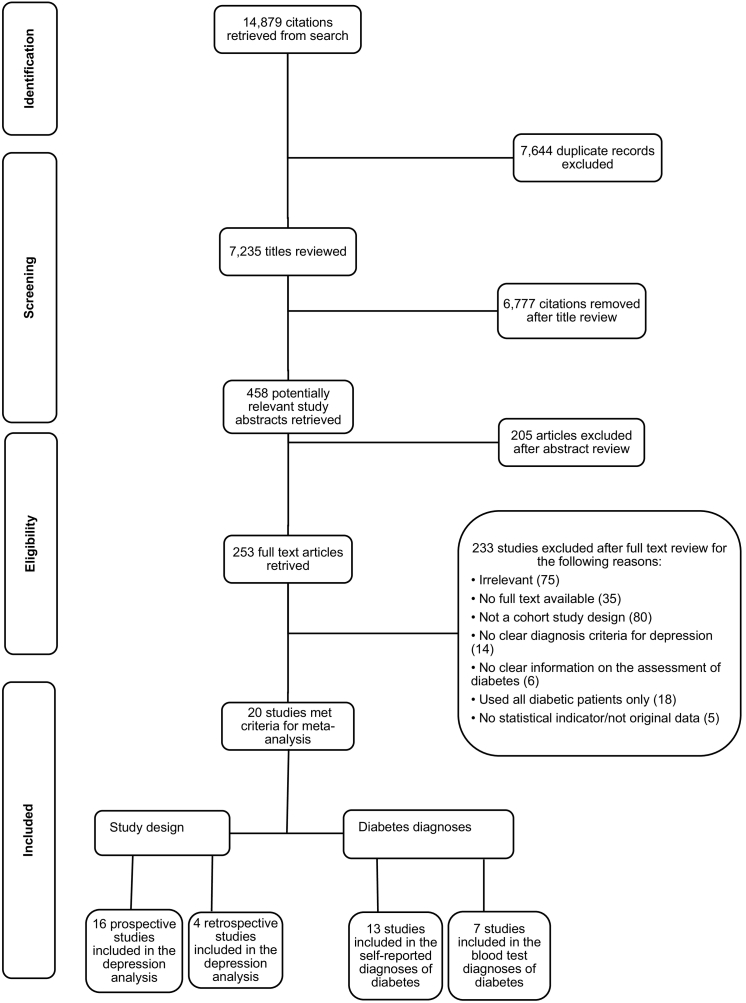
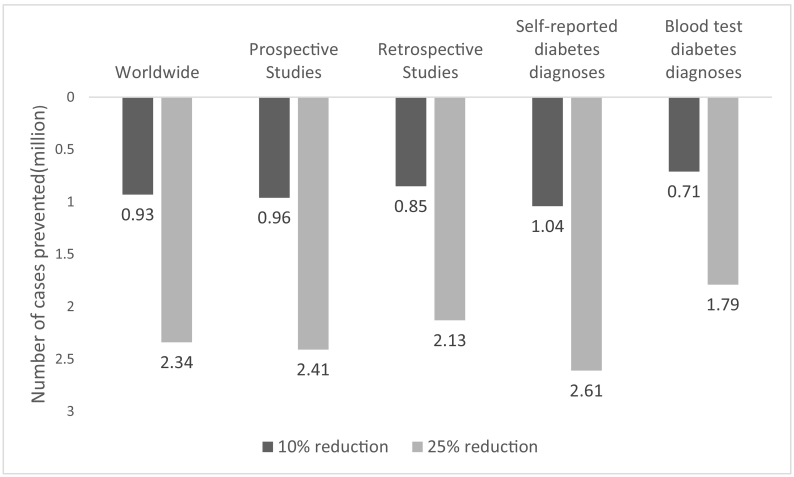
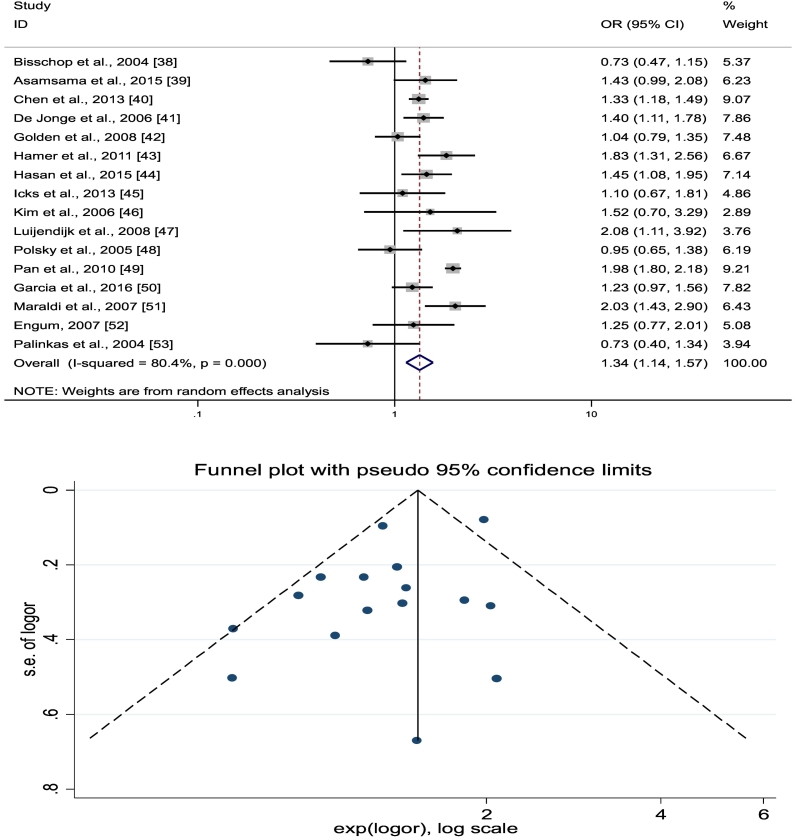
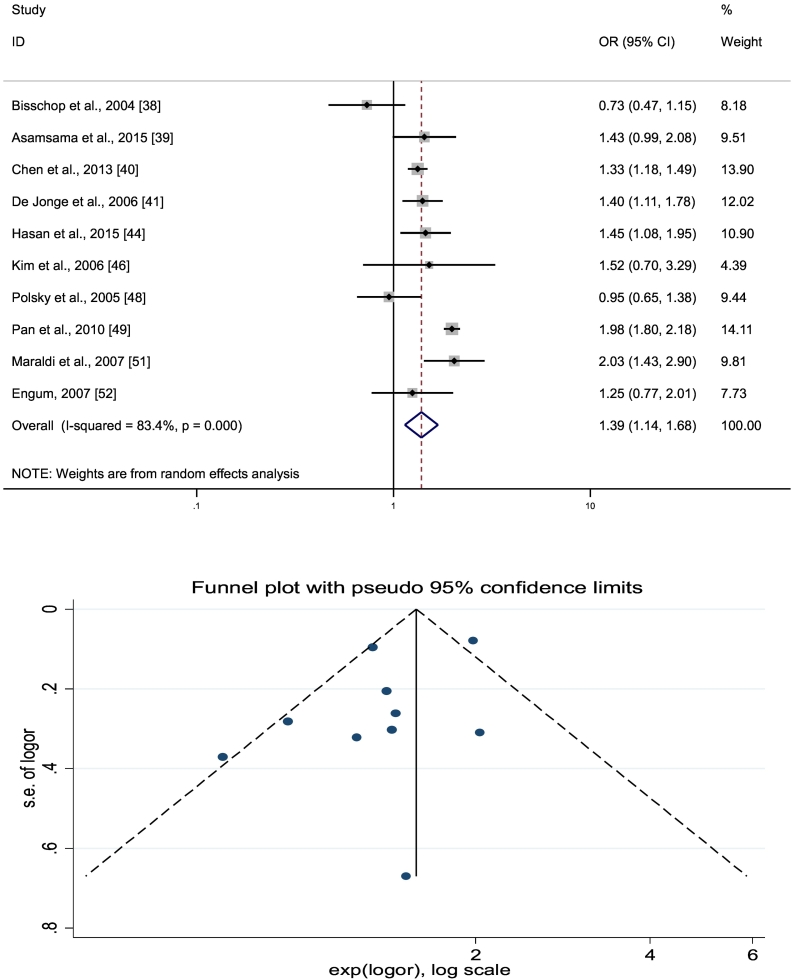
We aim to examine the relationship between diabetes and depression risk in longitudinal cohort studies and by how much the incidence of depression in a population would be reduced if diabetes was reduced. Medline/PubMed, EMBASE, PsycINFO, and Cochrane Library databases were searched for English-language published literature from January 1990 to December 2017. Longitudinal studies with criteria for depression and self-report doctors' diagnoses or diagnostic blood test measurement of diabetes were assessed. Systematic review with meta-analysis synthesized the results. Study quality, heterogeneity, and publication bias were examined. Pooled odds ratios were calculated using random effects models. Population attributable fractions (PAFs) were used to estimate potential preventive impact. Twenty high-quality articles met inclusion criteria and were analyzed. The pooled odds ratio (OR) between diabetes and depression was 1.33 (95% CI, 1.18-1.51). For the various study types the ORs were as follows: prospective studies (OR 1.34, 95% CI 1.14-1.57); retrospective studies (OR 1.30, 95% CI 1.05-1.62); self-reported diagnosis of diabetes (OR 1.37, 95% CI 1.17-1.60); and diagnostic diabetes blood test (OR 1.25, 95% CI 1.04-1.52). PAFs suggest that over 9.5 million of global depression cases are potentially attributable to diabetes. A 10-25% reduction in diabetes could potentially prevent 930,000 to 2.34 million depression cases worldwide. Our systematic review provides fairly robust evidence to support the hypothesis that diabetes is an independent risk factor for depression while also acknowledging the impact of risk factor reduction, study design and diagnostic measurement of exposure which may inform preventive interventions.
我们旨在通过纵向队列研究,探讨糖尿病与抑郁症风险之间的关系,以及如果糖尿病患病率降低,人群中抑郁症发病率会降低多少。检索了Medline/PubMed、EMBASE、PsycINFO和Cochrane图书馆数据库,以获取1990年1月至2017年12月发表的英文文献。评估了符合抑郁症标准以及自我报告医生诊断或糖尿病诊断性血液检测的纵向研究。采用荟萃分析进行系统评价以综合结果。检查了研究质量、异质性和发表偏倚。使用随机效应模型计算合并比值比。采用人群归因分数(PAF)来估计潜在的预防影响。20篇高质量文章符合纳入标准并进行了分析。糖尿病与抑郁症之间的合并比值比(OR)为1.33(95%CI,1.18 - 1.51)。对于各种研究类型,OR如下:前瞻性研究(OR 1.34,95%CI 1.14 - 1.57);回顾性研究(OR 1.30,95%CI 1.05 - 1.62);糖尿病自我报告诊断(OR 1.37,95%CI 1.17 - 1.60);以及糖尿病诊断性血液检测(OR 1.25,95%CI 1.04 - 1.52)。PAF表明,全球超过950万例抑郁症病例可能归因于糖尿病。糖尿病患病率降低10% - 25%可能在全球预防93万至234万例抑郁症病例。我们的系统评价提供了相当有力的证据来支持糖尿病是抑郁症独立危险因素这一假设,同时也认识到危险因素降低、研究设计和暴露诊断测量的影响,这些可能为预防性干预提供参考。