Department of Biological Science and Technology, China University of Science and Technology, Taipei, 115, Taiwan.
Institute of Cellular and System Medicine, National Health Research Institutes, Miaoli, 350, Taiwan.
J Biomed Sci. 2019 Aug 7;26(1):56. doi: 10.1186/s12929-019-0551-8.
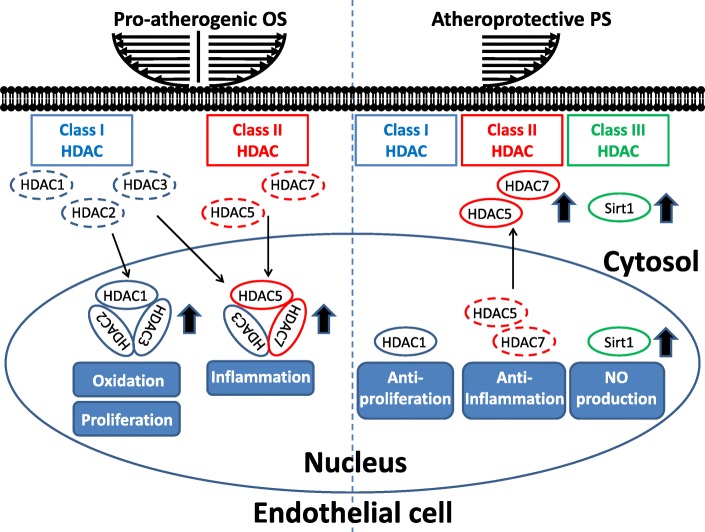
Endothelial cell (EC) dysfunctions, including turnover enrichment, gap junction disruption, inflammation, and oxidation, play vital roles in the initiation of vascular disorders and atherosclerosis. Hemodynamic forces, i.e., atherprotective pulsatile (PS) and pro-atherogenic oscillatory shear stress (OS), can activate mechanotransduction to modulate EC function and dysfunction. This review summarizes current studies aiming to elucidate the roles of epigenetic factors, i.e., histone deacetylases (HDACs), non-coding RNAs, and DNA methyltransferases (DNMTs), in mechanotransduction to modulate hemodynamics-regulated EC function and dysfunction. OS enhances the expression and nuclear accumulation of class I and class II HDACs to induce EC dysfunction, i.e., proliferation, oxidation, and inflammation, whereas PS induces phosphorylation-dependent nuclear export of class II HDACs to inhibit EC dysfunction. PS induces overexpression of the class III HDAC Sirt1 to enhance nitric oxide (NO) production and prevent EC dysfunction. In addition, hemodynamic forces modulate the expression and acetylation of transcription factors, i.e., retinoic acid receptor α and krüppel-like factor-2, to transcriptionally regulate the expression of microRNAs (miRs). OS-modulated miRs, which stimulate proliferative, pro-inflammatory, and oxidative signaling, promote EC dysfunction, whereas PS-regulated miRs, which induce anti-proliferative, anti-inflammatory, and anti-oxidative signaling, inhibit EC dysfunction. PS also modulates the expression of long non-coding RNAs to influence EC function. i.e., turnover, aligmant, and migration. On the other hand, OS enhances the expression of DNMT-1 and -3a to induce EC dysfunction, i.e., proliferation, inflammation, and NO repression.
Overall, epigenetic factors play vital roles in modulating hemodynamic-directed EC dysfunction and vascular disorders, i.e., atherosclerosis. Understanding the detailed mechanisms through which epigenetic factors regulate hemodynamics-directed EC dysfunction and vascular disorders can help us to elucidate the pathogenic mechanisms of atherosclerosis and develop potential therapeutic strategies for atherosclerosis treatment.
内皮细胞(EC)功能障碍,包括周转率增加、缝隙连接破坏、炎症和氧化,在血管疾病和动脉粥样硬化的发生中起着至关重要的作用。血流动力学力,即抗动脉粥样硬化的脉动(PS)和促动脉粥样硬化的振荡剪切应力(OS),可以激活机械转导来调节 EC 功能和功能障碍。本综述总结了目前旨在阐明表观遗传因子(如组蛋白去乙酰化酶(HDACs)、非编码 RNA 和 DNA 甲基转移酶(DNMTs))在机械转导中调节血流调节的 EC 功能和功能障碍的作用。OS 增强了 I 类和 II 类 HDACs 的表达和核积累,从而诱导 EC 功能障碍,如增殖、氧化和炎症,而 PS 诱导 II 类 HDACs 的磷酸化依赖性核输出,以抑制 EC 功能障碍。PS 诱导 III 类 HDAC Sirt1 的过表达,以增强一氧化氮(NO)的产生并防止 EC 功能障碍。此外,血流动力学力调节转录因子的表达和乙酰化,如维甲酸受体α和 Krüppel 样因子 2,以转录调节 microRNAs(miRs)的表达。OS 调节的 miRs 刺激增殖、促炎和氧化信号,促进 EC 功能障碍,而 PS 调节的 miRs 诱导抗增殖、抗炎和抗氧化信号,抑制 EC 功能障碍。PS 还调节长非编码 RNA 的表达以影响 EC 功能,如周转率、排列和迁移。另一方面,OS 增强了 DNMT-1 和 -3a 的表达,诱导 EC 功能障碍,如增殖、炎症和 NO 抑制。
总的来说,表观遗传因子在调节血流导向的 EC 功能障碍和血管疾病,即动脉粥样硬化中起着至关重要的作用。了解表观遗传因子调节血流导向的 EC 功能障碍和血管疾病的详细机制,可以帮助我们阐明动脉粥样硬化的发病机制,并为动脉粥样硬化的治疗开发潜在的治疗策略。