Department of Radiation Oncology, Seoul National University Hospital, Seoul, Republic of Korea.
Biomedical Research Institute, Seoul National University Hospital, Seoul, Republic of Korea.
Radiat Oncol. 2019 Aug 6;14(1):139. doi: 10.1186/s13014-019-1349-2.
This study compared adaptive replanning and repositioning corrections based on soft-tissue matching for prostate cancer by using the magnetic resonance-guided radiation therapy (MRgRT) system.
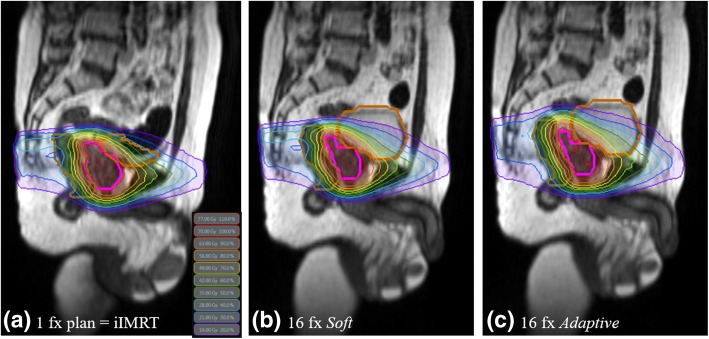
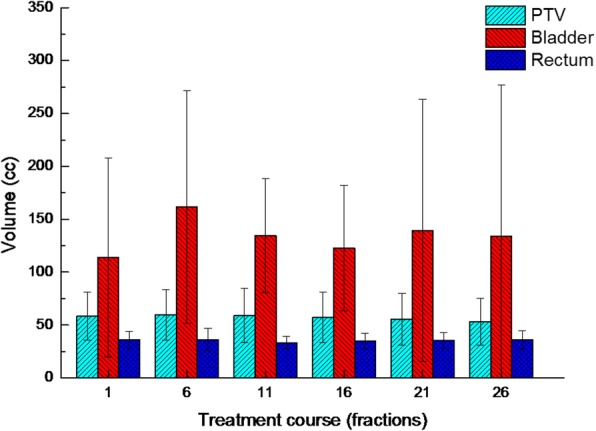
A total of 19 patients with prostate cancer were selected retrospectively. Weekly magnetic resonance image (MRI) scans were acquired for 5 weeks for each patient to observe the anatomic changes during the treatment course. Initial intensity-modulated radiation therapy (IMRT) plans (iIMRT) were generated for each patient with 13 coplanar Co beams on a ViewRay™ system. Two techniques were applied: patient repositioning and replanning. For patient repositioning, one plan was created: soft-tissue (prostate) matching (Soft). The dose distribution was calculated for each MRI with the beam delivery parameters from the initial IMRT plan. The replanning technique was used to generate the Adaptive plan, which was the reoptimized plan for the weekly MRI. The dose-volumetric parameters of the planning target volume (PTV), bladder, and rectum were calculated for all plans. During the treatment course, the PTV, bladder, and rectum were evaluated for changes in volume and the effect on dosimetric parameters. The differences between the dose-volumetric parameters of the plans were examined through the Wilcoxon test. The initial plan was used as a baseline to compare the differences.
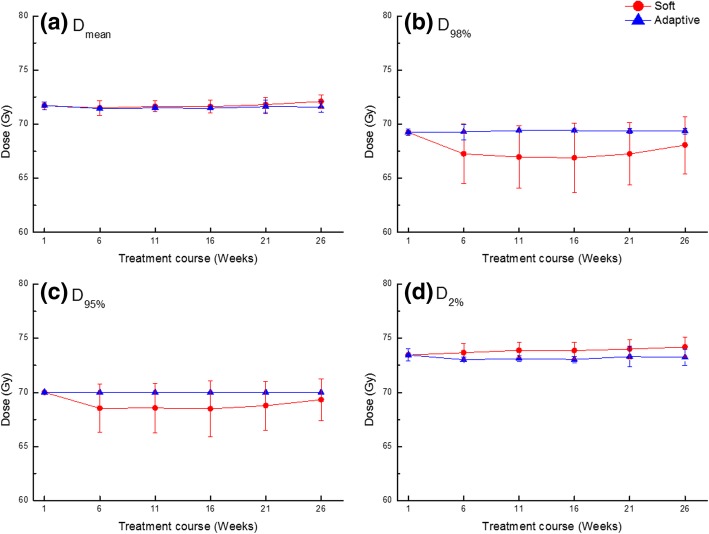
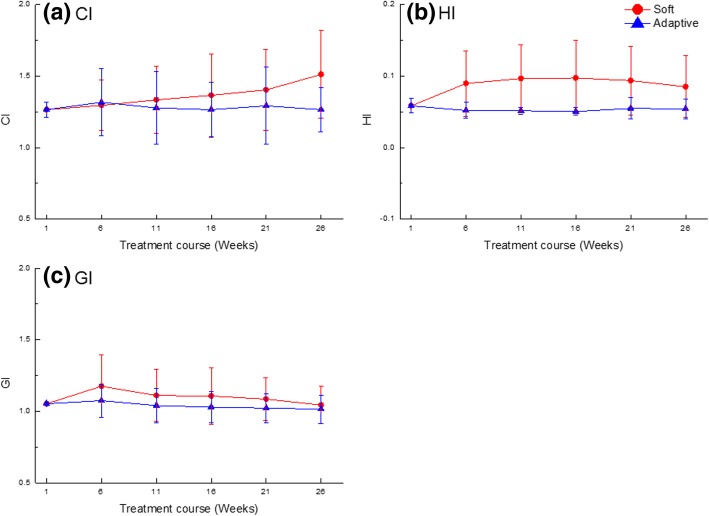
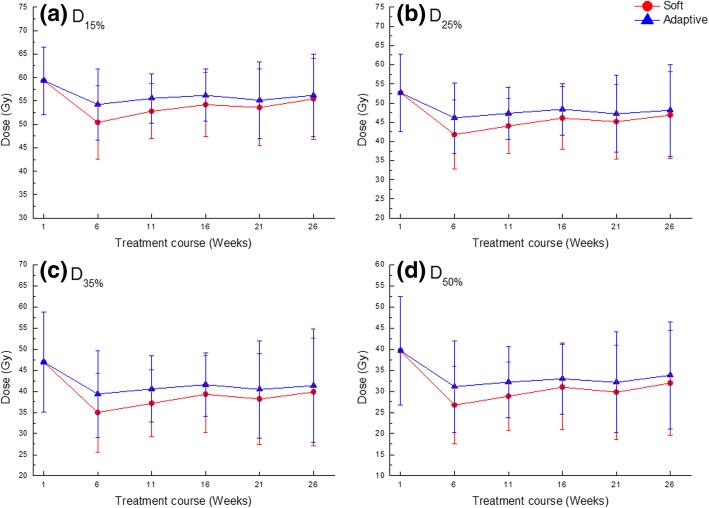
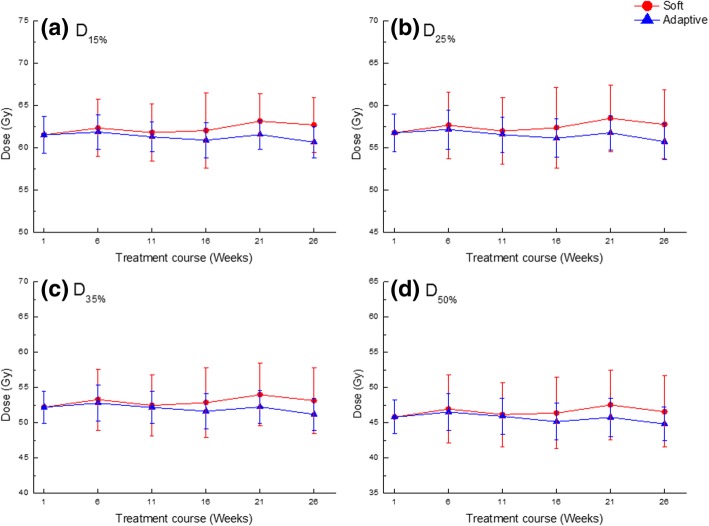
The Adaptive plan showed better target coverage during the treatment period, but the change was not significant in the Soft plan. There were significant differences in D, D, and D in PTV between the Soft and Adaptive plans (p < 0.05) except for D. There was no significant change in D and D as the treatment progressed with all plans. All indices for the Adaptive plan stayed the same compared to those of iIMRT during the treatment course. There were significant differences in D, D, D, and D in the bladder between the Soft and Adaptive plans. The Adaptive plan showed the worse dose sparing than the Soft plan for the bladder according to each dosimetric index. In contrast to the bladder, the Adaptive plan achieved better sparing than the Soft plan during the treatment course. The significant differences were only observed in D and D between the Soft and Adaptive plans (p < 0.05).
Patient repositioning based on the target volume (Soft plan) can relatively retain the target coverage for patients and the OARs remain at a clinically tolerance level during the treatment course. The Adaptive plan did not clinically improve for the dose delivered to OARs, it kept the dose delivered to the target volume constant. However, the Adaptive plan is beneficial when the organ positions and volumes change considerable during treatment.
本研究通过使用磁共振引导放射治疗(MRgRT)系统,比较了前列腺癌的自适应重计划和基于软组织匹配的重新定位校正。
回顾性选择了 19 例前列腺癌患者。为每位患者每周采集 5 周的磁共振图像(MRI)扫描,以观察治疗过程中的解剖变化。为每位患者使用 ViewRay™系统上的 13 个共面钴束生成初始调强放射治疗(IMRT)计划(iIMRT)。应用了两种技术:患者重新定位和重计划。对于患者重新定位,创建了一个计划:软组织(前列腺)匹配(Soft)。根据初始 IMRT 计划的射束传递参数计算每个 MRI 的剂量分布。重计划技术用于生成适应性计划,这是每周 MRI 的重新优化计划。计算所有计划的计划靶区(PTV)、膀胱和直肠的剂量-体积参数。在治疗过程中,评估 PTV、膀胱和直肠的体积变化及其对剂量学参数的影响。通过 Wilcoxon 检验检查计划之间剂量-体积参数的差异。以初始计划为基线比较差异。
在治疗期间,适应性计划显示出更好的靶区覆盖,但软组织计划的变化不显著。除了 D,PTV 中的 D、D 和 D 在软组织和适应性计划之间存在显著差异(p<0.05)。随着所有计划的治疗进展,D 和 D 没有显著变化。与治疗过程中的 iIMRT 相比,适应性计划的所有指标保持不变。在膀胱中,软组织和适应性计划之间的 D、D、D 和 D 存在显著差异。根据每个剂量学指标,适应性计划对膀胱的剂量保护均不如软组织计划。与膀胱相反,在治疗过程中,适应性计划比软组织计划获得更好的保护。仅在软组织和适应性计划之间观察到 D 和 D 存在显著差异(p<0.05)。
基于靶区的患者重新定位(Soft 计划)可以相对保留靶区覆盖范围,并且在治疗过程中 OAR 保持在临床耐受水平。自适应计划对 OAR 给予的剂量没有临床改善,它使靶区给予的剂量保持不变。然而,当器官位置和体积在治疗过程中发生较大变化时,适应性计划是有益的。