Arthritis Research UK Primary Care Centre, Institute for Primary care and Health Sciences, Keele University, Keele, ST5 5BG, UK.
Haywood Academic Rheumatology Centre, Midlands Partnership Foundation Trust, Staffordshire, ST6 7AG, UK.
BMC Med. 2019 Aug 7;17(1):154. doi: 10.1186/s12916-019-1394-6.
Antibiotic-induced disturbances of the human microbiota have been implicated in the development of chronic autoimmune conditions. This study aimed to assess whether antibiotic use is associated with the onset of rheumatoid arthritis (RA).
A nested case-control study was conducted utilising data from the primary care Clinical Practice Research Datalink (CPRD). Patients with an incident diagnosis of RA were identified (1995-2017). Each case was matched on age, gender, and general practice to ≥ 5 controls without RA. Conditional logistic regression was used to examine previous antibiotic prescriptions and RA onset after controlling for confounding factors.
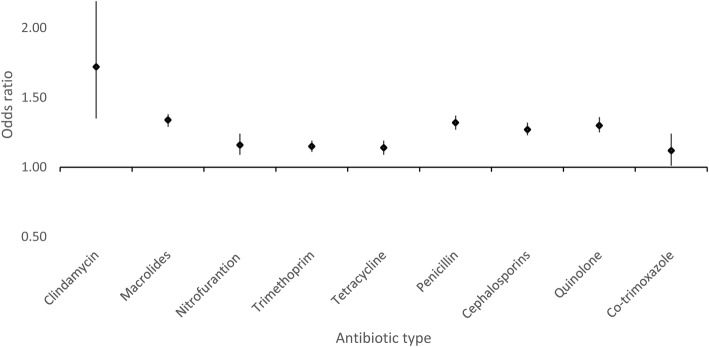
We identified 22,677 cases of RA, matched to 90,013 controls, with a median follow-up of 10 years before RA diagnosis. The odds of developing RA were 60% higher in those exposed to antibiotics than in those not exposed (OR 1.60; 95% CI 1.51-1.68). A dose- or frequency-dependent association was observed between the number of previous antibiotic prescriptions and RA. All classes of antibiotics were associated with higher odds of RA, with bactericidal antibiotics carrying higher risk than bacteriostatic (45% vs. 31%). Those with antibiotic-treated upper respiratory tract (URT) infections were more likely to be RA cases. However, this was not observed for URT infections not treated with antibiotics. Antifungal (OR = 1.27; 95% CI 1.20-1.35) and antiviral (OR = 1.19; 95% CI 1.14-1.24) prescriptions were also associated with increased odds of RA.
Antibiotic prescriptions are associated with a higher risk of RA. This may be due to microbiota disturbances or underlying infections driving risk. Further research is needed to explore these mechanisms.
抗生素诱导的人类微生物群紊乱与慢性自身免疫性疾病的发展有关。本研究旨在评估抗生素的使用是否与类风湿关节炎(RA)的发病有关。
利用初级保健临床实践研究数据库(CPRD)的数据,进行了一项嵌套病例对照研究。确定了患有 RA 首发诊断的患者(1995-2017 年)。每个病例均按年龄、性别和全科医生与≥5 名无 RA 的对照相匹配。在控制混杂因素后,使用条件逻辑回归来检查先前的抗生素处方与 RA 发病之间的关系。
我们确定了 22677 例 RA 病例,与 90013 例对照相匹配,在 RA 诊断前的中位随访时间为 10 年。与未暴露于抗生素的患者相比,暴露于抗生素的患者发生 RA 的几率高出 60%(比值比 1.60;95%置信区间 1.51-1.68)。观察到先前抗生素处方的数量与 RA 之间存在剂量或频率依赖性关联。所有类别的抗生素都与 RA 的发病几率增加有关,杀菌性抗生素的风险高于抑菌性抗生素(45%比 31%)。接受抗生素治疗的上呼吸道(URT)感染患者更有可能成为 RA 病例。然而,对于未经抗生素治疗的 URT 感染,并未观察到这种情况。抗真菌(比值比 1.27;95%置信区间 1.20-1.35)和抗病毒(比值比 1.19;95%置信区间 1.14-1.24)处方也与 RA 发病几率增加有关。
抗生素处方与 RA 的发病风险增加有关。这可能是由于微生物群紊乱或潜在感染导致风险增加。需要进一步研究来探讨这些机制。