Departamento de Saúde Mental, Faculdade de Medicina, Universidade de Minas Gerais, Minas Gerais, Brazil.
Department of Psychiatry, University of California San Diego, San Diego, CA, USA.
J Int Neuropsychol Soc. 2019 Oct;25(9):901-909. doi: 10.1017/S1355617719000717. Epub 2019 Aug 7.
Low educational attainment is a risk factor for more rapid cognitive aging, but there is substantial variability in cognitive trajectories within educational groups. The aim of this study was to determine the factors that confer resilience to memory decline within educational strata.
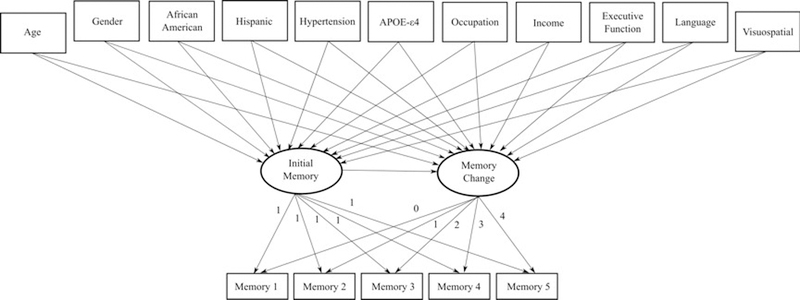
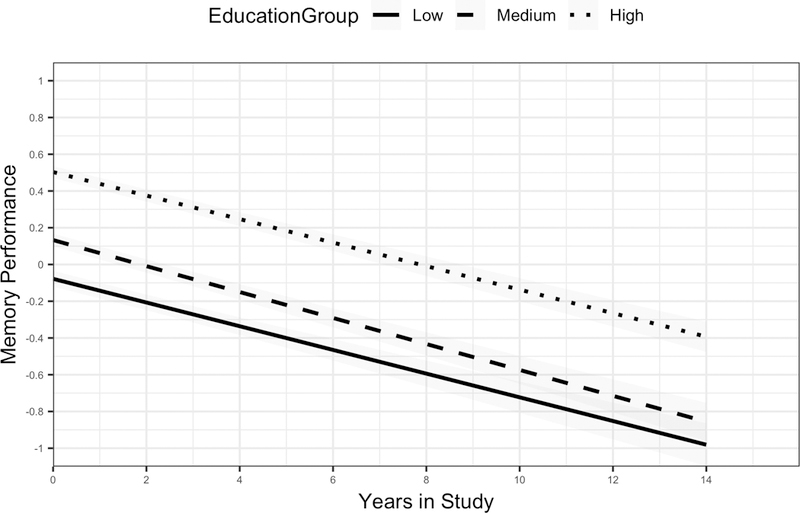
We selected 2573 initially nondemented White, African American, and Hispanic participants from the longitudinal community-based Washington Heights/Inwood Columbia Aging Project who had at least two visits. We estimated initial memory (intercept) and the rate of memory decline (slope) using up to five occasions of measurement. We classified groups according to the educational attainment groups as low (≤5 years), medium (6-11 years), and high (≥12 years). We used a multiple-group latent growth model to identify the baseline predictors of initial memory performance and rate of memory decline across groups. The model specification considered the influence of demographic, socioeconomic, biomedical, and cognitive variables on the intercept and the slope of memory trajectory.
Our results indicated that the three educational groups do not benefit from the same factors. When allowed to differ across groups, the predictors were related to cognitive outcomes in the highly educated group, but we found no unique predictor of cognition for the low educated older adults.
These findings highlight that memory-protective factors may differ across older adults with distinct educational backgrounds, and the need to evaluate a broader range of potential resilience factors for older adults with few years of school.
受教育程度较低是认知衰老加速的一个风险因素,但在教育群体内部,认知轨迹存在很大的可变性。本研究旨在确定在教育层次内赋予记忆力下降韧性的因素。
我们从纵向社区为基础的华盛顿高地/因伍德哥伦比亚老龄化项目中选择了 2573 名最初非痴呆的白种人、非裔美国人和西班牙裔参与者,他们至少有两次就诊。我们使用多达五次的测量来估计初始记忆(截距)和记忆下降率(斜率)。我们根据教育程度将人群分为低(≤5 年)、中(6-11 年)和高(≥12 年)组。我们使用多组潜在增长模型来确定跨组初始记忆表现和记忆轨迹下降率的基线预测因子。该模型的规格考虑了人口统计学、社会经济、生物医学和认知变量对记忆轨迹截距和斜率的影响。
我们的结果表明,这三个教育群体不能从相同的因素中受益。当允许在组间有所不同时,预测因子与高教育群体的认知结果有关,但我们没有发现低教育程度的老年人认知的独特预测因子。
这些发现强调了记忆保护因素可能因具有不同教育背景的老年人而有所不同,并且需要为受教育程度较低的老年人评估更广泛的潜在适应因素。