Department of Breast Surgery, Cancer Hospital of University of Chinese Academy of Sciences, Zhejiang Cancer Hospital, Hangzhou 310022, Zhejiang Province, China.
Shanxi Academy of Medical Sciences, Radiology Department of Shanxi Dayi Hospital, Taiyuan, 030032, Shanxi Province, China
Biosci Rep. 2019 Sep 6;39(9). doi: 10.1042/BSR20190230. Print 2019 Sep 30.
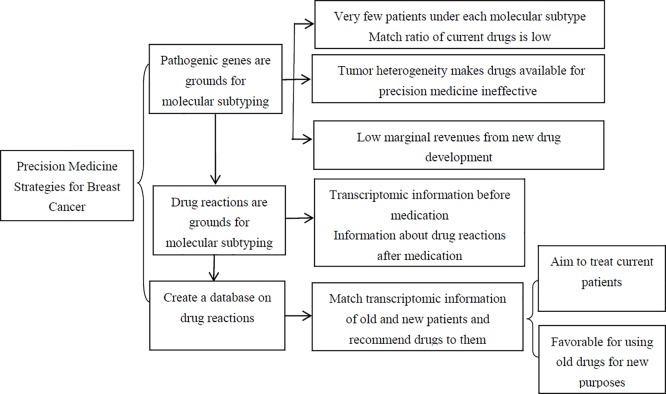
Breast cancer (BC) is a malignancy with the highest incidence in women. Great progress has been made in research related to traditional precision medicine for BC. However, many reports have suggested that patients with BC have not benefited a lot from such progress. Thus, we analyze traditional precision medicine strategies for BC, sum up their limitations and challenges, and preliminarily propose future orientations of precision medicine strategies based on a database on drug reaction of patients with BC. According to related research, traditional precision medicine strategies for BC, which are based on molecular subtypes, perform pertinent treatments, new drug research and development according to molecular typing results. Nevertheless, these strategies still have some deficiencies. First, there are very few patients with each molecular subtype, the match ratio of drugs is low. Second, these strategies can not solve the problem of poor drug sensitivity resulting from heterogeneity. The main strategy we put forward in the present paper is based on patients' varying drug reactions. Focusing on treating existing patients and maximizing the utilization of existing drugs, it is expected to not have deficiencies of traditional precision medicine for BC, including low match rate and poor therapeutic efficacy arising from tumor heterogeneity of BC.
乳腺癌(BC)是女性发病率最高的恶性肿瘤。在乳腺癌相关的传统精准医学研究方面已经取得了巨大进展。然而,许多报道表明,BC 患者并没有从这些进展中获益很多。因此,我们分析了乳腺癌传统精准医学策略,总结了其局限性和挑战,并基于 BC 患者药物反应数据库初步提出了精准医学策略的未来方向。根据相关研究,基于分子亚型的乳腺癌传统精准医学策略根据分子分型结果进行相关治疗、新药研发。然而,这些策略仍存在一些不足。首先,每种分子亚型的患者非常少,药物的匹配率较低。其次,这些策略不能解决异质性导致的药物敏感性差的问题。我们在本文中提出的主要策略是基于患者的药物反应差异。该策略侧重于治疗现有患者,最大限度地利用现有药物,有望避免乳腺癌传统精准医学的不足,包括由于 BC 肿瘤异质性导致的低匹配率和较差的治疗效果。