Cutter Asher D, Garrett Rose H, Mark Stephanie, Wang Wei, Sun Lei
Department of Ecology and Evolutionary Biology University of Toronto Toronto ON M6G1W3 Canada.
Division of Biostatistics, Dalla Lana School of Public Health University of Toronto Toronto ON M6G1W3 Canada.
Evol Lett. 2019 Jun 19;3(4):359-373. doi: 10.1002/evl3.122. eCollection 2019 Aug.
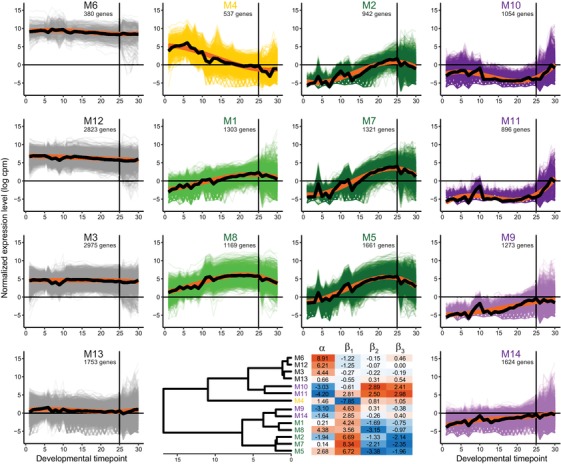
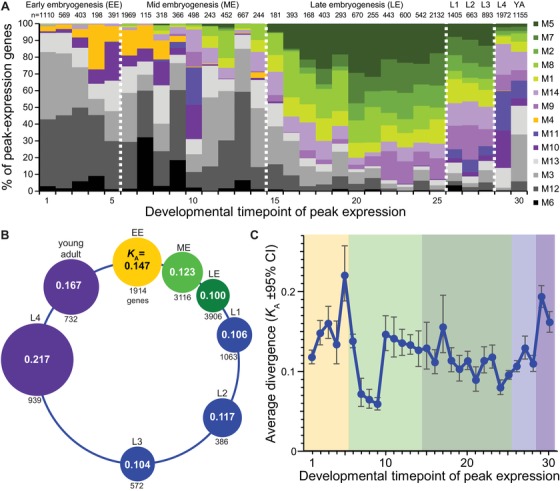
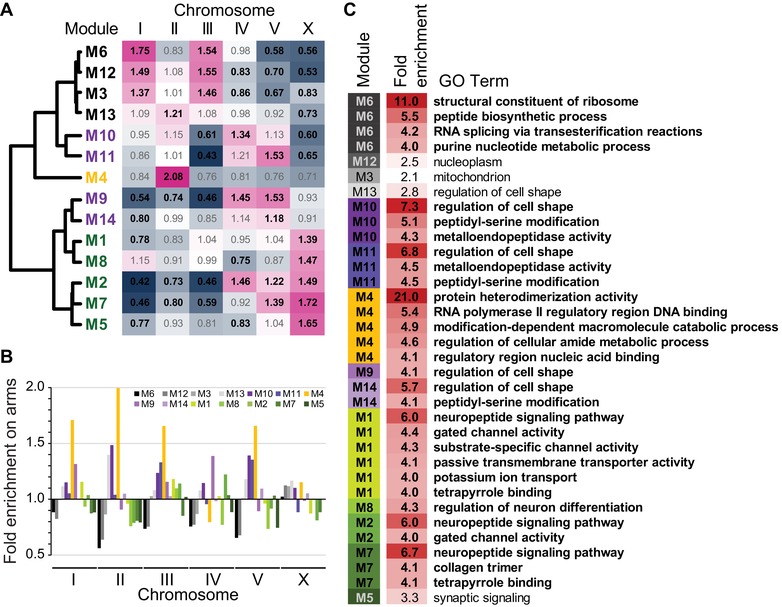
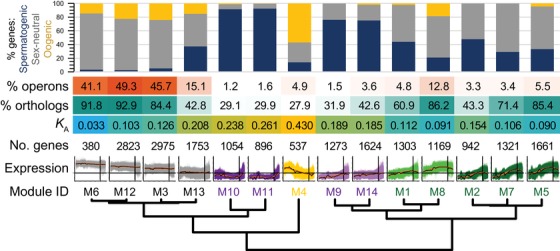
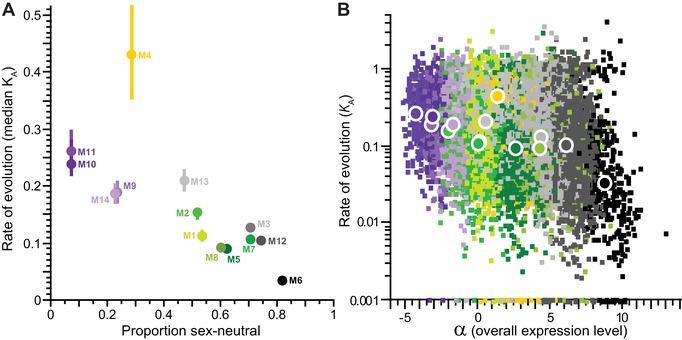
Ontogenetic development hinges on the changes in gene expression in time and space within an organism, suggesting that the demands of ontogenetic growth can impose or reveal predictable pattern in the molecular evolution of genes expressed dynamically across development. Here, we characterize coexpression modules of the transcriptome, using a time series of 30 points from early embryo to adult. By capturing the functional form of expression profiles with quantitative metrics, we find fastest evolution in the distinctive set of genes with transcript abundance that declines through development from a peak in young embryos. These genes are highly enriched for oogenic function and transient early zygotic expression, are nonrandomly distributed in the genome, and correspond to a life stage especially prone to inviability in interspecies hybrids. These observations conflict with the "early conservation model" for the evolution of development, although expression-weighted sequence divergence analysis provides some support for the "hourglass model." Genes in coexpression modules that peak toward adulthood also evolve fast, being hyper-enriched for roles in spermatogenesis, implicating a history of sexual selection and relaxation of selection on sperm as key factors driving rapid change to ontogenetically distinguishable coexpression modules of genes. We propose that these predictable trends of molecular evolution for dynamically expressed genes across ontogeny predispose particular life stages, early embryogenesis in particular, to hybrid dysfunction in the speciation process.
个体发育依赖于生物体内部基因表达在时间和空间上的变化,这表明个体发育生长的需求能够在整个发育过程中动态表达的基因的分子进化中施加或揭示可预测的模式。在此,我们利用从早期胚胎到成年的30个时间点的时间序列,对转录组的共表达模块进行了表征。通过用定量指标捕捉表达谱的功能形式,我们发现在转录本丰度从幼胚期的峰值开始在发育过程中下降的一组独特基因中,进化速度最快。这些基因在卵子发生功能和短暂的早期合子表达方面高度富集,在基因组中呈非随机分布,并且对应于种间杂种中特别容易出现 inviability 的生命阶段。这些观察结果与发育进化的“早期保守模型”相冲突,尽管表达加权序列分歧分析为“沙漏模型”提供了一些支持。在成年期达到峰值的共表达模块中的基因也进化得很快,在精子发生中的作用高度富集,这意味着性选择历史和对精子选择的放松是驱动基因向个体发育可区分的共表达模块快速变化的关键因素。我们提出,这些在个体发育过程中动态表达基因的分子进化的可预测趋势,使特定的生命阶段,尤其是早期胚胎发生,在物种形成过程中易出现杂种功能障碍。