Cridge Andrew G, Dearden Peter K, Brownfield Lynette R
Laboratory for Evolution and Development, Genetics Otago and Department of Biochemistry, University of Otago, Dunedin, 9054, New Zealand and
Laboratory for Evolution and Development, Genetics Otago and Department of Biochemistry, University of Otago, Dunedin, 9054, New Zealand and.
Ann Bot. 2016 Apr;117(5):833-43. doi: 10.1093/aob/mcw024. Epub 2016 Mar 24.
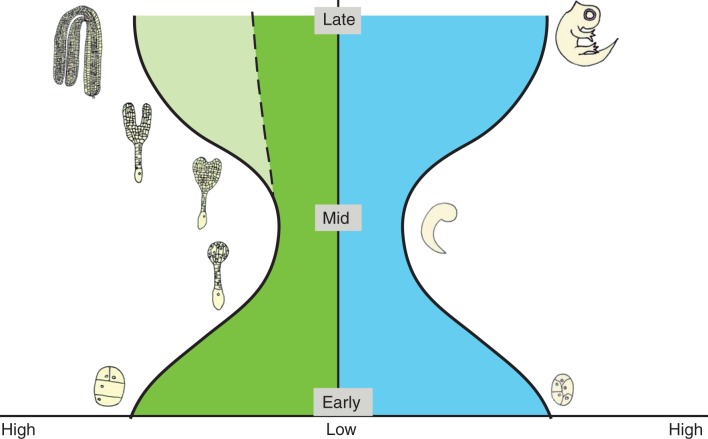
The remarkable similarity of animal embryos at particular stages of development led to the proposal of a developmental hourglass. In this model, early events in development are less conserved across species but lead to a highly conserved 'phylotypic period'. Beyond this stage, the model suggests that development once again becomes less conserved, leading to the diversity of forms. Recent comparative studies of gene expression in animal groups have provided strong support for the hourglass model. How and why might such an hourglass pattern be generated? More importantly, how might early acting events in development evolve while still maintaining a later conserved stage?
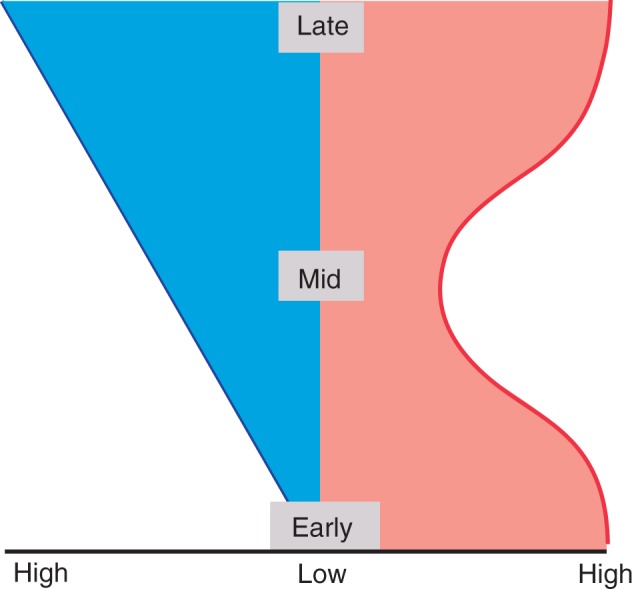
The discovery that an hourglass pattern may also exist in the embryogenesis of plants provides comparative data that may help us explain this phenomenon. Whether the developmental hourglass occurs in plants, and what this means for our understanding of embryogenesis in plants and animals is discussed. Models by which conserved early-acting genes might change their functional role in the evolution of gene networks, how networks buffer these changes, and how that might constrain, or confer diversity, of the body plan are also discused.
Evidence of a morphological and molecular hourglass in plant and animal embryogenesis suggests convergent evolution. This convergence is likely due to developmental constraints imposed upon embryogenesis by the need to produce a viable embryo with an established body plan, controlled by the architecture of the underlying gene regulatory networks. As the body plan is largely laid down during the middle phases of embryo development in plants and animals, then it is perhaps not surprising this stage represents the narrow waist of the hourglass where the gene regulatory networks are the oldest and most robust and integrated, limiting species diversity and constraining morphological space.
动物胚胎在特定发育阶段具有显著的相似性,这促使人们提出了发育沙漏模型。在这个模型中,发育早期事件在物种间的保守性较低,但会导致一个高度保守的“系统发育型期”。在这个阶段之后,该模型表明发育再次变得不那么保守,从而导致形态的多样性。最近对动物群体基因表达的比较研究为沙漏模型提供了有力支持。这样的沙漏模式是如何以及为何产生的呢?更重要的是,发育早期的作用事件在进化过程中如何演变,同时仍保持后期的保守阶段呢?
植物胚胎发生中可能也存在沙漏模式这一发现提供了比较数据,有助于我们解释这一现象。本文讨论了发育沙漏是否存在于植物中,以及这对我们理解植物和动物胚胎发生意味着什么。还讨论了保守的早期作用基因在基因网络进化中可能改变其功能作用的模型、网络如何缓冲这些变化,以及这可能如何限制或赋予身体结构多样性。
植物和动物胚胎发生中存在形态和分子沙漏的证据表明存在趋同进化。这种趋同可能是由于胚胎发生受到的发育限制,即需要产生一个具有既定身体结构的可行胚胎,这由潜在基因调控网络的结构所控制。由于身体结构在植物和动物胚胎发育的中期阶段基本确定,那么这个阶段代表沙漏的细腰部分,基因调控网络在此处最古老、最稳健且最整合,限制了物种多样性并约束了形态空间,这也许并不奇怪。