Department of Emergency Medicine, Stanford University, Stanford, California.
Center for Innovation to Implementation, VA Palo Alto Health Care System, Palo Alto, California.
JAMA Netw Open. 2019 Aug 2;2(8):e198642. doi: 10.1001/jamanetworkopen.2019.8642.
Monitoring emergency care quality requires understanding which conditions benefit most from timely, quality emergency care.
To identify a set of emergency care-sensitive conditions (ECSCs) that are treated in most emergency departments (EDs), are associated with a spectrum of adult age groups, and represent common reasons for seeking emergency care and to provide benchmark national estimates of ECSC acute care utilization.
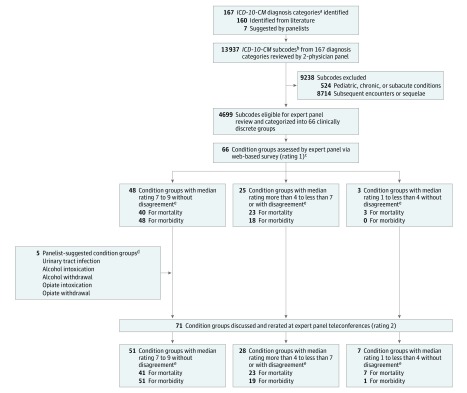
DESIGN, SETTING, AND PARTICIPANTS: A modified Delphi method was used to identify ECSCs. In a cross-sectional analysis, ECSC-associated visits by adults (aged ≥18 years) were identified based on International Statistical Classification of Diseases, Tenth Revision, Clinical Modification diagnosis codes and analyzed with nationally representative data from the 2016 US Nationwide Emergency Department Sample. Data analysis was conducted from January 2018 to December 2018.
Identification of ECSCs and ECSC-associated ED utilization patterns, length of stay, and charges.
An expert panel rated 51 condition groups as emergency care sensitive. Emergency care-sensitive conditions represented 16 033 359 of 114 323 044 ED visits (14.0%) in 2016. On average, 8 535 261 of 17 886 220 ED admissions (47.7%) were attributed to ECSCs. The most common ECSC ED visits were for sepsis (1 716 004 [10.7%]), chronic obstructive pulmonary disease (1 273 319 [7.9%]), pneumonia (1 263 971 [7.9%]), asthma (970 829 [6.1%]), and heart failure (911 602 [5.7%]) but varied by age group. Median (interquartile range) length of stay for ECSC ED admissions was longer than non-ECSC ED admissions (3.2 [1.7-5.8] days vs 2.7 [1.4-4.9] days; P < .001). In 2016, median (interquartile range) ED charges per visit for ECSCs were $2736 ($1684-$4605) compared with $2179 ($1118-$4359) per visit for non-ECSC ED visits (P < .001).
This comprehensive list of ECSCs can be used to guide indicator development for pre-ED, intra-ED, and post-ED care and overall assessment of the adult, non-mental health, acute care system. Health care utilization and costs among patients with ECSCs are substantial and warrant future study of validation, variations in care, and outcomes associated with ECSCs.
监测急诊护理质量需要了解哪些情况最能从及时、高质量的急诊护理中受益。
确定一组急诊护理敏感条件(ECSCs),这些条件在大多数急诊部(ED)中得到治疗,与一系列成人年龄组相关,并代表寻求急诊护理的常见原因,并提供 ECSC 急性护理利用的基准国家估计。
设计、地点和参与者:使用改良 Delphi 法确定 ECSC。在横断面分析中,根据国际疾病分类,第十次修订,临床修正诊断代码,对成年(年龄≥18 岁)的 ECSC 相关就诊进行识别,并使用来自 2016 年美国全国急诊部样本的全国代表性数据进行分析。数据分析于 2018 年 1 月至 2018 年 12 月进行。
确定 ECSC 和 ECSC 相关 ED 利用模式、住院时间和费用。
一个专家小组将 51 个条件组评为急诊护理敏感。2016 年,ECSCs 占 11432.31 万 ED 就诊的 1603.359 例(14.0%)。平均而言,1788.6220 例 ED 入院中有 853.5261 例(47.7%)归因于 ECSC。最常见的 ECSC ED 就诊是败血症(171.6 万例[10.7%])、慢性阻塞性肺疾病(127.3 万例[7.9%])、肺炎(126.3971 例[7.9%])、哮喘(97.0829 例[6.1%])和心力衰竭(91.1602 例[5.7%]),但因年龄组而异。ECSC ED 入院的中位(四分位间距)住院时间长于非 ECSC ED 入院(3.2[1.7-5.8]天比 2.7[1.4-4.9]天;P<0.001)。2016 年,ECSCs 每次就诊的 ED 费用中位数(四分位间距)为 2736 美元(1684-4605 美元),而非 ECSC ED 就诊的每次就诊费用中位数(四分位间距)为 2179 美元(1118-4359 美元)(P<0.001)。
这组全面的 ECSC 可以用于指导 ED 前、ED 内和 ED 后护理的指标制定,以及对成人、非心理健康、急性护理系统的整体评估。ECSC 患者的医疗保健利用率和成本很高,需要进一步研究验证、护理差异以及与 ECSC 相关的结果。