The University of Sydney, School of Pharmacy and University Centre for Rural Health, Faculty of Medicine and Health, PO Box 3074, Lismore, NSW, 2480, Australia.
The University of Sydney, University Centre for Rural Health and Sydney School of Public Health, Faculty of Medicine and Health, Edward Ford Building (A27), Sydney, NSW, 2006, Australia.
BMC Pregnancy Childbirth. 2019 Aug 7;19(1):280. doi: 10.1186/s12884-019-2396-2.
The prevalence of complementary medicine product (CMP) use by pregnant or breastfeeding Australian mothers is high, however, there is limited data on factors influencing women's decision-making to use CMPs. This study explored and described the factors influencing women's decisions take a CMP when pregnant or breastfeeding.
Qualitative in-depth interviews and focus group discussions were held with 25 pregnant and/or breastfeeding women who currently used CMPs. Participants' health literacy was assessed using a validated single-item health literacy screening question and the Newest Vital Sign. Interview and focus group discussions were audio-recorded, transcribed verbatim and thematically analysed.
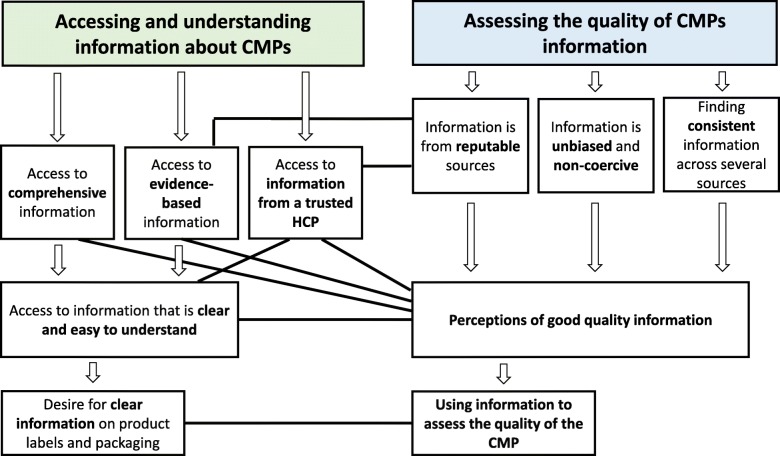
Participants were a homogenous group. Most had higher education, medium to high incomes and high health literacy skills. They actively sought information from multiple sources and used a reiterative collation and assessment process. Their decision-making to take or not to take CMPs was informed by the need to establish the safety of the CMPs, as well as possible benefits or harms to their baby's or their own health that could result from taking a CMP. Their specific information needs included the desire to access comprehensive, consistent, clear, easy to understand, and evidence-based information. Women preferred to access information from reputable sources, namely, their trusted health care practitioners, and information linked to government or hospital websites and published research. A lack of comprehensive, clear, consistent, or evidence-based information often led to decisions not to take a CMP, as they felt unable to adequately establish its safety or benefits. Conversely, when the participants felt the CMPs information they collected was good quality and from reputable sources, it reassured them of the safety of the CMP in pregnancy and/or breastfeeding. If this confirmed a clear benefit to their baby or themselves, they were more likely to decide to take a CMP.
The participants' demographic profile confirms previous research concerning Australian women who use CMPs during pregnancy and lactation. Participants' high health literacy skills led them to engage in a reiterative, information-seeking and analysis process fuelled by the need to find clear information before making the decision to take, or not to take, a CMP.
在澳大利亚,怀孕或哺乳期的母亲使用补充医学产品(CMP)的现象十分普遍,但目前关于影响女性使用 CMP 决策的因素的数据有限。本研究旨在探讨和描述影响女性在怀孕或哺乳期使用 CMP 的决策因素。
采用定性深入访谈和焦点小组讨论的方法,对 25 名正在使用 CMP 的孕妇或哺乳期妇女进行了研究。参与者的健康素养使用经过验证的单一健康素养筛选问题和最新生命体征进行评估。对访谈和焦点小组讨论进行了录音、逐字记录,并进行了主题分析。
参与者是一个同质群体。大多数参与者具有较高的教育水平、中等或较高的收入以及较高的健康素养技能。他们积极从多个来源获取信息,并使用反复的整理和评估过程。他们决定是否使用 CMP 的依据是需要确定 CMP 的安全性,以及使用 CMP 可能对婴儿或自身健康造成的潜在益处或危害。他们的具体信息需求包括获取全面、一致、清晰、易于理解和基于证据的信息。女性更愿意从信誉良好的来源获取信息,即她们信任的医疗保健从业者,以及来自政府或医院网站和已发表研究的信息。缺乏全面、清晰、一致或基于证据的信息往往导致她们决定不使用 CMP,因为她们觉得无法充分确定 CMP 的安全性或益处。相反,当参与者认为他们收集到的 CMP 信息质量良好且来自可靠来源时,这使她们对 CMP 在怀孕和/或哺乳期的安全性有了信心。如果这对婴儿或自己有明显的好处,她们更有可能决定使用 CMP。
参与者的人口统计学特征证实了之前关于澳大利亚女性在怀孕和哺乳期使用 CMP 的研究。参与者较高的健康素养技能促使她们进行反复的信息搜索和分析过程,这是由在做出使用或不使用 CMP 的决策之前寻找明确信息的需求所驱动的。