Institute of Agricultural and Nutritional Sciences, Group Animal Nutrition, Martin Luther University Halle-Wittenberg, Halle (Saale), Germany.
Laboratory of Microbiology, Wageningen University & Research, Wageningen, The Netherlands.
PLoS One. 2019 Aug 8;14(8):e0220553. doi: 10.1371/journal.pone.0220553. eCollection 2019.
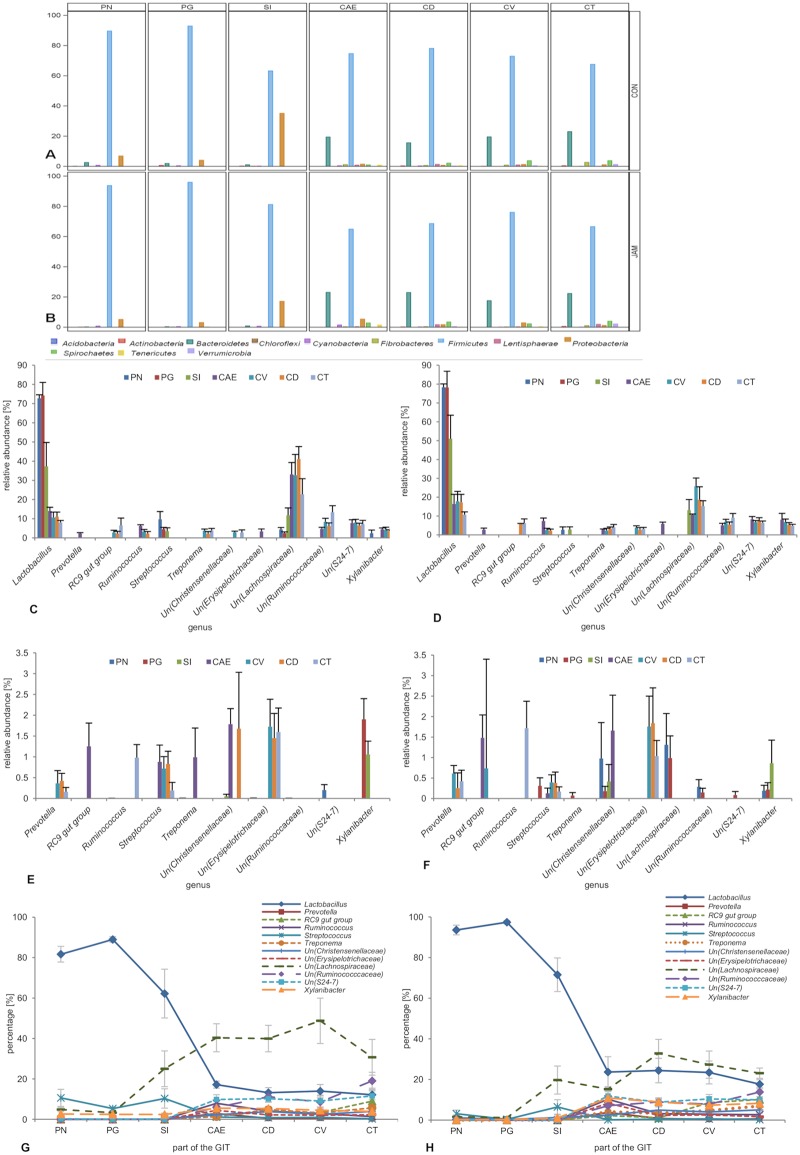
The objective of this study was to investigate the impact of natural prebiotic active compounds on the microbial composition in different regions of the equine gastrointestinal tract. Twelve adult horses (body weight [bwt] 534 ± 64.5 kg; age 14 ± 7.5 years) were randomly divided into two feeding groups. Six horses received a basal diet consisting of 1.5 kg hay/100 kg bwt x d-1 and oat grains equal to 1.19 g starch/kg bwt x d-1, supplemented with Jerusalem artichoke meal providing prebiotic fructooligosaccharides + inulin in a quantity of 0.15 g/kg bwt x d-1. The remaining horses received a placebo added to the basal diet. The horses were fed for 21 d and euthanized at the end of the feeding period. Digesta samples from different parts of the gastrointestinal tract were taken, DNA extracted and the V1-V2 region of the 16S rRNA gene amplified. Supplementation with the prebiotic increased the relative abundance of Lactobacillus (P < 0.05), with a concurrent reduction of the relative abundance of Streptococcus mainly in the stomach (P < 0.05). In the hindgut, the supplemental prebiotic also increased the relative abundance of Lactobacillus but further reduced the relative abundance of fibrolytic bacteria, specifically the unclassified members of the families Lachnospiraceae (P < 0.05) and Ruminococcaceae. The relative abundance of the genus Ruminococcus increased solely in the caecum and colon transversum. Overall, the addition of the prebiotic significantly increased the diversity in nearly all parts of the gastrointestinal tract (P < 0.05). The feeding of this natural prebiotic compound to horses had an impact on the microbial community in the entire gastrointestinal tract. Furthermore, the effect on the bacterial community in the foregut (especially the stomach) was more pronounced in comparison to the effect in the hindgut. Therefore, the impact on stomach health should be carefully considered.
本研究旨在探究天然益生元活性化合物对马不同胃肠道区域微生物组成的影响。12 匹成年马(体重[BWt]534 ± 64.5kg;年龄 14 ± 7.5 岁)被随机分为两组。六匹马接受基础日粮,包括 1.5kg 干草/100kg BWt·d-1 和与 1.19g 淀粉/kg BWt·d-1 等量的燕麦粒,补充菊芋粉提供益生元果寡糖+菊粉,添加量为 0.15g/kg BWt·d-1。其余马接受基础日粮添加安慰剂。马饲喂 21d,在饲喂期末处死。从胃肠道不同部位采集食糜样本,提取 DNA,扩增 16S rRNA 基因 V1-V2 区。补充益生元增加了乳酸杆菌的相对丰度(P<0.05),同时胃中链球菌的相对丰度降低(P<0.05)。在后肠,补充益生元还增加了乳酸杆菌的相对丰度,但进一步降低了纤维分解菌的相对丰度,特别是未分类的毛螺菌科(Lachnospiraceae)(P<0.05)和瘤胃球菌科(Ruminococcaceae)成员。瘤胃球菌属的相对丰度仅在盲肠和结肠横部增加。总体而言,益生元的添加显著增加了胃肠道几乎所有部位的多样性(P<0.05)。这种天然益生元化合物对马的喂养对整个胃肠道的微生物群落产生了影响。此外,与后肠相比,其对前肠(特别是胃)细菌群落的影响更为明显。因此,应仔细考虑对胃健康的影响。