Sydney School of Veterinary Science, The University of Sydney, Camden, NSW, Australia.
Jockey Club College of Veterinary Medicine and Life Sciences, City University of Hong Kong, Tat Chee Avenue, Kowloon, Hong Kong SAR, China.
PLoS One. 2019 Aug 8;14(8):e0220335. doi: 10.1371/journal.pone.0220335. eCollection 2019.
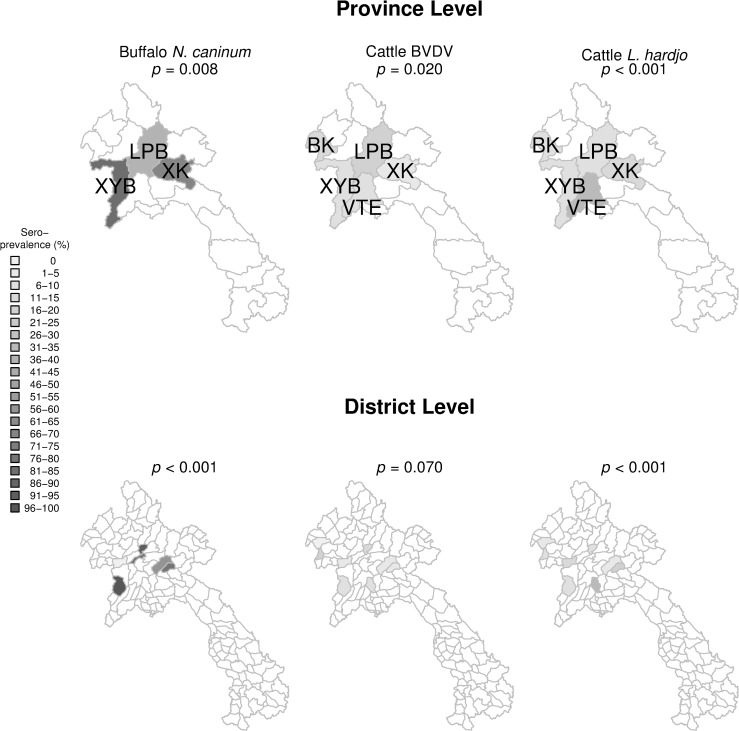
Smallholder large ruminant production in Lao People's Democratic Republic (Laos) is characterised by low reproductive efficiency. To determine if common abortifacient bovid infectious diseases are involved, a serological investigation was conducted. Sera was collected from stored and fresh cattle (n = 390) and buffalo (n = 130) samples from 2016-18 from, and then examined for associations in a retrospective risk factor study of 71 herds. The sera were assayed for antibodies to Neospora caninum, bovine viral diarrhoea virus (BVDV), Leptospira interrogans serovar Hardjo and Brucella abortus using commercially available enzyme-linked immunosorbent assay kits. These pathogens were detected in buffalo samples at 78.5% (95% CI 71.4-85.6), 0%, 2.3% (95% CI 0-4.9) and 0%, respectively, and in cattle at 4.4% (95% CI 2.4-6.4), 7.7% (95% CI 3.1-12.3), 12.8% (95% CI 9.5-16.1) and 0.26% (95% CI 0-0.8), respectively. Exposure of buffalo to N. caninum was positively associated with buffalo age, with a predicted seropositivity at birth of 52.8%, increasing to 97.2% by 12 years of age (p = 0.037). Exposure of cattle to L. interrogans serovar Hardjo was more prevalent in females compared to males, was associated with higher titres of BVDV, and was more prevalent in the wet season compared to the dry season. Exposure of cattle to BVDV was more prevalent in males compared to females, the wet and dry seasons were comparable, and was associated with rising antibody titres against N. caninum and L. interrogans serovar Hardjo. The risk factor survey identified that the probability of herds being N. caninum positive increased with farmer age, if farmers believed there were rodents on farm, and if farmers weren't aware that canids or rodents could contaminate bovid feed on their farm. The probability of a herd being positive to L. interrogans serovar Hardjo increased on farms where multiple cows shared the same bull, where farmers had lower husbandry knowledge, and on farms that used water troughs. The probability of a herd being BVDV seropositive increased with increasing herd size and increasing titres to N. caninum. The benchmarking of bovid exposure to emerging abortifacient pathogens and identification of their risk factors potentially informs disease prevention strategies, supporting efforts to establish a biosecure beef supply for enhanced smallholder livestock productivity, public health and food security in Laos and surrounding countries.
老挝人民民主共和国(老挝)的小农户大牲畜生产以生殖效率低下为特征。为了确定是否涉及常见的流产性牛传染性疾病,进行了血清学调查。从 2016 年至 2018 年,从存储和新鲜的牛(n=390)和水牛(n=130)样本中收集血清,并在对 71 个畜群的回顾性危险因素研究中对其进行了检查。使用市售的酶联免疫吸附测定试剂盒检测血清中抗新孢子虫、牛病毒性腹泻病毒(BVDV)、钩端螺旋体 interrogans 血清型 Hardjo 和布鲁氏菌 abortus 的抗体。在水牛样本中检测到这些病原体的比例分别为 78.5%(95%CI 71.4-85.6)、0%、2.3%(95%CI 0-4.9)和 0%,而在牛中分别为 4.4%(95%CI 2.4-6.4)、7.7%(95%CI 3.1-12.3)、12.8%(95%CI 9.5-16.1)和 0.26%(95%CI 0-0.8)。水牛接触新孢子虫与水牛年龄呈正相关,出生时的血清阳性率为 52.8%,12 岁时增加到 97.2%(p=0.037)。与雄性相比,雌性牛接触钩端螺旋体 interrogans 血清型 Hardjo 的情况更为普遍,与 BVDV 的高滴度有关,在雨季比旱季更为普遍。与雌性相比,雄性牛接触 BVDV 的情况更为普遍,雨季和旱季的情况相当,并且与新孢子虫和钩端螺旋体 interrogans 血清型 Hardjo 的抗体滴度升高有关。危险因素调查发现,如果农民认为农场有啮齿动物,如果农民不知道犬科动物或啮齿动物会污染农场的牛饲料,如果农民年龄较大,那么牛群感染新孢子虫的概率就会增加。如果多只奶牛共用同一头公牛,如果农民的畜牧业知识水平较低,如果农场使用水槽,则牛群感染钩端螺旋体 interrogans 血清型 Hardjo 的概率就会增加。随着牛群规模的扩大和新孢子虫抗体滴度的增加,牛群感染 BVDV 的概率也会增加。对新兴流产性病原体的牛接触情况进行基准测试,并确定其危险因素,这可能为疾病预防策略提供信息,支持建立一个具有生物安全性的牛肉供应系统,以提高老挝及周边国家小农户牲畜的生产力、公共卫生和粮食安全。