Universidade de São Paulo (USP), Faculdade de Filosofia, Ciências e Letras, Departamento de Física, Ribeirão Preto, SP, Brazil.
Universidade de São Paulo (USP), Faculdade de Medicina de Ribeirão Preto (FMRP), Ribeirão Preto, SP, Brazil.
Braz J Otorhinolaryngol. 2021 Jan-Feb;87(1):3-10. doi: 10.1016/j.bjorl.2019.06.006. Epub 2019 Jul 23.
Even with improved treatment outcomes with multimodality approaches, the question of what is the best initial treatment for locally advanced head and neck cancer still remains unanswered.
To review the overall survival of a large cohort of head and neck cancer, patients with locally advanced head and neck cancer treated in a single institution.
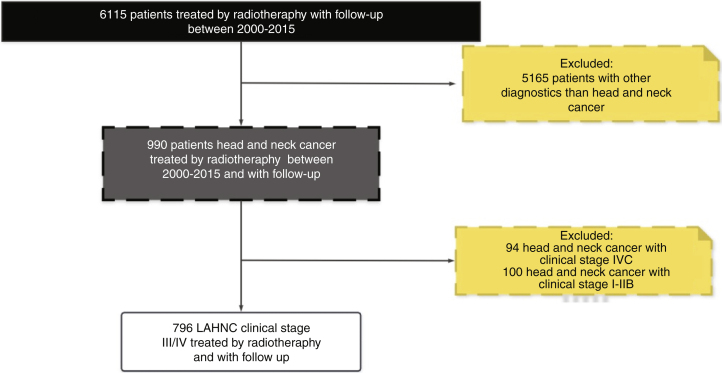
We studied a cohort of patients with locally advanced head and neck cancer treated in our institution in the last fifteen years. To gather a large sample of patients with adequate follow-up time, a cross-check between ours and Fundação Oncocentro de São Paulo databases were done. We included patients with head and neck cancer, clinical or pathological staging III or IV, treated with surgery followed by radiotherapy or surgery plus chemoradiation or radiotherapy alone or chemoradiation alone.
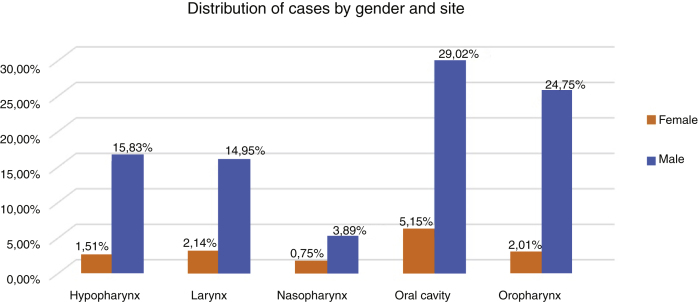
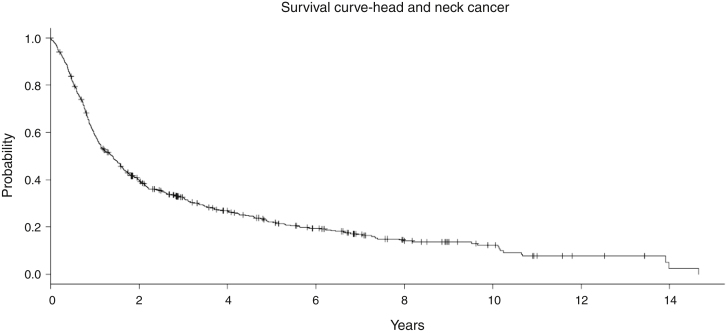
796 patients with locally advanced head and neck cancer were included, 88% male, 44% age >60 years and 76% stage IV. The tumor location was the oral cavity (34%), oropharynx (27%), hypopharynx (17%) and larynx (17%). The treatment groups were chemoradiation alone (39.7%), surgery plus chemoradiation (26.3%), surgery followed by radiotherapy (18.5%) and radiotherapy alone (15.5%). Comparing the clinical variables between the treatment groups significant differences in age and clinical stage were observed. With a median follow up of 7.5 years (1-16 years), for the entire cohort, the overall survival at 5 and 10 years was 34.8% and 28%. The overall survival at 5 and 10 years was 16.7% and 12.2% for radiotherapy alone, 38.8% and 26.3% for surgery followed by radiotherapy, 28% and 16.6% for chemoradiation alone, and 37.3% and 23.2% for surgery plus chemoradiation. The staging IV (p = 0.03) and radiotherapy alone (p = 0.05), had a worst survival in multivariate analysis. Surgical groups vs. chemoradiation alone had no significant difference for overall survival.
The present study is the largest cohort of locally advanced head and neck cancer of Brazilian patients to evaluate treatment outcomes. Although there were significant clinical differences between surgical and radiotherapy groups, surgery or chemoradiation alone as the initial treatment resulted in no significant difference in survival.
尽管采用多模式方法治疗后,患者的治疗结果有所改善,但局部晚期头颈部癌症的最佳初始治疗方法仍未得到解答。
回顾在单机构治疗的局部晚期头颈部癌症患者的总体生存率。
我们研究了在过去十五年内在我院接受治疗的局部晚期头颈部癌症患者队列。为了获得具有足够随访时间的大量患者样本,我们对我们的数据库和 Fundação Oncocentro de São Paulo 的数据库进行了交叉检查。我们纳入了临床或病理分期为 III 或 IV 期、接受手术联合放疗或手术加放化疗、单纯放疗或单纯放化疗治疗的头颈部癌症患者。
纳入了 796 例局部晚期头颈部癌症患者,88%为男性,44%年龄>60 岁,76%为 IV 期。肿瘤部位为口腔(34%)、口咽(27%)、下咽(17%)和喉(17%)。治疗组为单纯放化疗(39.7%)、手术加放化疗(26.3%)、手术后继以放疗(18.5%)和单纯放疗(15.5%)。比较治疗组的临床变量,年龄和临床分期存在显著差异。中位随访时间为 7.5 年(1-16 年),对于整个队列,5 年和 10 年的总生存率为 34.8%和 28%。单纯放疗的 5 年和 10 年总生存率为 16.7%和 12.2%,手术后继以放疗为 38.8%和 26.3%,单纯放化疗为 28%和 16.6%,手术加放化疗为 37.3%和 23.2%。多因素分析显示,IV 期(p=0.03)和单纯放疗(p=0.05)与较差的生存相关。手术组与单纯放疗组的总生存率无显著差异。
本研究是评估巴西局部晚期头颈部癌症患者治疗结果的最大队列研究。尽管手术组和放疗组之间存在显著的临床差异,但作为初始治疗的手术或单纯放化疗并没有导致生存率的显著差异。