Park Seona, Kim Jihye, Chun Jaeyoung, Han Kyungdo, Soh Hosim, Kang Eun Ae, Lee Hyun Jung, Im Jong Pil, Kim Joo Sung
Department of Internal Medicine and Liver Research Institute, Seoul National University College of Medicine, Seoul 03080, Korea.
Department of Internal Medicine, CHA Gangnam Medical Center, CHA University, Seoul 06135, Korea.
J Clin Med. 2019 Aug 8;8(8):1191. doi: 10.3390/jcm8081191.
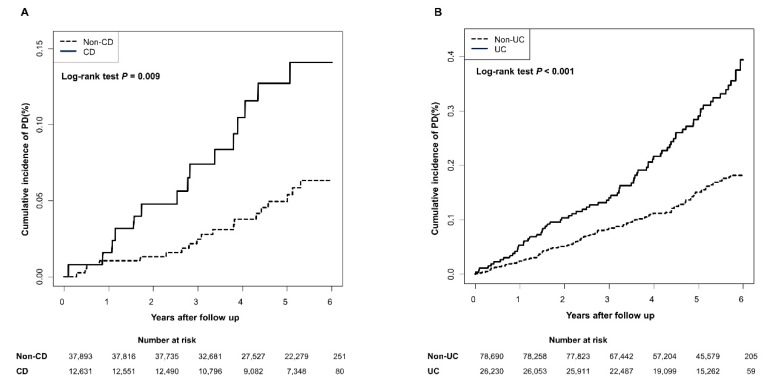
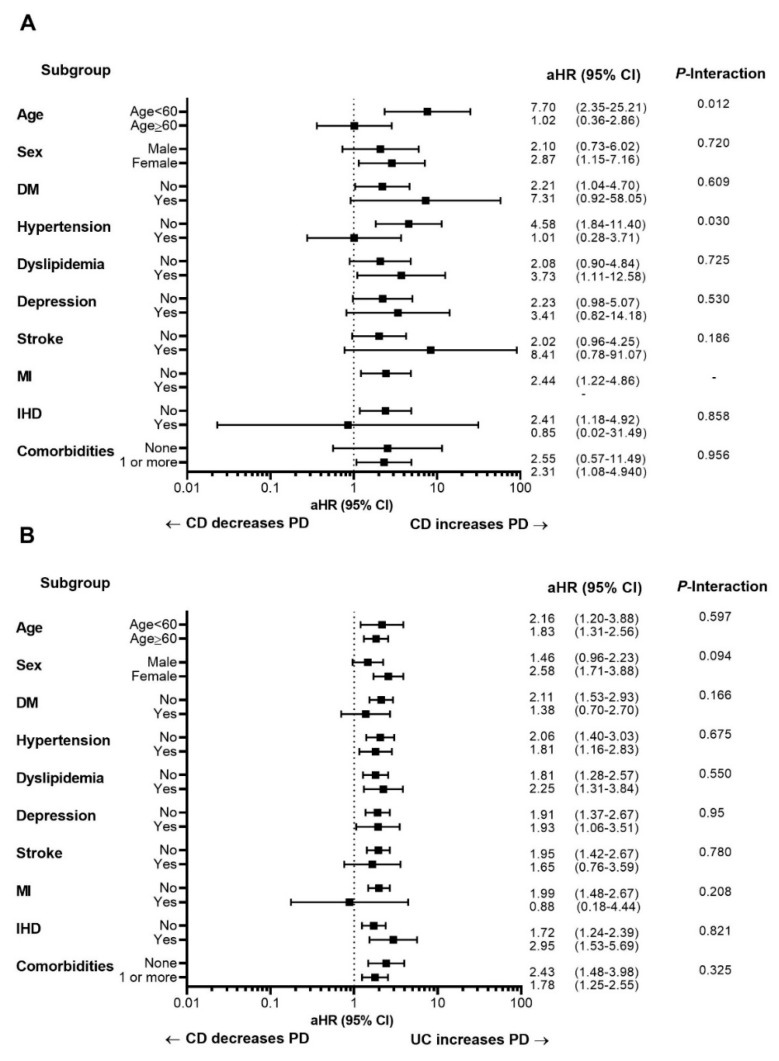
It is not known whether inflammatory bowel disease (IBD) enhances the risk of Parkinson's disease (PD) or whether PD diagnosis is the result of increased health care use. We determined the risk of developing PD among patients with IBD in terms of health care and medication use. A nationwide population-based study was conducted using claims data from the Korean National Health care Insurance service. From 2010 to 2013, patients with Crohn's disease (CD) and ulcerative colitis (UC) were identified through both International Classification of Disease, Tenth Revision (ICD-10) and national rare intractable disease (RID) registration program codes. We compared 38,861 IBD patients with age and sex-matched non-IBD individuals at a ratio of 1:3. Patients with newly diagnosed PD were identified through both ICD-10 and RID codes. The incidence of PD among patients with IBD was 49 per 100,000 person-years. The risk of developing PD in patients with IBD was significantly higher than controls even after adjustment for health care use (adjusted hazard ratio (aHR), 1.87; < 0.001). Compared to controls, the risk of PD was significantly higher in patients with CD (aHR, 2.23; = 0.023) and UC (aHR, 1.85; < 0.001). Corticosteroid use showed a preventive effect on developing PD in patients with CD (aHR 0.08; < 0.001), but not UC (aHR, 0.75; = 0.213). Among 2110 patients receiving anti-tumor necrosis factor (anti-TNF), none of the treated patients experienced PD during 9950 person-years. Patients with IBD are at an increased risk of PD, regardless of health care use. Corticosteroid and anti-TNF use may prevent PD in patients with IBD.
炎症性肠病(IBD)是否会增加帕金森病(PD)的风险,或者PD诊断是否是医疗保健使用增加的结果尚不清楚。我们根据医疗保健和药物使用情况确定了IBD患者发生PD的风险。利用韩国国民健康保险服务的理赔数据进行了一项全国性的基于人群的研究。2010年至2013年期间,通过国际疾病分类第十版(ICD - 10)和国家罕见难治性疾病(RID)登记计划代码识别出克罗恩病(CD)和溃疡性结肠炎(UC)患者。我们以1:3的比例将38861名IBD患者与年龄和性别匹配的非IBD个体进行了比较。通过ICD - 10和RID代码识别出新诊断为PD的患者。IBD患者中PD的发病率为每10万人年49例。即使在调整了医疗保健使用情况后,IBD患者发生PD的风险仍显著高于对照组(调整后的风险比(aHR),1.87;<0.001)。与对照组相比,CD患者(aHR,2.23;=0.023)和UC患者(aHR,1.85;<0.001)发生PD的风险显著更高。使用皮质类固醇对CD患者发生PD有预防作用(aHR 0.08;<0.001),但对UC患者没有(aHR,0.75;=0.213)。在2110名接受抗肿瘤坏死因子(抗TNF)治疗的患者中,在9950人年的时间里,没有一名接受治疗的患者发生PD。无论医疗保健使用情况如何,IBD患者发生PD的风险都会增加。使用皮质类固醇和抗TNF可能预防IBD患者发生PD。