Graduate School of Public Health, Yonsei University, Seoul, South Korea.
Department of Surveillance and Prevention of Infectious diseases, National Center for Communicable Diseases, Ulaanbaatar, Mongolia.
BMC Infect Dis. 2019 Aug 9;19(1):705. doi: 10.1186/s12879-019-4362-z.
In recent times, emerging and re-emerging infectious diseases are posing a public health threat in developing countries, and vigilant surveillance is necessary to prepare against these threats. Analyses of multi-year comprehensive infectious disease syndrome data are required in Mongolia, but have not been conducted till date. This study aimed to describe the trends in the incidence of infectious disease syndromes in Mongolia during 2009-2017 using a nationwide syndrome surveillance system for infectious diseases established in 2009.
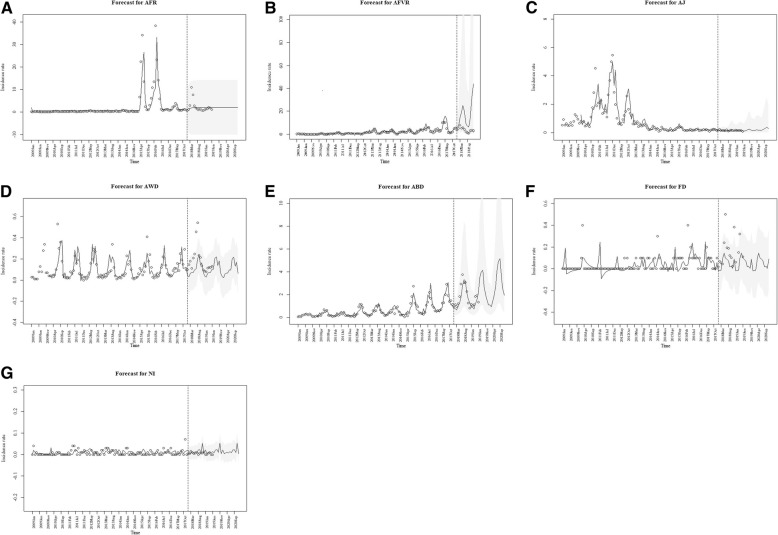
We analyzed time trends using monthly data on the incidence of infectious disease syndromes such as acute fever with rash (AFR), acute fever with vesicular rash (AFVR), acute jaundice (AJ), acute watery diarrhea (AWD), acute bloody diarrhea (ABD), foodborne disease (FD) and nosocomial infection (NI) reported from January 1, 2009 to December 31, 2017. Time series forecasting models based on the data up to 2017 estimated the future trends in the incidence of syndromes up to December 2020.
During the study, the overall prevalence of infectious disease syndromes was 71.8/10,000 population nationwide. The average number of reported infectious disease syndromes was 14,519 (5229-55,132) per year. The major types were AFR (38.7%), AFVR (31.7%), AJ (13.9%), ABD (10.2%), and AWD (1.8%), accounting for 96.4% of all reported syndromes. The most prevalent syndromes were AJ between 2009 and 2012 (59.5-48.7%), AFVR between 2013 and 2014 (54.5-59%), AFR between 2015 and 2016 (67.6-65.9%), and AFVR in 2017 (62.2%). There were increases in the prevalence of AFR, with the monthly number of cases being 37.7 ± 6.1 during 2015-2016; this could be related to the measles outbreak in Mongolia during that period. The AFVR incidence rate showed winter's multiplicative seasonal fluctuations with a peak of 10.6 ± 2 cases per 10,000 population in 2017. AJ outbreaks were identified in 2010, 2011, and 2012, and these could be associated with hepatitis A outbreaks. Prospective time series forecasting showed increasing trends in the rates of AFVR and ABD.
The evidence-based method for infectious disease syndromes was useful in gaining an understanding of the current situation, and predicting the future trends of various infectious diseases in Mongolia.
近年来,新发和再现传染病对发展中国家的公共卫生构成威胁,因此有必要进行警惕性监测以应对这些威胁。蒙古需要分析多年全面传染病综合征数据,但截至目前尚未进行此类分析。本研究旨在使用 2009 年建立的全国传染病综合征监测系统,描述 2009-2017 年蒙古传染病综合征发病率的趋势。
我们分析了 2009 年 1 月 1 日至 2017 年 12 月 31 日期间报告的传染病综合征(急性发热伴皮疹[AFR]、急性发热伴疱疹性皮疹[AFVR]、急性黄疸[AJ]、急性水样腹泻[AWD]、急性血性腹泻[ABD]、食源性疾病[FD]和医院感染[NI])的发病率月度数据的时间趋势。基于截至 2017 年的数据的时间序列预测模型估计了截至 2020 年 12 月综合征发病率的未来趋势。
在研究期间,全国传染病综合征的总体流行率为 71.8/10000 人口。每年报告的传染病综合征平均数量为 14519 例(5229-55132 例)。主要类型为 AFR(38.7%)、AFVR(31.7%)、AJ(13.9%)、ABD(10.2%)和 AWD(1.8%),占所有报告综合征的 96.4%。最常见的综合征是 2009 年至 2012 年的 AJ(59.5-48.7%)、2013 年至 2014 年的 AFVR(54.5-59%)、2015 年至 2016 年的 AFR(67.6-65.9%)和 2017 年的 AFVR(62.2%)。AFR 的患病率呈上升趋势,2015-2016 年每月病例数为 37.7±6.1;这可能与蒙古麻疹疫情有关。AFVR 发病率呈冬季倍增季节性波动,2017 年峰值为每 10000 人口 10.6±2 例。2010 年、2011 年和 2012 年发生了 AJ 暴发,这些暴发可能与甲型肝炎暴发有关。前瞻性时间序列预测显示 AFVR 和 ABD 的发病率呈上升趋势。
基于证据的传染病综合征方法有助于了解当前形势,并预测蒙古各种传染病的未来趋势。