Pediatric Clinic, Department of Surgical and Biomedical Sciences, Università degli Studi di Perugia, Perugia, Italy.
Gastroenterology Unit, Department of Medicine and Surgery, University of Parma, Parma, Italy.
J Transl Med. 2019 Aug 9;17(1):262. doi: 10.1186/s12967-019-2014-0.
Eosinophilic esophagitis (EoE) is a chronic immune-mediated inflammatory disorder and represents the leading cause of food impaction. The pathogenesis of EoE is the result of an interplay between genetic, environmental and host immune system factors. New therapeutic approaches for EoE have been proposed. In this manuscript we review the current evidence regarding EoE management in pediatric age, with a particular focus on new findings related to the efficacy and safety of monoclonal antibodies.
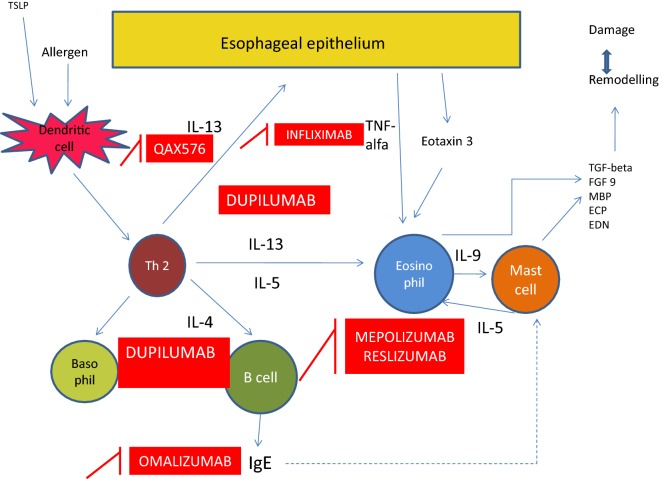
Conventional therapies have failed in treating some patients with EoE, which then requires aggressive procedures such as esophageal dilatation. The most effective available medical therapy for EoE is swallowed topic corticosteroids (fluticasone propionate and budesonide), which have two main drawbacks: they are related to well-known adverse effects (especially in the paediatric population), and there are not enough long-term data to confirm that they are able to reverse the remodelling process of the esophageal mucosa, which is the major cause of EoE symptoms (including dysphagia, abdominal pain, nausea, obstruction, perforation and vomiting). The monoclonal antibodies appear to be an interesting therapeutic approach. However, the studies conducted until now have shown substantial histological improvement not coupled with significant clinical improvements and no significant relationship between a decreasing number of eosinophils and clinical symptoms, highlighting the importance in the pathogenesis of EoE of cells such as T-helper cells, mast cells, B cells, epithelial cells and natural killer cells.
Monoclonal antibodies targeting a signal involved in the pathogenesis of EoE may not break the complex self-propagating inflammatory activation responsible for perpetuation of the inflammatory response and the development of symptoms and complications. We speculate that combined biological therapies targeting more than one molecule or cell may provide better results, with conventional therapies potentially enhancing the effects of antibodies. However, further studies should aim to find the best therapeutic approach to target the cells involved in the remodelling process and to reverse the histological changes in this complex clinical condition.
嗜酸性粒细胞性食管炎 (EoE) 是一种慢性免疫介导的炎症性疾病,是食物嵌塞的主要原因。EoE 的发病机制是遗传、环境和宿主免疫系统因素相互作用的结果。已经提出了新的 EoE 治疗方法。在本文中,我们综述了儿科年龄 EoE 管理的当前证据,特别关注与单克隆抗体疗效和安全性相关的新发现。
传统疗法在治疗一些 EoE 患者方面已经失败,这就需要进行食管扩张等激进治疗。目前治疗 EoE 最有效的药物是口服皮质类固醇(丙酸氟替卡松和布地奈德),但它们有两个主要缺点:它们与众所周知的不良反应有关(尤其是在儿科人群中),并且没有足够的长期数据来确认它们能够逆转食管黏膜的重塑过程,这是 EoE 症状的主要原因(包括吞咽困难、腹痛、恶心、梗阻、穿孔和呕吐)。单克隆抗体似乎是一种很有前途的治疗方法。然而,迄今为止进行的研究表明,组织学有明显改善,但临床改善不明显,且嗜酸性粒细胞减少与临床症状之间没有显著相关性,这突出表明在 EoE 的发病机制中,辅助性 T 细胞、肥大细胞、B 细胞、上皮细胞和自然杀伤细胞等细胞很重要。
针对参与 EoE 发病机制的信号的单克隆抗体可能无法打破导致炎症反应持续存在和症状及并发症发展的复杂自我传播炎症激活。我们推测,针对多个分子或细胞的联合生物疗法可能会提供更好的效果,而常规疗法可能会增强抗体的效果。然而,进一步的研究应该旨在找到针对参与重塑过程的细胞的最佳治疗方法,并逆转这种复杂临床情况下的组织学变化。