Department of Neuroscience, Pomona College, Claremont, CA, United States; Cognition and Brain Plasticity Unit, Bellvitge Biomedical Research Institute - IDIBELL, 08097 L'Hospitalet de Llobregat, Barcelona, Spain.
Cognition and Brain Plasticity Unit, Bellvitge Biomedical Research Institute - IDIBELL, 08097 L'Hospitalet de Llobregat, Barcelona, Spain; Department of Cognition, Development and Education Psychology, Universitat de Barcelona, Barcelona, Spain; Radboud University, Donders Institute for Brain, Cognition and Behaviour, Nijmegen, The Netherlands; Radboud University Medical Center, Donders Institute for Brain Cognition and Behaviour, Department of Medical Psychology, Nijmegen, The Netherlands.
Neuroimage Clin. 2019;24:101965. doi: 10.1016/j.nicl.2019.101965. Epub 2019 Jul 30.
Apathy is the neuropsychiatric syndrome that correlates most highly with Huntington's disease progression, and, like early patterns of neurodegeneration, is associated with lesions to cortico-striatal connections. However, due to its multidimensional nature and elusive etiology, treatment options are limited.
To disentangle underlying white matter microstructural correlates across the apathy spectrum in Huntington's disease.
Forty-six Huntington's disease individuals (premanifest (N = 22) and manifest (N = 24)) and 35 healthy controls were scanned at 3-tesla and underwent apathy evaluation using the short-Problem Behavior Assessment and short-Lille Apathy Rating Scale, with the latter being characterized into three apathy domains, namely emotional, cognitive, and auto-activation deficit. Diffusion tensor imaging was used to study whether individual differences in specific cortico-striatal tracts predicted global apathy and its subdomains.
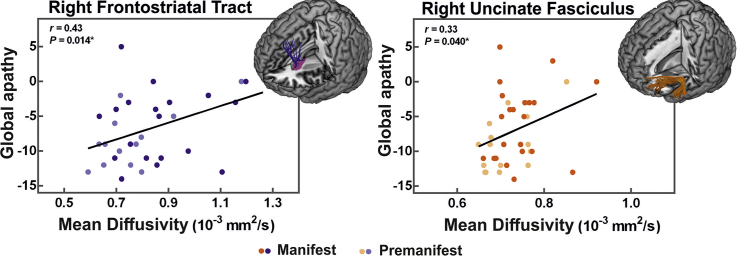
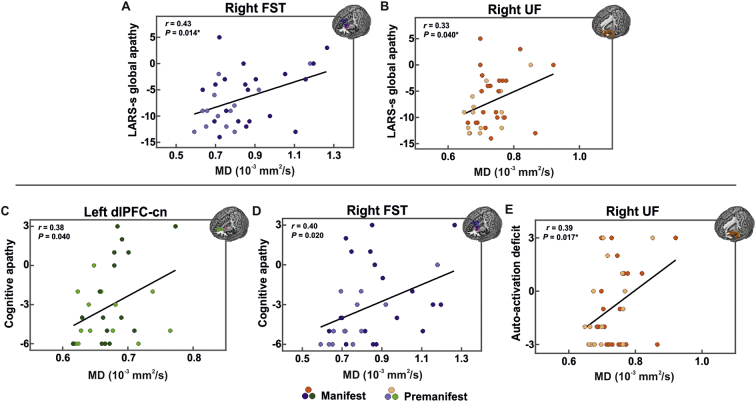
We elucidate that apathy profiles may develop along differential timelines, with the auto-activation deficit domain manifesting prior to motor onset. Furthermore, diffusion tensor imaging revealed that inter-individual variability in the disruption of discrete cortico-striatal tracts might explain the heterogeneous severity of apathy profiles. Specifically, higher levels of auto-activation deficit symptoms significantly correlated with increased mean diffusivity in the right uncinate fasciculus. Conversely, those with severe cognitive apathy demonstrated increased mean diffusivity in the right frontostriatal tract and left dorsolateral prefrontal cortex to caudate nucleus tract.
The current study provides evidence that white matter correlates associated with emotional, cognitive, and auto-activation subtypes may elucidate the heterogeneous nature of apathy in Huntington's disease, as such opening a door for individualized pharmacological management of apathy as a multidimensional syndrome in other neurodegenerative disorders.
淡漠是与亨廷顿病进展相关性最高的神经精神综合征,与皮质纹状体连接的神经退行性变早期模式一样,与皮质纹状体连接的病变有关。然而,由于其多维性质和难以捉摸的病因,治疗选择有限。
阐明亨廷顿病淡漠谱中潜在的白质微观结构相关性。
对 46 名亨廷顿病患者(前表现期(N=22)和表现期(N=24))和 35 名健康对照者进行 3 特斯拉扫描,并使用简短问题行为评估和简短里尔淡漠评定量表进行淡漠评估,后者分为三个淡漠域,即情感、认知和自动激活缺陷。弥散张量成像用于研究特定皮质纹状体束的个体差异是否预测整体淡漠及其亚域。
我们阐明了淡漠谱可能沿着不同的时间线发展,自动激活缺陷域在运动发作之前表现出来。此外,弥散张量成像显示,离散皮质纹状体束破坏的个体间变异性可能解释了淡漠谱严重程度的异质性。具体而言,自动激活缺陷症状的严重程度与右侧钩束的平均弥散度增加显著相关。相反,严重认知淡漠的患者右侧额纹状体束和左侧背外侧前额叶皮层至尾状核束的平均弥散度增加。
本研究提供的证据表明,与情感、认知和自动激活亚型相关的白质相关性可能阐明亨廷顿病淡漠的异质性,从而为其他神经退行性疾病作为多维综合征的淡漠个体化药物治疗开辟了道路。