Huntington's Disease Centre, Department of Neurodegenerative Disease, UCL Queen Square Institute of Neurology, University College London, WC1N 3BG, UK.
The Murdoch Children's Research Institute, Parkville Victoria 3052, Australia.
Neuroimage Clin. 2022;33:102927. doi: 10.1016/j.nicl.2021.102927. Epub 2022 Jan 6.
To investigate the timeframe prior to symptom onset when cortico-basal ganglia white matter (white matter) loss begins in premanifest Huntington's disease (preHD), and which striatal and thalamic sub-region white matter tracts are most vulnerable.
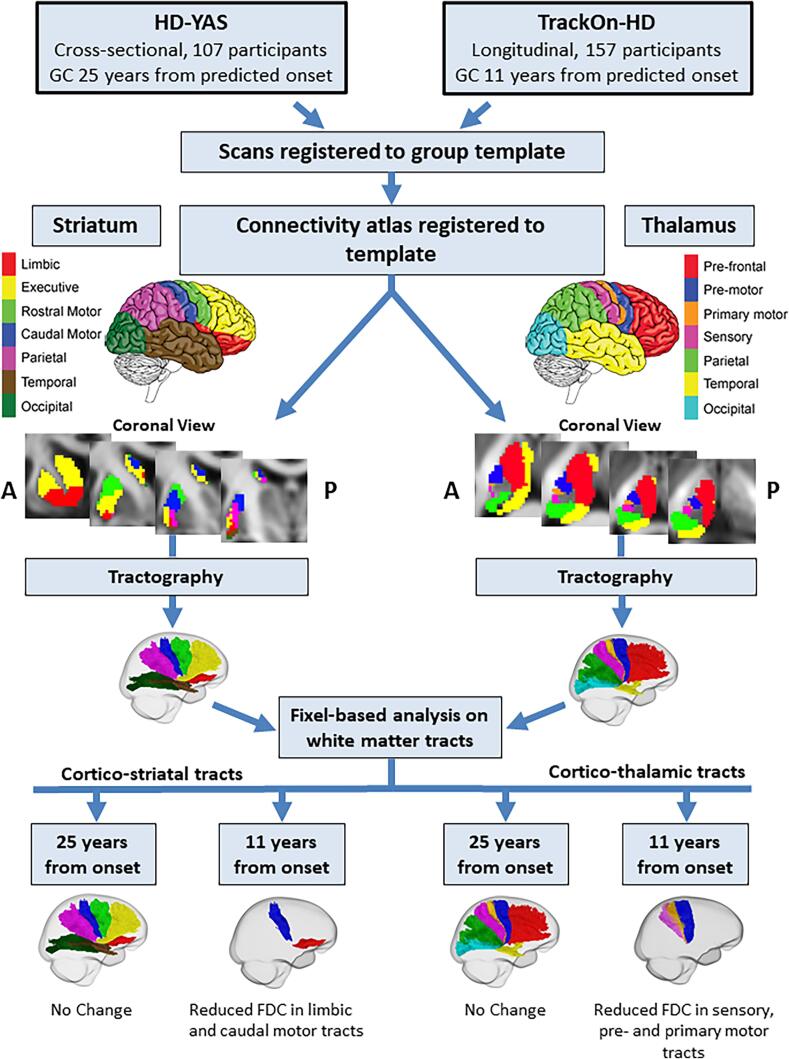
We performed fixel-based analysis, which allows resolution of crossing white matter fibres at the voxel level, on diffusion tractography derived white matter tracts of striatal and thalamic sub-regions in two independent cohorts; TrackON-HD, which included 72 preHD (approx. 11 years before disease onset) and 85 controls imaged at three time points over two years; and the HD young adult study (HD-YAS), which included 54 preHD (approx. 25 years before disease onset) and 53 controls, imaged at one time point. Group differences in fibre density and cross section (FDC) were investigated.
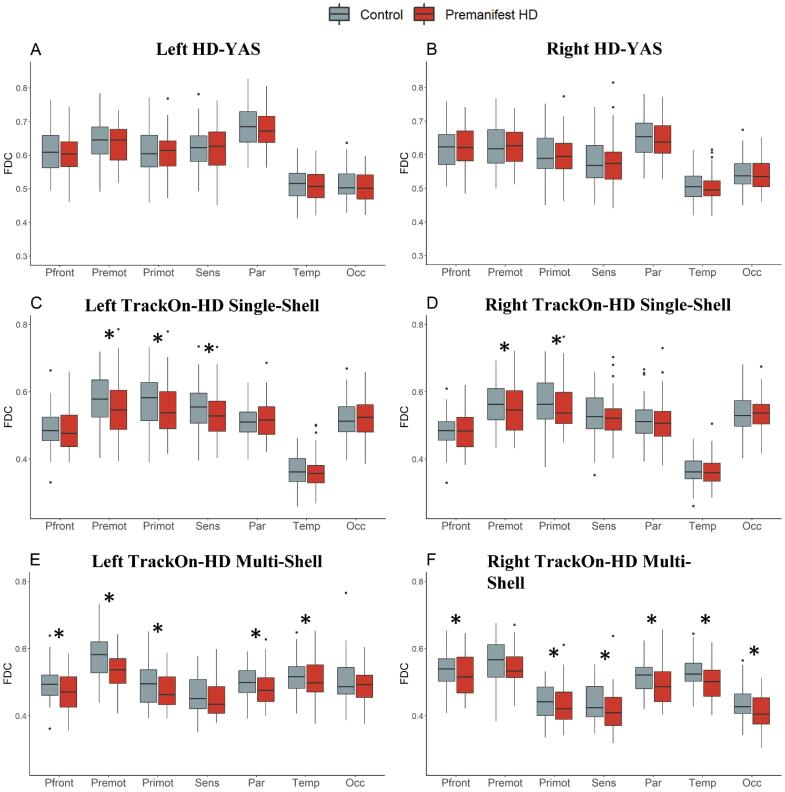
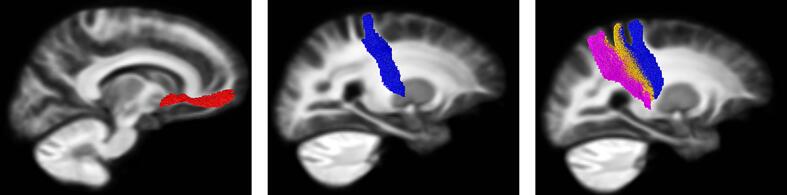
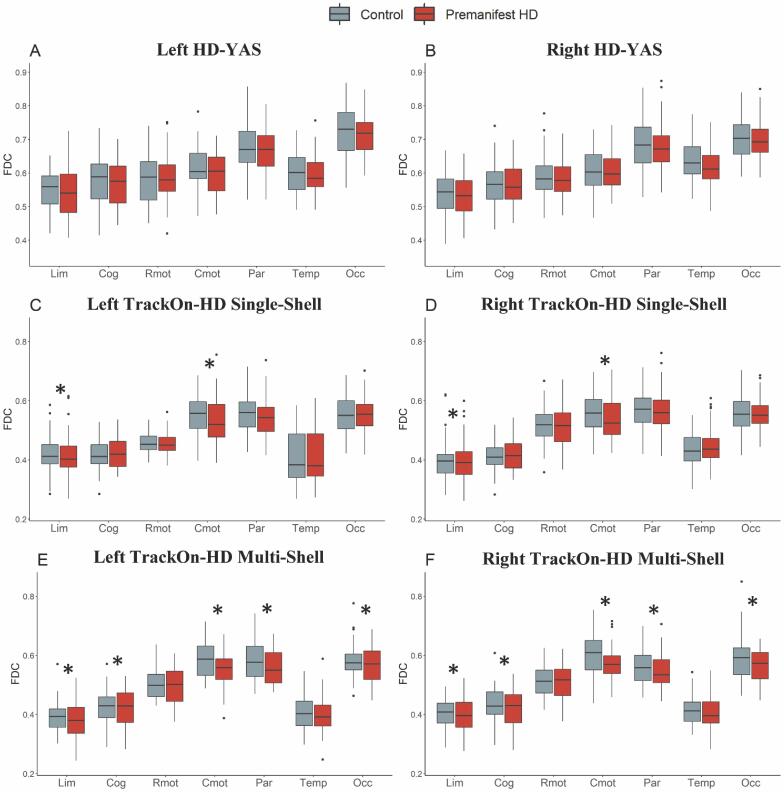
We found no significant group differences in cortico-basal ganglia sub-region FDC in preHD gene carriers 25 years before onset. In gene carriers 11 years before onset, there were reductions in striatal (limbic and caudal motor) and thalamic (premotor, motor and sensory) FDC at baseline, with no significant change over 2 years. Caudal motor-striatal, pre-motor-thalamic, and primary motor-thalamic FDC at baseline, showed significant correlations with the Unified Huntington's disease rating scale (UHDRS) total motor score (TMS). Limbic cortico-striatal FDC and apathy were also significantly correlated.
Our findings suggest that limbic and motor white matter tracts to the striatum and thalamus are most susceptible to early degeneration in HD but that approximately 25 years from onset, these tracts appear preserved. These findings may have importance in determining the optimum time to initiate future disease modifying therapies in HD.
研究在有症状前亨廷顿病(preHD)出现之前,皮质基底节白质(white matter)损失开始的症状前时间框架,以及哪些纹状体和丘脑亚区白质束最容易受到影响。
我们对两个独立队列的纹状体和丘脑亚区扩散轨迹进行了基于固定点的分析(fixel-based analysis),这种分析可以在体素水平上解析交叉白质纤维。TrackON-HD 队列包括 72 名 preHD(发病前约 11 年)和 85 名对照,在两年内进行了三次扫描;HD 青年研究(HD-YAS)队列包括 54 名 preHD(发病前约 25 年)和 53 名对照,仅进行了一次扫描。研究了纤维密度和横截面(FDC)的组间差异。
我们发现在发病前 25 年,preHD 基因携带者的皮质基底节亚区 FDC 没有显著的组间差异。在发病前 11 年,纹状体(边缘和尾部运动)和丘脑(前运动、运动和感觉)的 FDC 在基线时有降低,而在 2 年内没有明显变化。基线时的尾状核-纹状体、前运动-丘脑、初级运动-丘脑 FDC 与统一亨廷顿病评定量表(UHDRS)总运动评分(TMS)显著相关。边缘皮质-纹状体 FDC 和淡漠也与 TMS 显著相关。
我们的研究结果表明,纹状体和丘脑的边缘和运动白质束最容易受到 HD 的早期退化影响,但在发病前约 25 年,这些束似乎得到了保留。这些发现可能对确定 HD 中启动未来疾病修饰治疗的最佳时间具有重要意义。