• 文献检索
  • 文档翻译
  • 深度研究
  • 学术资讯
  • Suppr Zotero 插件Zotero 插件
  • 邀请有礼
  • 套餐&价格
  • 历史记录
应用&插件
Suppr Zotero 插件Zotero 插件浏览器插件Mac 客户端Windows 客户端微信小程序
定价
高级版会员购买积分包购买API积分包
服务
文献检索文档翻译深度研究API 文档MCP 服务
关于我们
关于 Suppr公司介绍联系我们用户协议隐私条款
关注我们

Suppr 超能文献

核心技术专利:CN118964589B侵权必究
粤ICP备2023148730 号-1Suppr @ 2026

文献检索

告别复杂PubMed语法,用中文像聊天一样搜索,搜遍4000万医学文献。AI智能推荐,让科研检索更轻松。

立即免费搜索

文件翻译

保留排版,准确专业,支持PDF/Word/PPT等文件格式,支持 12+语言互译。

免费翻译文档

深度研究

AI帮你快速写综述,25分钟生成高质量综述,智能提取关键信息,辅助科研写作。

立即免费体验

2017年利比里亚综合疾病监测与应对实施情况:数据质量审计结果

Integrated disease surveillance and response implementation in Liberia, findings from a data quality audit, 2017.

作者信息

Nagbe Thomas, Yealue Kwuakuan, Yeabah Trokon, Rude Julius Monday, Fallah Musoka, Skrip Laura, Agbo Chukwuemeka, Mouhamoud Nuha, Okeibunor Joseph Chukwudi, Tuopileyi Roland, Talisuna Ambrose, Yahaya Ali Ahmed, Rajatonirina Soatiana, Frimpong Joseph Asamoah, Stephen Mary, Hamblion Esther, Nyenswah Tolbert, Dahn Bernice, Gasasira Alex, Fall Ibrahima Socé

机构信息

National Public Health Institute, Monrovia, Liberia.

World Health Organization, Monrovia, Liberia.

出版信息

Pan Afr Med J. 2019 May 31;33(Suppl 2):10. doi: 10.11604/pamj.supp.2019.33.2.17608. eCollection 2019.

DOI:10.11604/pamj.supp.2019.33.2.17608
PMID:31402968
原文链接:https://pmc.ncbi.nlm.nih.gov/articles/PMC6675580/
Abstract

INTRODUCTION

in spite of the efforts and resources committed by the division of infectious disease and epidemiology (DIDE) of the national public health institute of Liberia (NPHIL)/Ministry of health to strengthening integrated disease surveillance and response (IDSR) across the country, quality data management system remains a challenge to the Liberia NPHIL/MoH (Ministry of health), with incomplete and inconsistent data constantly being reported at different levels of the surveillance system. As part of the monitoring and evaluation strategy for IDSR continuous improvement, data quality assessment (DQA) of the IDSR system to identify successes and gaps in the disease surveillance information system (DSIS) with the aim of ensuring data accuracy, reliability and credibility of generated data at all levels of the health system; and to inform an operational plan to address data quality needs for IDSR activities is required.

METHODS

multi-stage cluster sampling that included simple random sample (SRS) of five counties, simple random sample of two districts and simple random sample of three health facilities was employed during the study pilot assessment done in Montserrado County with Liberia institute of bio medical research (LIBR) inclusive. A total of thirty (30) facilities was targeted, twenty nine (29) of the facilities were successfully audited: one hospital, two health centers, twenty clinics and respondents included: health facility surveillance focal persons (HFSFP), zonal surveillance officers (ZSOs), district surveillance officers (DSOs) and County surveillance officers (CSOs).

RESULTS

the assessment revealed that data use is limited to risk communication and sensitization, no examples of use of data for prioritization or decision making at the subnational level. The findings indicated the following: 23% (7/29) of health facilities having dedicated phone for reporting, 20% (6/29) reported no cell phone network, 17% (5/29) reported daily access to internet, 56.6% (17/29) reported a consistent supply of electricity, and no facility reported access to functional laptop. It was also established that 40% of health facilities have experienced a stock out of laboratory specimens packaging supplies in the past year. About half of the surveyed health facilities delivered specimens through riders and were assisted by the DSOs. There was a large variety in the reported packaging process, with many staff unable to give clear processes. The findings during the exercise also indicated that 91% of health facility staff were mentored on data quality check and data management including the importance of the timeliness and completeness of reporting through supportive supervision and mentorship; 65% of the health facility assessed received supervision on IDSR core performance indicator; and 58% of the health facility officer in charge gave feedback to the community level.

CONCLUSION

public health is a data-intensive field which needs high-quality data and authoritative information to support public health assessment, decision-making and to assure the health of communities. Data quality assessment is important for public health. In this review completeness, accuracy, and timeliness were the three most-assessed attributes. Quantitative data quality assessment primarily used descriptive surveys and data audits, while qualitative data quality assessment methods include primarily interviews, questionnaires administration, documentation reviews and field observations. We found that data-use and data-process have not been given adequate attention, although they were equally important factors which determine the quality of data. Other limitations of the previous studies were inconsistency in the definition of the attributes of data quality, failure to address data users' concerns and a lack of triangulation of mixed methods for data quality assessment. The reliability and validity of the data quality assessment were rarely reported. These gaps suggest that in the future, data quality assessment for public health needs to consider equally the three dimensions of data quality, data use and data process. Measuring the perceptions of end users or consumers towards data quality will enrich our understanding of data quality issues. Data use is limited to risk communication and sensitization, no examples of use of data for prioritization or decision making at the sub national level.

摘要

引言

尽管利比里亚国家公共卫生研究所/卫生部传染病与流行病学司(DIDE)投入了精力和资源来加强全国的综合疾病监测与应对(IDSR),但质量数据管理系统对利比里亚国家公共卫生研究所/卫生部而言仍是一项挑战,在监测系统的不同层面持续报告着不完整和不一致的数据。作为IDSR持续改进监测与评估策略的一部分,需要对IDSR系统进行数据质量评估(DQA),以识别疾病监测信息系统(DSIS)中的成功之处和差距,目的是确保卫生系统各级生成数据的准确性、可靠性和可信度;并为满足IDSR活动数据质量需求的运营计划提供依据。

方法

在蒙罗维亚县进行的研究试点评估中采用了多阶段整群抽样,包括对五个县的简单随机抽样(SRS)、对两个区的简单随机抽样以及对三个卫生设施的简单随机抽样,利比里亚生物医学研究所(LIBR)也包括在内。总共针对30个设施,成功审计了其中29个:1家医院、2个卫生中心、20个诊所,受访者包括:卫生设施监测负责人(HFSFP)、区域监测官员(ZSO)、区监测官员(DSO)和县监测官员(CSO)。

结果

评估显示数据使用仅限于风险沟通和宣传,没有在国家以下层面将数据用于确定优先事项或决策的实例。调查结果如下:23%(7/29)的卫生设施有专用报告电话,20%(6/29)报告没有手机网络,17%(5/29)报告每天可访问互联网,56.6%(17/29)报告电力供应稳定,没有设施报告可使用功能正常的笔记本电脑。还确定在过去一年中,40%的卫生设施经历过实验室标本包装用品缺货情况。约一半接受调查的卫生设施通过骑手运送标本,并得到DSO的协助。报告的包装过程差异很大,许多工作人员无法给出清晰的流程。此次调查期间的结果还表明,91%的卫生设施工作人员接受了数据质量检查和数据管理方面的指导,包括通过支持性监督和指导了解报告及时性和完整性的重要性;65%接受评估的卫生设施接受了关于IDSR核心绩效指标的监督;58%的卫生设施负责人向社区层面提供了反馈。

结论

公共卫生是一个数据密集型领域,需要高质量数据和权威信息来支持公共卫生评估、决策并确保社区健康。数据质量评估对公共卫生很重要。在本次综述中,完整性、准确性和及时性是评估最多的三个属性。定量数据质量评估主要使用描述性调查和数据审计,而定性数据质量评估方法主要包括访谈、问卷调查、文件审查和实地观察。我们发现数据使用和数据处理未得到充分关注,尽管它们是决定数据质量的同等重要因素。以往研究的其他局限性包括数据质量属性定义不一致、未解决数据用户的担忧以及缺乏用于数据质量评估的混合方法三角测量。数据质量评估的可靠性和有效性很少被报告。这些差距表明,未来公共卫生数据质量评估需要同等考虑数据质量、数据使用和数据处理这三个维度。衡量最终用户或消费者对数据质量的看法将丰富我们对数据质量问题的理解。数据使用仅限于风险沟通和宣传,没有在国家以下层面将数据用于确定优先事项或决策的实例。
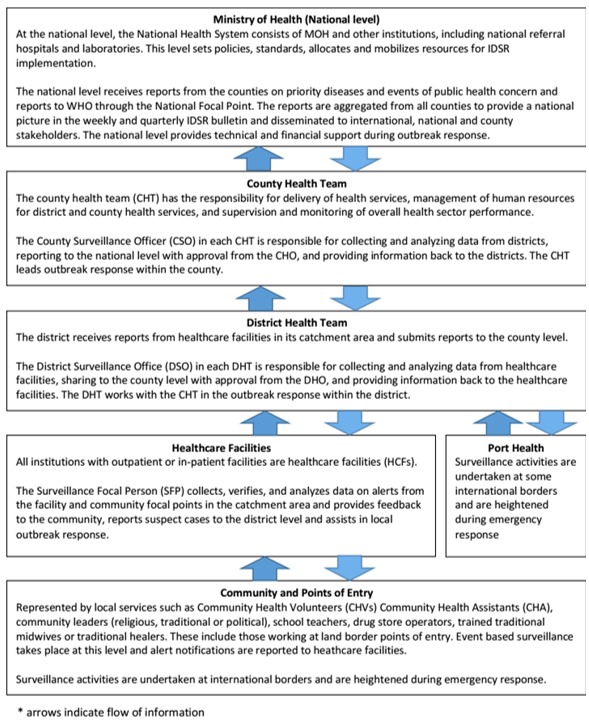
https://cdn.ncbi.nlm.nih.gov/pmc/blobs/a0f0/6675580/618fe0a7edd3/PAMJ-SUPP-33-2-10-g005.jpg
https://cdn.ncbi.nlm.nih.gov/pmc/blobs/a0f0/6675580/8994547785a2/PAMJ-SUPP-33-2-10-g001.jpg
https://cdn.ncbi.nlm.nih.gov/pmc/blobs/a0f0/6675580/257ceb9177ed/PAMJ-SUPP-33-2-10-g002.jpg
https://cdn.ncbi.nlm.nih.gov/pmc/blobs/a0f0/6675580/70ecca09b818/PAMJ-SUPP-33-2-10-g003.jpg
https://cdn.ncbi.nlm.nih.gov/pmc/blobs/a0f0/6675580/8a7315b478a2/PAMJ-SUPP-33-2-10-g004.jpg
https://cdn.ncbi.nlm.nih.gov/pmc/blobs/a0f0/6675580/618fe0a7edd3/PAMJ-SUPP-33-2-10-g005.jpg
https://cdn.ncbi.nlm.nih.gov/pmc/blobs/a0f0/6675580/8994547785a2/PAMJ-SUPP-33-2-10-g001.jpg
https://cdn.ncbi.nlm.nih.gov/pmc/blobs/a0f0/6675580/257ceb9177ed/PAMJ-SUPP-33-2-10-g002.jpg
https://cdn.ncbi.nlm.nih.gov/pmc/blobs/a0f0/6675580/70ecca09b818/PAMJ-SUPP-33-2-10-g003.jpg
https://cdn.ncbi.nlm.nih.gov/pmc/blobs/a0f0/6675580/8a7315b478a2/PAMJ-SUPP-33-2-10-g004.jpg
https://cdn.ncbi.nlm.nih.gov/pmc/blobs/a0f0/6675580/618fe0a7edd3/PAMJ-SUPP-33-2-10-g005.jpg

相似文献

1
Integrated disease surveillance and response implementation in Liberia, findings from a data quality audit, 2017.2017年利比里亚综合疾病监测与应对实施情况:数据质量审计结果
Pan Afr Med J. 2019 May 31;33(Suppl 2):10. doi: 10.11604/pamj.supp.2019.33.2.17608. eCollection 2019.
2
A rapid assessment of the implementation of integrated disease surveillance and response system in Northeast Nigeria, 2017.尼日利亚东北部 2017 年综合疾病监测和应对系统实施情况快速评估。
BMC Public Health. 2020 May 1;20(1):600. doi: 10.1186/s12889-020-08707-4.
3
The implementation of integrated disease surveillance and response in Liberia after Ebola virus disease outbreak 2015-2017.2015 - 2017年埃博拉病毒病疫情后利比里亚综合疾病监测与应对的实施情况
Pan Afr Med J. 2019 May 28;33(Suppl 2):3. doi: 10.11604/pamj.supp.2019.33.2.16820. eCollection 2019.
4
Documenting the development, adoption and pre-ebola implementation of Liberia's integrated disease surveillance and response (IDSR) strategy.记录利比里亚综合疾病监测和应对 (IDSR) 战略的制定、采用和埃博拉前实施情况。
BMC Public Health. 2023 Oct 25;23(1):2093. doi: 10.1186/s12889-023-17006-7.
5
Challenges with the implementation of an Integrated Disease Surveillance and Response (IDSR) system: systematic review of the lessons learned.综合疾病监测与应对(IDSR)系统实施中的挑战:经验教训的系统评价
Health Policy Plan. 2015 Feb;30(1):131-43. doi: 10.1093/heapol/czt097. Epub 2013 Dec 20.
6
Folic acid supplementation and malaria susceptibility and severity among people taking antifolate antimalarial drugs in endemic areas.在流行地区,服用抗叶酸抗疟药物的人群中,叶酸补充剂与疟疾易感性和严重程度的关系。
Cochrane Database Syst Rev. 2022 Feb 1;2(2022):CD014217. doi: 10.1002/14651858.CD014217.
7
Institutionalized data quality assessments: a critical pathway to improving the accuracy of integrated disease surveillance data in Sierra Leone.制度化的数据质量评估:提高塞拉利昂综合疾病监测数据准确性的关键途径。
BMC Health Serv Res. 2020 Aug 7;20(1):724. doi: 10.1186/s12913-020-05591-x.
8
The future of Cochrane Neonatal.考克兰新生儿协作网的未来。
Early Hum Dev. 2020 Nov;150:105191. doi: 10.1016/j.earlhumdev.2020.105191. Epub 2020 Sep 12.
9
Revitalization of integrated disease surveillance and response in Sierra Leone post Ebola virus disease outbreak.埃博拉病毒病疫情后塞拉利昂综合疾病监测与应对的振兴
BMC Public Health. 2019 Apr 2;19(1):364. doi: 10.1186/s12889-019-6636-1.
10
Integrated Disease Surveillance and Response (IDSR) in Malawi: Implementation gaps and challenges for timely alert.马拉维综合疾病监测和应对(IDSR):及时警报的实施差距和挑战。
PLoS One. 2018 Nov 29;13(11):e0200858. doi: 10.1371/journal.pone.0200858. eCollection 2018.

引用本文的文献

1
Developing digital learning to help reduce laboratory inequalities: a viral haemorrhagic fever case study.发展数字学习以帮助减少实验室不平等:病毒性出血热案例研究
One Health Outlook. 2025 Jun 20;7(1):33. doi: 10.1186/s42522-025-00156-6.
2
Addressing data quality issues to assess clinical and epidemiological risk factors for COVID-19 among documented cases in Liberia: a single-centre, retrospective, observational study.解决数据质量问题以评估利比里亚确诊病例中新冠病毒病的临床和流行病学风险因素:一项单中心、回顾性、观察性研究
BMJ Public Health. 2024 Nov 7;2(2):e000230. doi: 10.1136/bmjph-2023-000230. eCollection 2024 Dec.
3

本文引用的文献

1
After Ebola in West Africa--Unpredictable Risks, Preventable Epidemics.西非埃博拉疫情之后——不可预测的风险,可预防的流行病
N Engl J Med. 2016 Aug 11;375(6):587-96. doi: 10.1056/NEJMsr1513109.
2
Perspectives on West Africa Ebola Virus Disease Outbreak, 2013-2016.2013 - 2016年西非埃博拉病毒病疫情透视
Emerg Infect Dis. 2016 Jun;22(6):956-63. doi: 10.3201/eid2206.160021. Epub 2016 Jun 15.
3
The next epidemic--lessons from Ebola.下一场疫情——埃博拉带来的教训
Development of novel composite data quality scores to evaluate facility-level data quality in electronic data in Kenya: a nationwide retrospective cohort study.
开发新型复合数据质量评分,以评估肯尼亚电子数据中的医疗机构数据质量:一项全国性回顾性队列研究。
BMC Health Serv Res. 2023 Oct 23;23(1):1139. doi: 10.1186/s12913-023-10133-2.
4
Post-epidemic health system recovery: A comparative case study analysis of routine immunization programs in the Republics of Haiti and Liberia.疫情后卫生系统恢复:海地和利比里亚共和国常规免疫规划的对比案例分析。
PLoS One. 2023 Oct 17;18(10):e0292793. doi: 10.1371/journal.pone.0292793. eCollection 2023.
5
Evaluation of Ebola virus disease surveillance system capability to promptly detect a new outbreak in Liberia.评估埃博拉病毒病监测系统及时发现利比里亚新疫情的能力。
BMJ Glob Health. 2023 Aug;8(8). doi: 10.1136/bmjgh-2023-012369.
6
Assessing routine health information system performance during the tenth outbreak of Ebola virus disease (2018-2020) in the Democratic Republic of the Congo: A qualitative study in North Kivu.评估刚果民主共和国第十次埃博拉病毒病疫情(2018 - 2020年)期间常规卫生信息系统的绩效:北基伍省的一项定性研究
PLOS Glob Public Health. 2022 Jul 29;2(7):e0000429. doi: 10.1371/journal.pgph.0000429. eCollection 2022.
7
Barriers to conducting independent quantitative research in low-income countries: A cross-sectional study of public health graduate students in Liberia.在低收入国家开展独立定量研究的障碍:利比里亚公共卫生研究生的横断面研究。
PLoS One. 2023 Feb 2;18(2):e0280917. doi: 10.1371/journal.pone.0280917. eCollection 2023.
8
Routine use of DHIS2 data: a scoping review.常规使用 DHIS2 数据:范围综述。
BMC Health Serv Res. 2022 Oct 6;22(1):1234. doi: 10.1186/s12913-022-08598-8.
9
Quality of National Disease Surveillance Reporting before and during COVID-19: A Mixed-Method Study in Indonesia.新冠肺炎疫情前后国家疾病监测报告质量:印度尼西亚的混合方法研究。
Int J Environ Res Public Health. 2022 Feb 26;19(5):2728. doi: 10.3390/ijerph19052728.
10
Twenty years of integrated disease surveillance and response in Sub-Saharan Africa: challenges and opportunities for effective management of infectious disease epidemics.撒哈拉以南非洲地区20年的综合疾病监测与应对:有效管理传染病疫情的挑战与机遇
One Health Outlook. 2021 Nov 9;3(1):22. doi: 10.1186/s42522-021-00052-9.
N Engl J Med. 2015 Apr 9;372(15):1381-4. doi: 10.1056/NEJMp1502918. Epub 2015 Mar 18.
4
The Ebola outbreak in West Africa: a story of related public health challenges and a pointer to solutions to mitigate the inevitable next outbreak.西非埃博拉疫情:一系列相关公共卫生挑战的故事以及减轻下一次不可避免疫情爆发的解决方法指南。
Pan Afr Med J. 2014 Sep 22;19:48. doi: 10.11604/pamj.2014.19.48.5336. eCollection 2014.
5
The case for integrating public health informatics networks.整合公共卫生信息学网络的理由。
IEEE Eng Med Biol Mag. 2004 Jan-Feb;23(1):81-8. doi: 10.1109/memb.2004.1297178.