Fong Kara D, Self Julian, Diederichsen Kyle M, Wood Brandon M, McCloskey Bryan D, Persson Kristin A
Department of Chemical and Biomolecular Engineering, Department of Materials Science and Engineering, and Department of Applied Science and Technology, University of California, Berkeley, California 94720, United States.
Energy Technologies Area, Lawrence Berkeley National Laboratory, Berkeley, California 94720, United States.
ACS Cent Sci. 2019 Jul 24;5(7):1250-1260. doi: 10.1021/acscentsci.9b00406. Epub 2019 Jun 14.
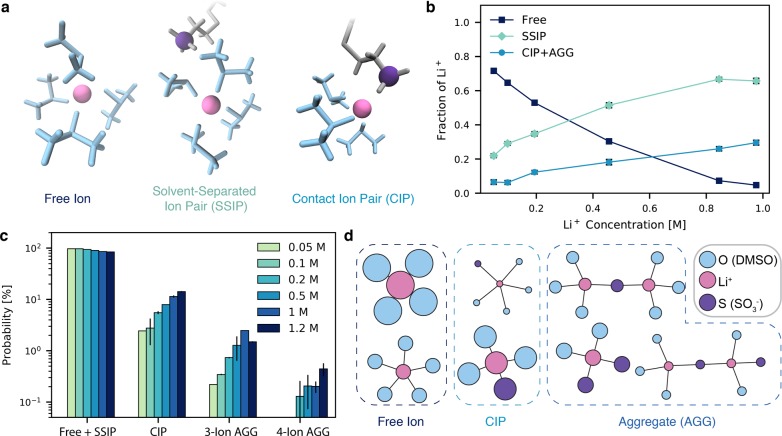
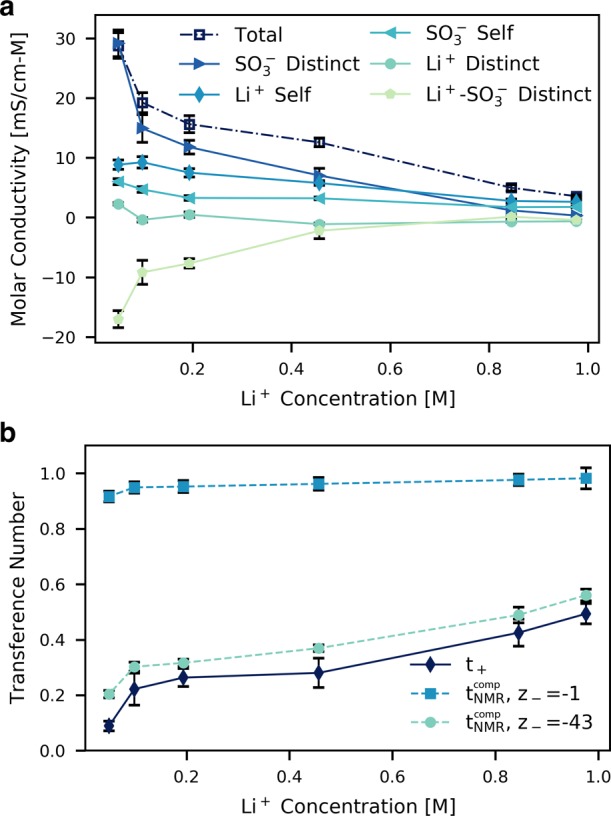
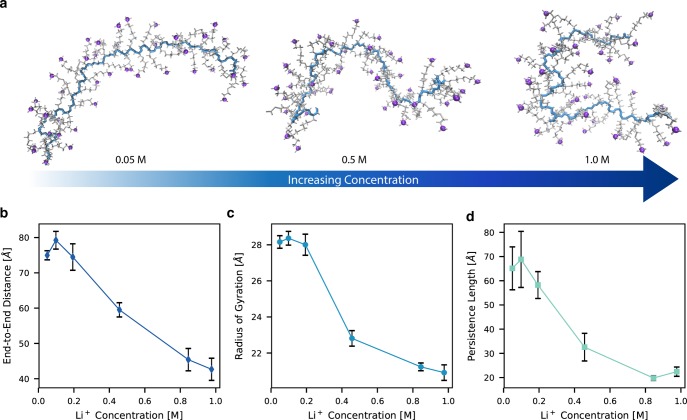
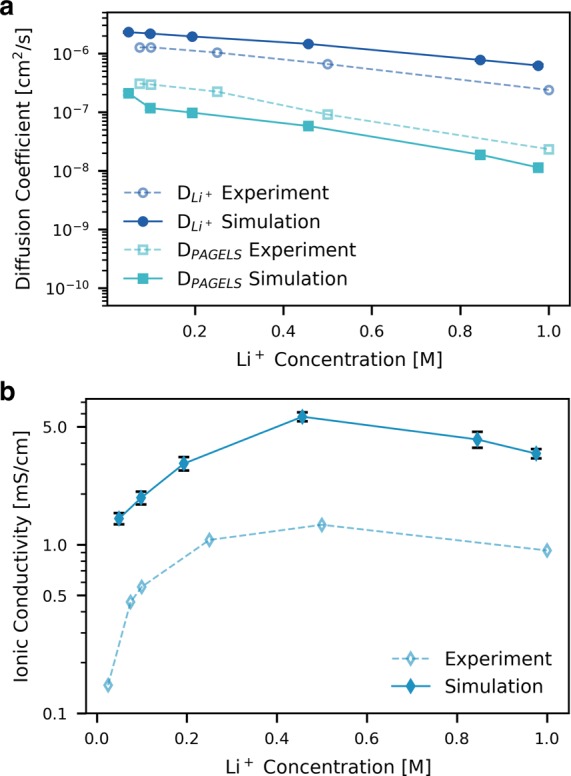
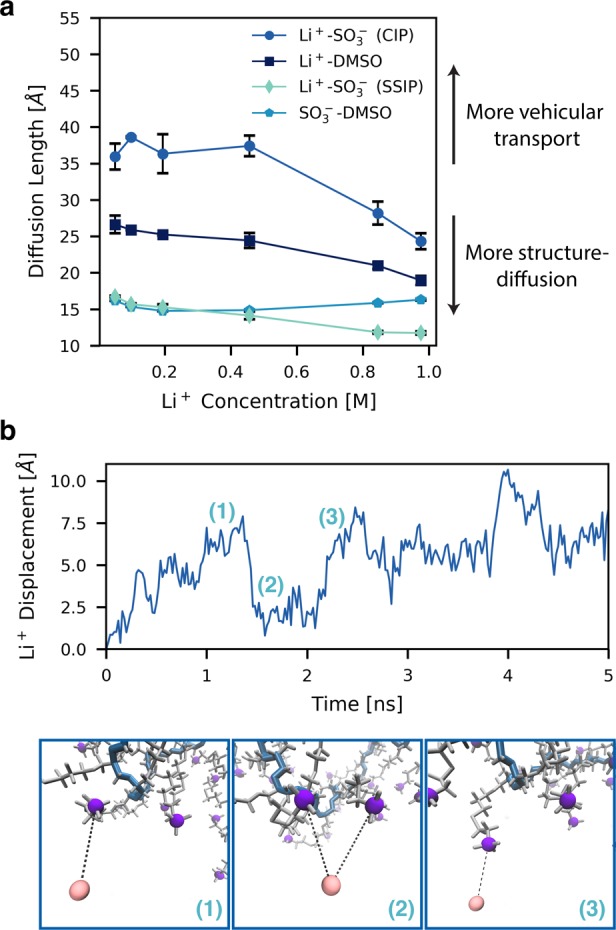
Nonaqueous polyelectrolyte solutions have been recently proposed as high Li transference number electrolytes for lithium ion batteries. However, the atomistic phenomena governing ion diffusion and migration in polyelectrolytes are poorly understood, particularly in nonaqueous solvents. Here, the structural and transport properties of a model polyelectrolyte solution, poly(allyl glycidyl ether-lithium sulfonate) in dimethyl sulfoxide, are studied using all-atom molecular dynamics simulations. We find that the static structural analysis of Li ion pairing is insufficient to fully explain the overall conductivity trend, necessitating a dynamic analysis of the diffusion mechanism, in which we observe a shift from largely vehicular transport to more structural diffusion as the Li concentration increases. Furthermore, we demonstrate that despite the significantly higher diffusion coefficient of the lithium ion, the negatively charged polyion is responsible for the majority of the solution conductivity at all concentrations, corresponding to Li transference numbers much lower than previously estimated experimentally. We quantify the ion-ion correlations unique to polyelectrolyte systems that are responsible for this surprising behavior. These results highlight the need to reconsider the approximations typically made for transport in polyelectrolyte solutions.
非水聚电解质溶液最近被提议作为锂离子电池中具有高锂离子迁移数的电解质。然而,人们对聚电解质中离子扩散和迁移的原子现象了解甚少,尤其是在非水溶剂中。在此,使用全原子分子动力学模拟研究了一种模型聚电解质溶液——聚(烯丙基缩水甘油醚 - 锂磺酸盐)在二甲基亚砜中的结构和传输性质。我们发现,锂离子配对的静态结构分析不足以完全解释整体电导率趋势,需要对扩散机制进行动态分析,在此过程中我们观察到随着锂浓度的增加,传输方式从主要的载流子传输转变为更多的结构扩散。此外,我们证明,尽管锂离子的扩散系数明显更高,但带负电的聚离子在所有浓度下都对溶液的大部分电导率负责,这对应着比之前实验估计低得多的锂迁移数。我们量化了聚电解质体系中导致这种惊人行为的独特离子 - 离子相关性。这些结果凸显了重新考虑通常用于聚电解质溶液传输的近似方法的必要性。