Mantuani Daniel, Luftig Josh, Herring Andrew, Dreyfuss Andrea, Nagdev Arun
Highland General Hospital, Alameda Health System, Department of Emergency Medicine, Oakland, California.
Clin Pract Cases Emerg Med. 2019 May 29;3(3):248-251. doi: 10.5811/cpcem.2019.4.42117. eCollection 2019 Aug.
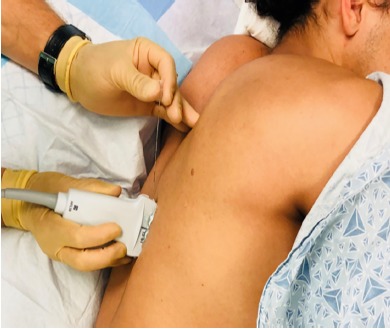
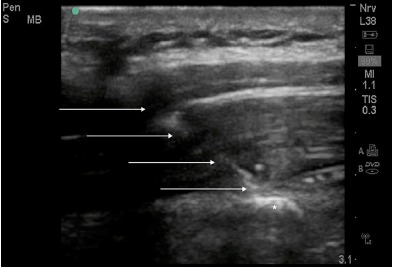
Single injection, ultrasound-guided nerve blocks have drastically changed the multimodal approach to pain management of the acutely injured patient in the emergency department (ED). Ultrasound-guided femoral nerve blocks in the ED have become standard aspects of multiple, hospital system pain management protocols, with early evidence demonstrating improved patient outcomes. Developing a multimodal pain management strategy can improve analgesia while reducing reliance on opioids in this era of opioid addiction.1 The single injection, ultrasound-guided erector spinae plane (ESP) block is a technique safely used for pain control for rib fractures that can be easily performed at the bedside and integrated into optimal emergency care. A more inferiorly located ultrasound-guided ESP block has been recently described in the anesthesia literature for perioperative pain control for various abdominal surgeries but has not yet been described for patients with acute appendicitis. Here we describe a single injection, lower ESP block performed by emergency physicians that successfully alleviated pain from acute appendicitis in an ED patient awaiting definitive surgical treatment. Along with allowing clinicians to actively manage pain without reliance on opioids, this novel ED technique may improve patient care outcomes.
单次注射、超声引导下神经阻滞极大地改变了急诊科(ED)对急性受伤患者疼痛管理的多模式方法。急诊超声引导下股神经阻滞已成为多个医院系统疼痛管理方案的标准组成部分,早期证据表明患者预后得到改善。在这个阿片类药物成瘾的时代,制定多模式疼痛管理策略可以改善镇痛效果,同时减少对阿片类药物的依赖。单次注射、超声引导下竖脊肌平面(ESP)阻滞是一种安全用于肋骨骨折疼痛控制的技术,可在床边轻松实施,并纳入最佳的急诊护理中。麻醉文献中最近描述了一种位置更低的超声引导下ESP阻滞用于各种腹部手术的围手术期疼痛控制,但尚未针对急性阑尾炎患者进行描述。在此,我们描述了由急诊医生实施的单次注射、低位ESP阻滞,成功缓解了一名等待确定性手术治疗的急诊科急性阑尾炎患者的疼痛。这种新颖的急诊科技术不仅使临床医生能够在不依赖阿片类药物的情况下积极管理疼痛,还可能改善患者的护理结局。