Krispin E, Wertheimer A, Trigerman S, Ben-Haroush A, Meizner I, Wiznitzer A, Bardin R
Helen Schneider Hospital for Women, Rabin Medical Center - Beilinson Hospital, Petach Tikva, Israel.
Sackler Faculty of Medicine, Tel Aviv University, Tel Aviv, Israel.
Eur J Obstet Gynecol Reprod Biol X. 2019 May 15;3:100051. doi: 10.1016/j.eurox.2019.100051. eCollection 2019 Jul.
To compare complication rates following amniocentesis in twin gestations, according to sampling technique and number of needle insertions.
A retrospective cohort study of all women with twin gestations who underwent amniocentesis and delivered in a single university affiliated medical center during 2002-2016. Amniocentesis was performed either through one uterine entry with passage through the inter-twin membrane or through two different entries to the two amniotic sacs. Pregnancy outcome of women that underwent single needle insertion amniocentesis, was compared to this of double needle insertion. Primary outcome was neonatal complications within 4 weeks after amniocentesis (late abortion, chorioamnionitis, preterm premature rupture of membranes, or hospitalization due to related symptoms). Secondary outcomes were gestational week at delivery and labor characteristics.
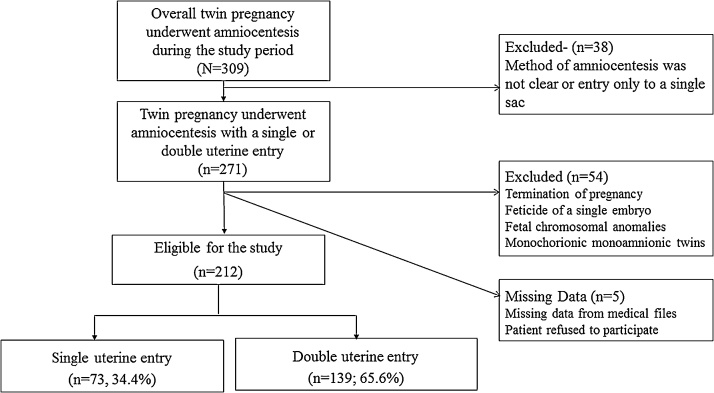
The study group comprised 212 women. Of them, 73 (34.4%) underwent a single uterine insertion and 139 (65.6%) two separate needle insertions. Baseline characteristics did not differ between the groups. The amniocentesis complication rate was 13.7% in the single insertion group and 16.5% in the double insertion group (p = 0.587). Multivariate analysis found that a single insertion method had no statistically significant influence on complication rate, after making adjustments for potential confounders (OR = 1.085, 95% CI 0.4-2.9; p = 0.871). Other labor characteristics were similar between the groups.
Needle insertion technique in twin gestation amniocentesis was not associated with procedure related complications.
根据采样技术和进针次数,比较双胎妊娠羊膜腔穿刺术后的并发症发生率。
一项回顾性队列研究,对象为2002年至2016年期间在某单一大学附属医疗中心接受羊膜腔穿刺术并分娩的所有双胎妊娠女性。羊膜腔穿刺术通过一个子宫进针点穿过双胎胎膜进行,或通过两个不同进针点分别进入两个羊膜囊进行。将单针穿刺羊膜腔穿刺术女性的妊娠结局与双针穿刺女性的妊娠结局进行比较。主要结局是羊膜腔穿刺术后4周内的新生儿并发症(晚期流产、绒毛膜羊膜炎、胎膜早破早产或因相关症状住院)。次要结局是分娩时的孕周和分娩特征。
研究组包括212名女性。其中,73名(34.4%)进行了单次子宫进针,139名(65.6%)进行了两次单独进针。两组的基线特征无差异。单针穿刺组的羊膜腔穿刺并发症发生率为13.7%,双针穿刺组为16.5%(p = 0.587)。多变量分析发现,在对潜在混杂因素进行调整后,单针穿刺方法对并发症发生率无统计学显著影响(OR = 1.085,95% CI 0.4 - 2.9;p = 0.871)。两组的其他分娩特征相似。
双胎妊娠羊膜腔穿刺术的进针技术与手术相关并发症无关。