Centre for Organelle Research, University of Stavanger, Stavanger, Norway.
Department of Electrical Engineering and Computer Science, University of Stavanger, Stavanger, Norway.
PLoS One. 2019 Aug 12;14(8):e0207831. doi: 10.1371/journal.pone.0207831. eCollection 2019.
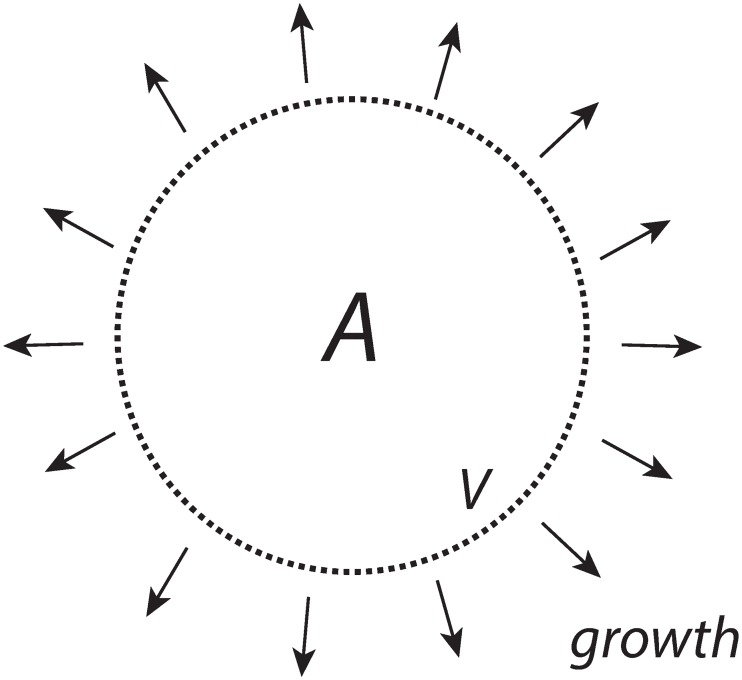
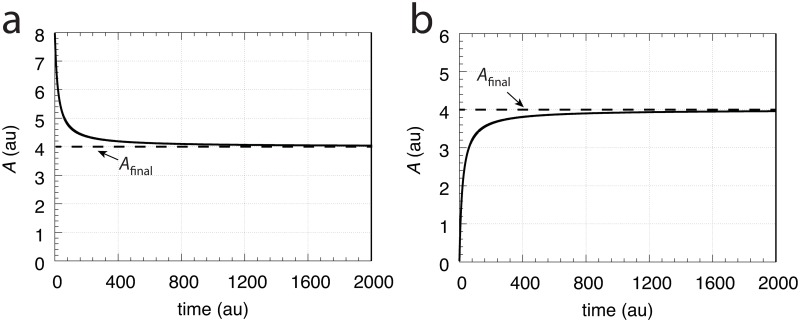
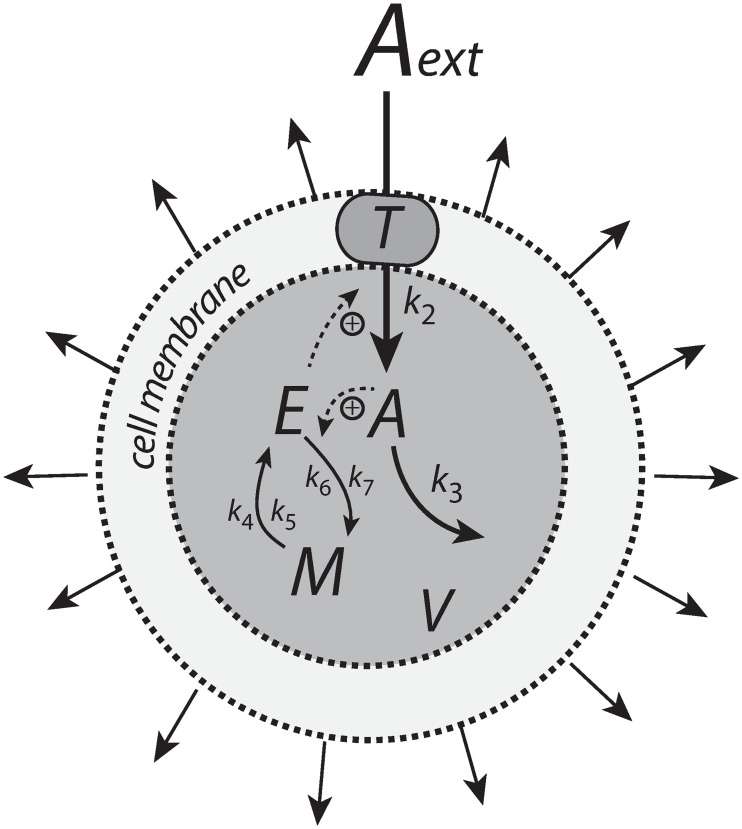
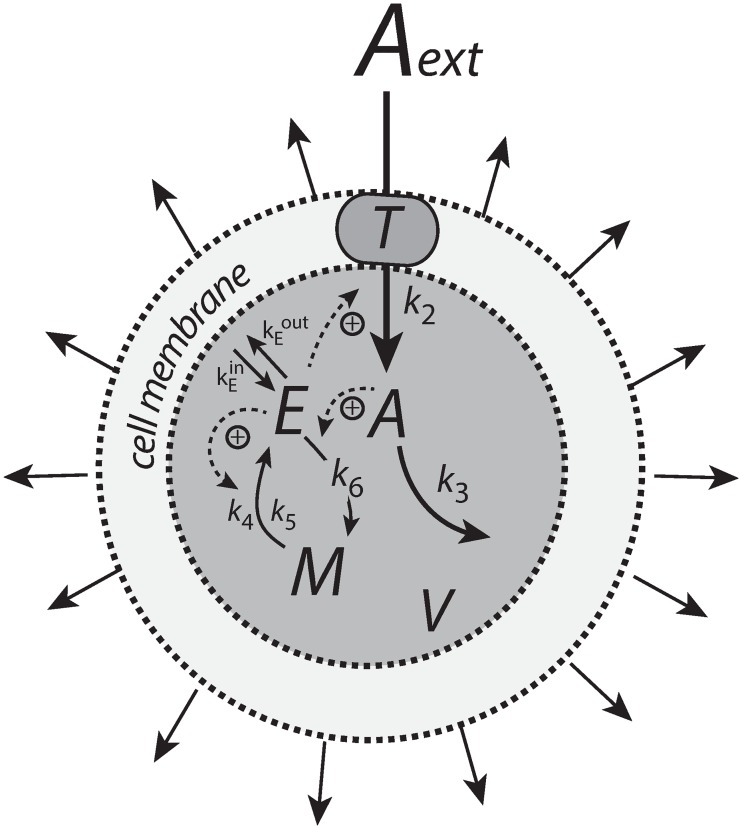
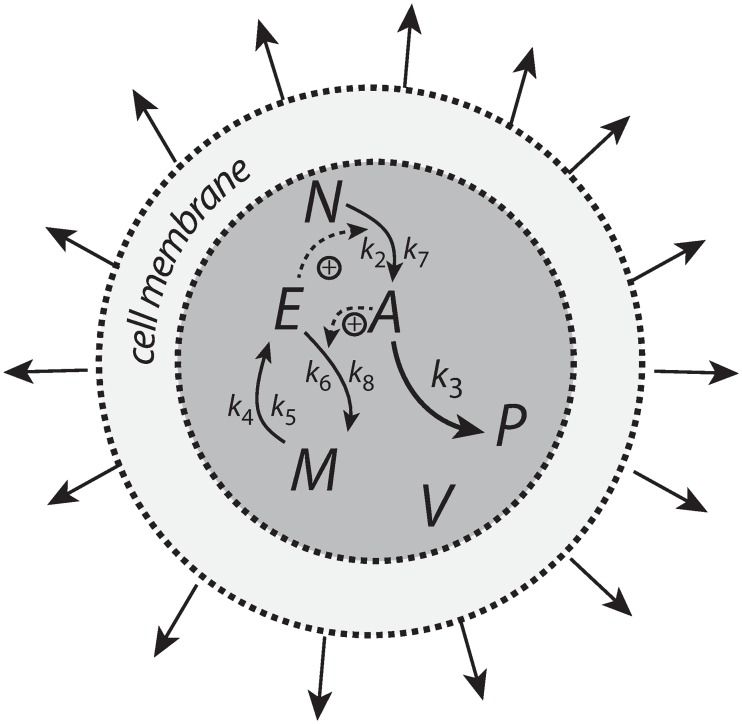
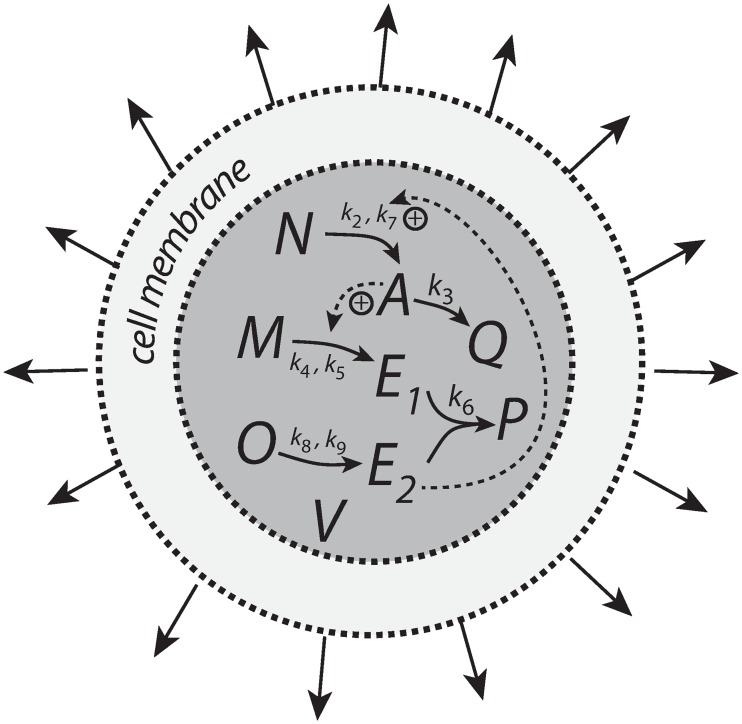
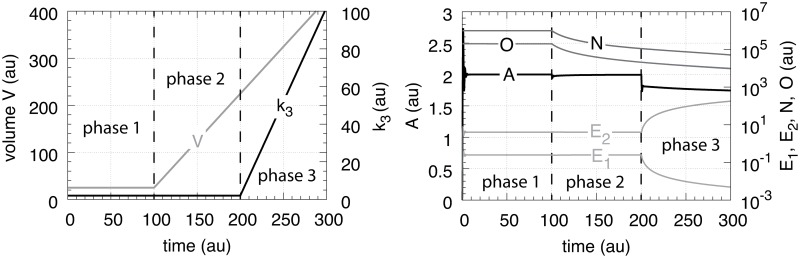
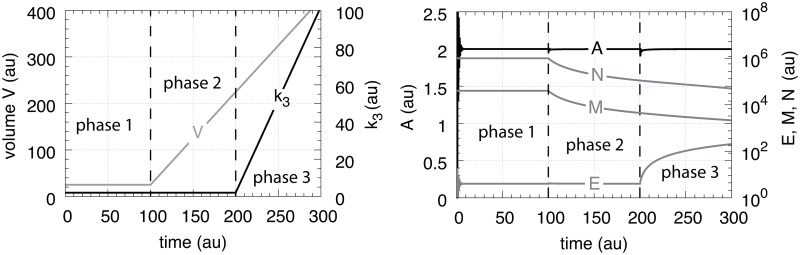
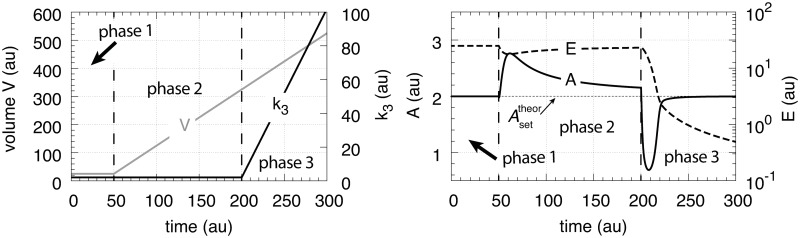
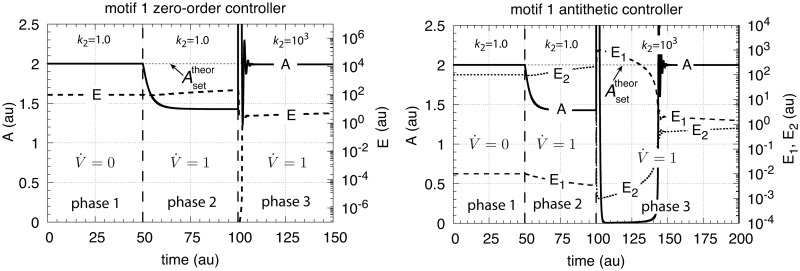
Cells and organisms have developed homeostatic mechanisms which protect them against a changing environment. How growth and homeostasis interact is still not well understood, but of increasing interest to the molecular and synthetic biology community to recognize and design control circuits which can oppose the diluting effects of cell growth. In this paper we describe the performance of selected negative feedback controllers in response to different applied growth laws and time dependent outflow perturbations of a controlled variable. The approach taken here is based on deterministic mass action kinetics assuming that cell content is instantaneously mixed. All controllers behave ideal in the sense that they for step-wise perturbations in volume and a controlled compound A are able to drive A precisely back to the controllers' theoretical set-points. The applied growth kinetics reflect experimentally observed growth laws, which range from surface to volume ratio growth to linear and exponential growth. Our results show that the kinetic implementation of integral control and the structure of the negative feedback loop are two properties which affect controller performance. Best performance is observed for controllers based on derepression kinetics and controllers with an autocatalytic implementation of integral control. Both are able to defend exponential growth and perturbations, although the autocatalytic controller shows an offset from its theoretical set-point. Controllers with activating signaling using zero-order or bimolecular (antithetic) kinetics for integral control behave very similar but less well. Their performance can be improved by implementing negative feedback structures having repression/derepression steps or by increasing controller aggressiveness. Our results provide a guide what type of feedback structures and integral control kinetics are suitable to oppose the dilution effects by different growth laws and time dependent perturbations on a deterministic level.
细胞和生物体已经发展出了内稳态机制,以保护它们免受不断变化的环境的影响。生长和内稳态如何相互作用仍然不太清楚,但越来越引起分子和合成生物学界的兴趣,以识别和设计可以对抗细胞生长稀释效应的控制回路。在本文中,我们描述了选择的负反馈控制器在响应不同应用的生长规律和受控变量的时变流出扰动时的性能。这里采用的方法基于确定性质量作用动力学,假设细胞内容物瞬时混合。所有控制器的行为都是理想的,即它们可以对体积的阶跃式扰动和受控化合物 A 进行精确控制,将 A 精确地驱动回到控制器的理论设定点。应用的生长动力学反映了实验观察到的生长规律,这些规律从表面积比生长到线性和指数生长不等。我们的结果表明,积分控制的动力学实现和负反馈环的结构是影响控制器性能的两个特性。基于去阻遏动力学的控制器和具有积分控制自动催化实现的控制器表现出最佳性能。它们都能够抵御指数生长和扰动,尽管自动催化控制器与其理论设定点存在偏差。使用零级或双分子(对偶)动力学进行积分控制的激活信号控制器表现非常相似,但效果较差。通过实现具有抑制/去抑制步骤的负反馈结构或增加控制器的攻击性,可以提高它们的性能。我们的结果为在确定性水平上对抗不同生长规律和时变扰动的稀释效应,提供了适合的反馈结构和积分控制动力学类型的指南。