Groningen Institute for Evolutionary Life Sciences, University of Groningen, Groningen, The Netherlands.
Neuroscience and Pain Research Unit, Pfizer Inc., Cambridge, MA, USA.
Sci Rep. 2019 Aug 12;9(1):11602. doi: 10.1038/s41598-019-47981-0.
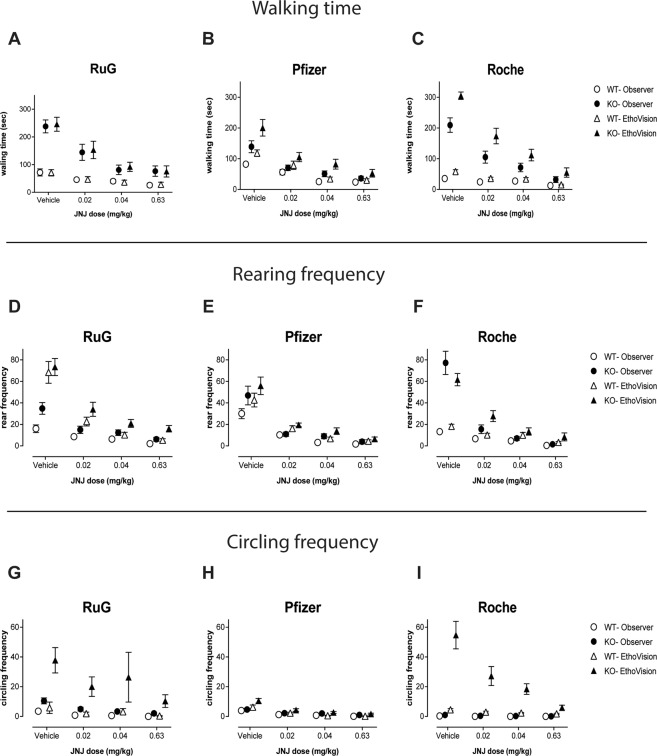
Inconsistent findings between laboratories are hampering scientific progress and are of increasing public concern. Differences in laboratory environment is a known factor contributing to poor reproducibility of findings between research sites, and well-controlled multisite efforts are an important next step to identify the relevant factors needed to reduce variation in study outcome between laboratories. Through harmonization of apparatus, test protocol, and aligned and non-aligned environmental variables, the present study shows that behavioral pharmacological responses in Shank2 knockout (KO) rats, a model of synaptic dysfunction relevant to autism spectrum disorders, were highly replicable across three research centers. All three sites reliably observed a hyperactive and repetitive behavioral phenotype in KO rats compared to their wild-type littermates as well as a dose-dependent phenotype attenuation following acute injections of a selective mGluR1 antagonist. These results show that reproducibility in preclinical studies can be obtained and emphasizes the need for high quality and rigorous methodologies in scientific research. Considering the observed external validity, the present study also suggests mGluR1 as potential target for the treatment of autism spectrum disorders.
实验室之间的结果不一致阻碍了科学的进步,也引起了公众越来越多的关注。实验室环境的差异是导致研究地点之间发现结果不可重现的已知因素,而精心控制的多地点努力是下一步的重要步骤,可以确定减少实验室之间研究结果差异所需的相关因素。通过仪器、测试方案的协调以及环境变量的对齐和不对齐,本研究表明,Shank2 敲除 (KO) 大鼠的行为药理学反应在三个研究中心具有高度可重复性,Shank2 敲除 (KO) 大鼠是一种与自闭症谱系障碍相关的突触功能障碍模型。与野生型同窝仔相比,所有三个地点都可靠地观察到 KO 大鼠表现出过度活跃和重复的行为表型,以及在急性注射选择性 mGluR1 拮抗剂后表型呈剂量依赖性减弱。这些结果表明,可以获得临床前研究的重现性,并强调了科学研究中高质量和严格方法的必要性。考虑到观察到的外部有效性,本研究还表明 mGluR1 可能是治疗自闭症谱系障碍的潜在靶点。