Clinical Experimental Pharmacology Group, Cancer Research UK Manchester Institute, University of Manchester, Alderley Park, SK10 4TG, Macclesfield, UK.
Computational Biology Support, Cancer Research UK Manchester Institute, University of Manchester, Alderley Park, M20 4BX, Macclesfield, UK.
Sci Rep. 2019 Aug 12;9(1):11610. doi: 10.1038/s41598-019-47489-7.
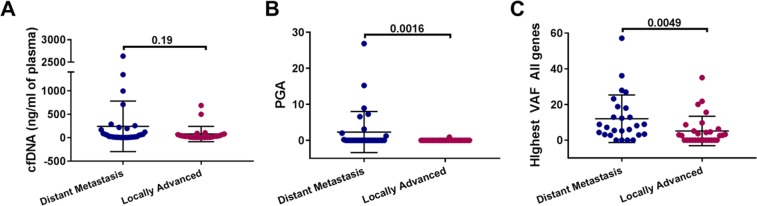
Serial biopsy of pancreatic ductal adenocarcinoma (PDAC), to chart tumour evolution presents a significant challenge. We examined the utility of circulating free DNA (cfDNA) as a minimally invasive approach across a cohort of 55 treatment-naïve patients with PDAC; 31 with metastatic and 24 with locally advanced disease. Somatic mutations in cfDNA were detected using next generation sequencing in 15/24 (62.5%) and 27/31 (87%) of patients with locally advanced and metastatic disease, respectively. Copy number changes were detected in cfDNA of 10 patients of whom 7 exhibited gain of chromosome 12p harbouring KRAS as well as a canonical KRAS codon 12 mutation. In multivariable Cox Regression analysis, we show for the first time that patients with KRAS copy number gain and KRAS mutation have significantly worse outcomes, suggesting that this may be linked to PDAC progression. The simple cfDNA assay we describe will enable determination of the presence of KRAS copy number gain and KRAS mutations in larger studies and clinical trials.
对胰腺导管腺癌 (PDAC) 进行连续活检以绘制肿瘤演变图是一项重大挑战。我们研究了循环游离 DNA (cfDNA) 在 55 名未经治疗的 PDAC 患者队列中的应用,其中 31 名患者患有转移性疾病,24 名患者患有局部晚期疾病。使用下一代测序技术在 24 名局部晚期和 31 名转移性疾病患者中的 15/24(62.5%)和 27/31(87%)中检测到 cfDNA 中的体细胞突变。cfDNA 中检测到 10 名患者存在拷贝数变化,其中 7 名患者显示 12p 染色体获得,其中包含 KRAS 以及经典 KRAS 密码子 12 突变。在多变量 Cox 回归分析中,我们首次表明,具有 KRAS 拷贝数增加和 KRAS 突变的患者预后明显更差,表明这可能与 PDAC 进展有关。我们描述的这种简单的 cfDNA 检测方法将能够在更大的研究和临床试验中确定 KRAS 拷贝数增加和 KRAS 突变的存在。