Department of Pathology, Stanford University School of Medicine, Palo Alto, CA, USA.
Division of Cardiovascular Medicine, Department of Medicine, Brigham and Women's Hospital, Harvard Medical School, Boston, MA, USA.
Nat Rev Cardiol. 2020 Mar;17(3):137-144. doi: 10.1038/s41569-019-0247-5. Epub 2019 Aug 12.
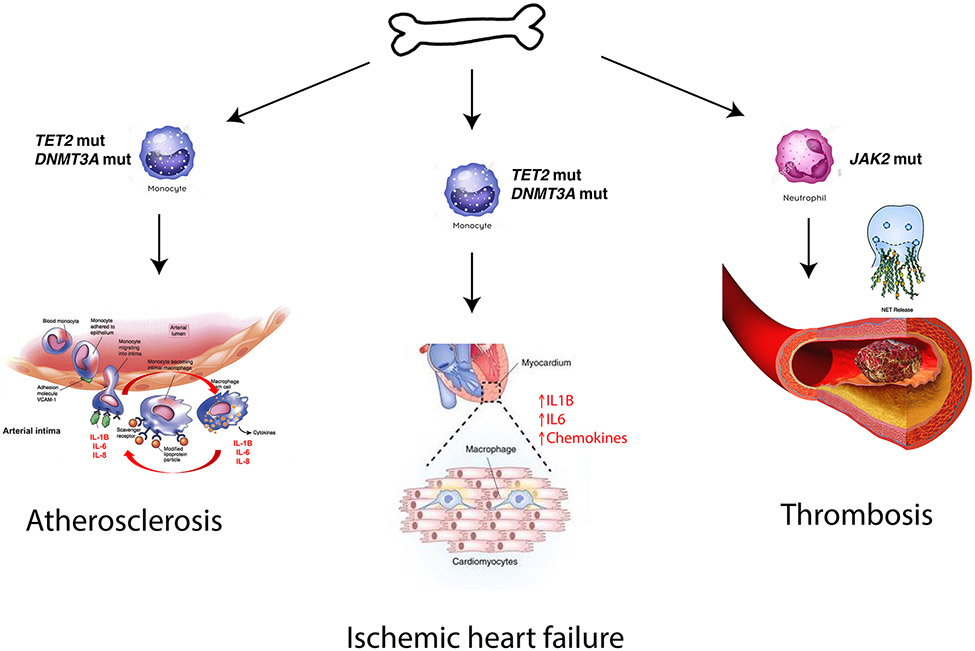
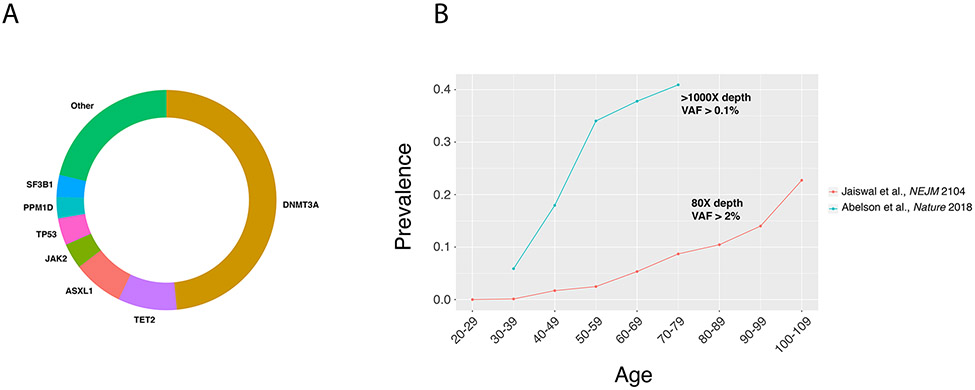
Ageing and inflammation strongly drive the risk of cardiovascular disease. Work over the past decade has uncovered a common condition characterized by the positive selection of certain somatic mutations in haematopoietic stem cells in ageing humans. This phenomenon, known as clonal haematopoiesis of indeterminate potential (CHIP), occurs most commonly as a result of mutations in the transcriptional regulators DNMT3A, TET2 and ASXL1. CHIP is associated with a variety of adverse outcomes, including haematological cancer and death. Surprisingly, CHIP is also associated with a doubling of the risk of atherosclerotic cardiovascular disease. Studies in mice support the causality of this relationship. Mutations in TET2, which are among the most commonly found mutations in CHIP, lead to increased expression of inflammatory genes in innate immune cells, potentially explaining the link between mutations and increased cardiovascular risk. Therapies targeting the mutant clones or the increased inflammatory mediators might be useful for ameliorating the risk of cardiovascular disease. We propose that the mutations leading to clonal haematopoiesis contribute to the increased inflammation seen in ageing and thereby explain some of the age-related risk of cardiovascular disease.
衰老和炎症强烈地增加了心血管疾病的风险。过去十年的研究揭示了一种共同的病症,其特征是在衰老的人类造血干细胞中某些体细胞突变被正向选择。这种现象被称为不确定潜能的克隆性造血(CHIP),最常见的是由于转录调节因子 DNMT3A、TET2 和 ASXL1 的突变引起的。CHIP 与多种不良后果相关,包括血液系统癌症和死亡。令人惊讶的是,CHIP 也与动脉粥样硬化性心血管疾病风险增加一倍相关。在小鼠中的研究支持了这种关系的因果关系。TET2 突变是 CHIP 中最常见的突变之一,导致先天免疫细胞中炎症基因表达增加,这可能解释了突变与心血管风险增加之间的联系。针对突变克隆或增加的炎症介质的治疗可能有助于改善心血管疾病的风险。我们提出,导致克隆性造血的突变导致衰老时炎症增加,从而解释了部分与年龄相关的心血管疾病风险。