Li Shuanhu, Zhou Xin, Duan Qinchun, Niu Shukun, Li Pengquan, Feng Yihan, Zhang Ye, Xu Xuehong, Gong Shou-Ping, Cao Huiling
Key Laboratory of Pharmacodynamics and Material Basis of Chinese Medicine of Shaanxi Administration of Traditional Chinese Medicine, Engineering Research Center of Brain Health Industry of Chinese Medicine, Pharmacology of Chinese Medicine, Shaanxi University of Chinese Medicine, University Government Committee of Shaanxi Province, Xianyang 712046, China.
Xi'an Key Laboratory of Basic and Translation of Cardiovascular Metabolic Disease, Xi'an Key Laboratory of Autoimmune Rheumatic Disease, College of Pharmacy, Xi'an Medical University, Xi'an 710021, China.
Int J Mol Sci. 2025 Apr 1;26(7):3252. doi: 10.3390/ijms26073252.
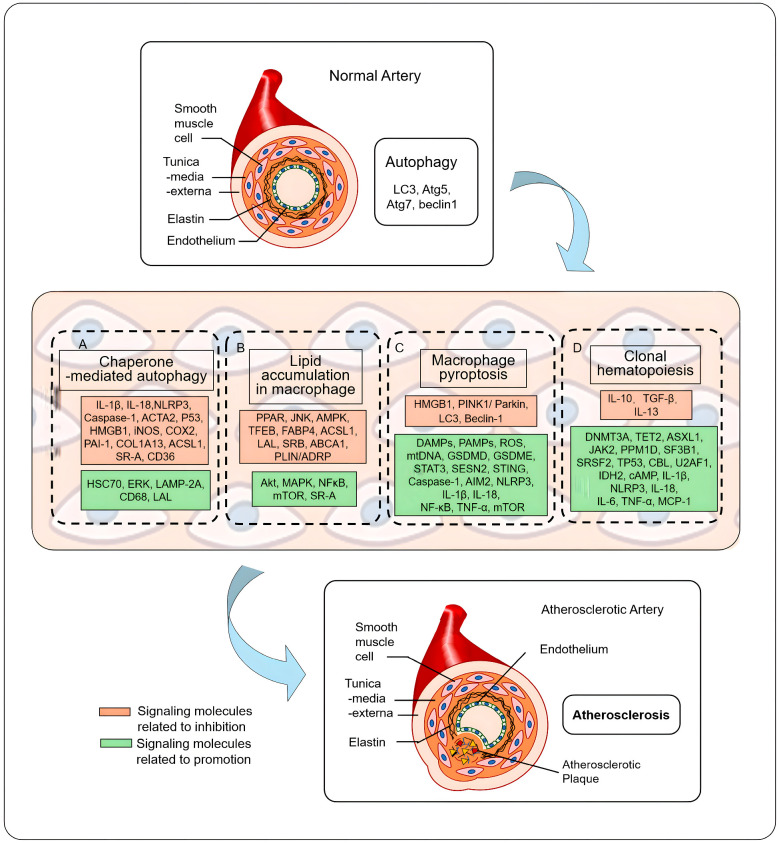
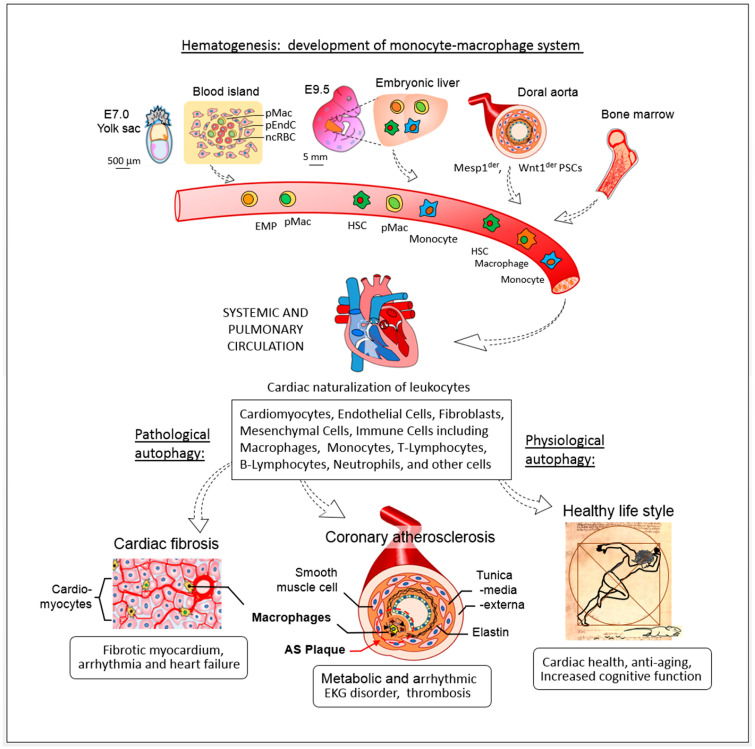
Atherosclerosis, a chronic inflammatory disease characterized by lipid accumulation and immune cell infiltration, is linked to plaque formation and cardiovascular events. While traditionally associated with lipid metabolism and endothelial dysfunction, recent research highlights the roles of autophagy and clonal hematopoiesis (CH) in its pathogenesis. Autophagy, a cellular process crucial for degrading damaged components, regulates macrophage homeostasis and inflammation, both of which are pivotal in atherosclerosis. In macrophages, autophagy influences lipid metabolism, cytokine regulation, and oxidative stress, helping to prevent plaque instability. Defective autophagy exacerbates inflammation, impairs cholesterol efflux, and accelerates disease progression. Additionally, autophagic processes in endothelial cells and smooth muscle cells further contribute to atherosclerotic pathology. Recent studies also emphasize the interplay between autophagy and CH, wherein somatic mutations in genes like , , and drive immune cell expansion and enhance inflammatory responses in atherosclerotic plaques. These mutations modify macrophage function, intensifying the inflammatory environment and accelerating atherosclerosis. Chaperone-mediated autophagy (CMA), a selective form of autophagy, also plays a critical role in regulating macrophage inflammation by degrading pro-inflammatory cytokines and oxidized low-density lipoprotein (ox-LDL). Impaired CMA activity leads to the accumulation of these substrates, activating the NLRP3 inflammasome and worsening inflammation. Preclinical studies suggest that pharmacologically activating CMA may mitigate atherosclerosis progression. In animal models, reduced CMA activity accelerates plaque instability and increases inflammation. This review highlights the importance of autophagic regulation in macrophages, focusing on its role in inflammation, plaque formation, and the contributions of CH. Building upon current advances, we propose a hypothesis in which autophagy, programmed cell death, and clonal hematopoiesis form a critical intrinsic axis that modulates the fundamental functions of macrophages, playing a complex role in the development of atherosclerosis. Understanding these mechanisms offers potential therapeutic strategies targeting autophagy and inflammation to reduce the burden of atherosclerotic cardiovascular disease.
动脉粥样硬化是一种以脂质积聚和免疫细胞浸润为特征的慢性炎症性疾病,与斑块形成和心血管事件相关。虽然传统上认为其与脂质代谢和内皮功能障碍有关,但最近的研究突出了自噬和克隆性造血(CH)在其发病机制中的作用。自噬是一种对降解受损成分至关重要的细胞过程,调节巨噬细胞稳态和炎症,而这两者在动脉粥样硬化中都起着关键作用。在巨噬细胞中,自噬影响脂质代谢、细胞因子调节和氧化应激,有助于防止斑块不稳定。自噬缺陷会加剧炎症、损害胆固醇流出并加速疾病进展。此外,内皮细胞和平滑肌细胞中的自噬过程进一步促成动脉粥样硬化病理。最近的研究还强调了自噬与CH之间的相互作用,其中 、 和 等基因的体细胞突变驱动免疫细胞扩增并增强动脉粥样硬化斑块中的炎症反应。这些突变改变巨噬细胞功能,强化炎症环境并加速动脉粥样硬化。伴侣介导的自噬(CMA)是自噬的一种选择性形式,也通过降解促炎细胞因子和氧化型低密度脂蛋白(ox-LDL)在调节巨噬细胞炎症中起关键作用。CMA活性受损导致这些底物积累,激活NLRP3炎性小体并加重炎症。临床前研究表明,药理学激活CMA可能减轻动脉粥样硬化进展。在动物模型中,CMA活性降低会加速斑块不稳定并增加炎症。本综述强调了巨噬细胞中自噬调节的重要性,重点关注其在炎症、斑块形成以及CH的作用。基于当前的进展,我们提出一个假设,即自噬、程序性细胞死亡和克隆性造血形成一个关键的内在轴,调节巨噬细胞的基本功能,在动脉粥样硬化发展中发挥复杂作用。了解这些机制为靶向自噬和炎症的潜在治疗策略提供了依据,以减轻动脉粥样硬化性心血管疾病的负担。