Rachmawati Meike, Yulianti Herry, Hernowo Bethy S, Suryanti Sri, Wijaya Indra, Rahadiani Nur, Heriyanto Didik S, Irianiwati Irianiwati
Department of Pathology Anatomy, Oncology and Stem Cells Research Centre, Padjadjaran University, Dr Hasan Sadikin Hospital, Bandung, Indonesia.
Department of Pathology Anatomy, Universitas Islam Bandung, Bandung, Indonesia.
Open Access Maced J Med Sci. 2019 Jun 30;7(12):1940-1945. doi: 10.3889/oamjms.2019.549.
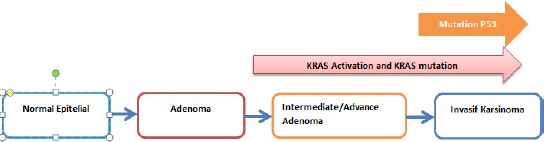
Colorectal Adenocarcinoma (ADCCR) is the third most cancer not only in the world but also in Indonesia. There were 623 cases of ADCCR at Dr Hasan Sadikin hospital within 2015-2017. Both KRAS and TP53 mutation are known as genes which involve in carcinogenesis through the same pathway, namely the chromosomal instability pathway. In West Java, researches focusing on mutation KRAS and p53 also a correlation between both biomarkers among ADCCR patients are still limited.
Therefore, this research aimed to perceive a correlation between KRAS gene expression with p53 immunoexpression in ADCCR.
Cross section research design was performed to 62 cases of ADCCR as paraffin block taken from 4 hospitals in West Java, including Dr Hasan Sadikin hospital Bandung, Santosa hospital Bandung, Borromeus hospital Bandung and Syamsudin hospital Sukabumi from January 1st 2014 to 31s November 2018. KRAS mutation gene data taken from secondary data at molecular laboratory in Ciptomangunkusumo Hospital Jakarta and Dr Sardjito Hospital Jogjakarta, while the detection of p53 immunoexpression data using immunohistochemical staining was carried out in the Laboratorium of Anatomical Pathology of Padjadjaran University (Dr Hasan Sadikin Hospital). All data were analysed using Chi-Square test with p-value < 0,05 of significant level then proceeded with Stata ver.11 for windows.
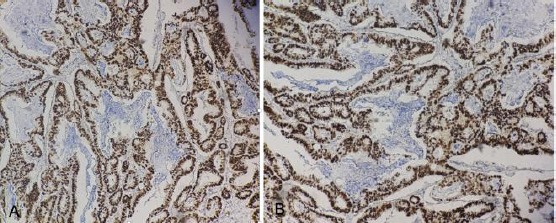
The results of this study showed that KRAS gene expressions from 62 sample consist of 39 wild type KRAS (62.39%) and 23 mutant KRAS (37.1%). The p53 immunoexpression consists of 27 negative cases (non-mutant p53) and 35 mutant p53, which includes 10 cases as focal expression (16.33%) and 25 cases as diffuse expressions (40.33%). There is a significant association between KRAS gene expression and p53 immunoexpressions in ADCCR (p = 0.04), with mild positive correlation (Rho 0.28).
This study concluded that KRAS and p53 mutations are involved in carcinogenesis, and the p53 mutation is a more dominant risk factor than KRAS mutation among West Java people. P53 mutations with diffuse pattern tend to express mutant KRAS while p53 negative and having a focal pattern tend to express wt KRAS.
结直肠癌(ADCCR)不仅是全球第三大癌症,也是印度尼西亚的第三大癌症。2015年至2017年期间,哈桑·萨迪金博士医院有623例ADCCR病例。KRAS和TP53突变均为通过相同途径(即染色体不稳定途径)参与致癌作用的基因。在西爪哇,针对KRAS和p53突变以及ADCCR患者中这两种生物标志物之间相关性的研究仍然有限。
因此,本研究旨在了解ADCCR中KRAS基因表达与p53免疫表达之间的相关性。
对62例ADCCR石蜡块进行横断面研究设计,这些石蜡块取自西爪哇的4家医院,包括万隆的哈桑·萨迪金博士医院、万隆的桑托萨医院、万隆的博罗梅乌斯医院和茂物的西亚姆苏丁医院,时间跨度为2014年1月1日至2018年11月31日。KRAS突变基因数据取自雅加达芝托芒古库苏莫医院和日惹萨迪托博士医院分子实验室的二手数据,而p53免疫表达数据的检测则使用免疫组织化学染色在帕捷贾兰大学解剖病理学实验室(哈桑·萨迪金博士医院)进行。所有数据均使用卡方检验进行分析,显著水平为p值<0.05,然后使用适用于Windows的Stata ver.11继续分析。
本研究结果显示,62个样本的KRAS基因表达包括39个野生型KRAS(62.39%)和23个突变型KRAS(37.1%)。p53免疫表达包括27例阴性病例(非突变型p53)和35例突变型p53,其中10例为局灶性表达(16.33%),25例为弥漫性表达(40.33%)。ADCCR中KRAS基因表达与p53免疫表达之间存在显著关联(p = 0.04),呈轻度正相关(Rho 0.28)。
本研究得出结论,KRAS和p53突变参与致癌作用,在西爪哇人群中,p53突变是比KRAS突变更主要的危险因素。弥漫性模式的p53突变倾向于表达突变型KRAS,而p53阴性且具有局灶性模式的倾向于表达野生型KRAS。