Yabe K, Ando Y, Hamasaki T
National Institute of Animal Health, Tsukuba-Science City, Ibaraki, Japan.
Appl Environ Microbiol. 1988 Aug;54(8):2101-6. doi: 10.1128/aem.54.8.2101-2106.1988.
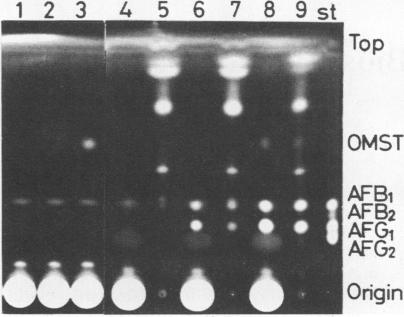
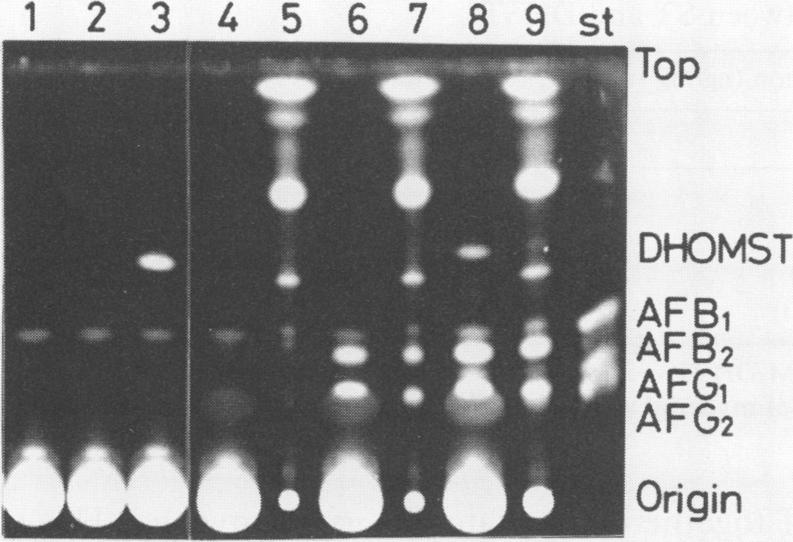
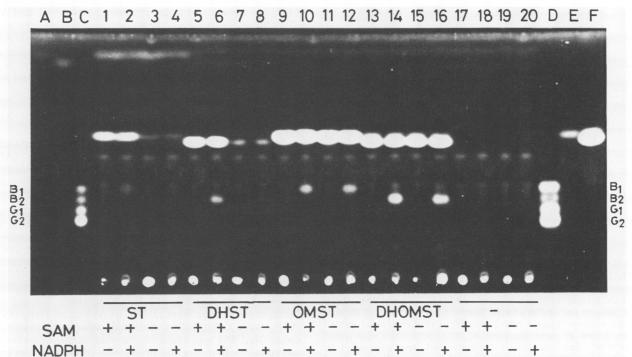
Aspergillus parasiticus NIAH-26, a UV-irradiated mutant of A. parasiticus SYS-4 (NRRL 2999), produces neither aflatoxins nor precursors. When sterigmatocystin (ST) or O-methylsterigmatocystin was fed to this mutant in YES medium, aflatoxins B1 (AFB1) and G1 (AFG1) were produced. When dihydrosterigmatocystin (DHST) or dihydro-O-methylsterigmatocystin was fed to this mold, aflatoxins B2 (AFB2) and G2 (AFG2) were produced. The reactions from ST to AFB1 and DHST to AFB2 were also observed in the cell-free system and were catalyzed stepwise by the methyltransferase and oxidoreductase enzymes. In the feeding experiments of strain NIAH-26, the convertibility from ST to AFB1-AFG1 was found to be remarkably suppressed by the coexistence of DHST in the medium, and the convertibility from DHST to AFB2-AFG2 was also suppressed by the presence of ST. When some other mutants which endogenously produce a small amount of aflatoxins (mainly AFB1 and AFG1) were cultured with DHST, the amounts of AFB1 and AFG1 produced were significantly decreased, whereas AFB2 and AFG2 were newly produced. In similar feeding experiments in which 27 kinds of mutants including these mutants were used, most of the mutants which were able to convert exogenous ST to AFB1-AFG1 were also found to convert exogenous DHST to AFB2-AFG2. These results suggest that the same enzymes may be involved in the both biosynthetic pathways from ST to AFB1-AFG1 and DHST to AFB2-AFG2. The reactions described herein were not observed when the molds had been cultured in the YEP medium.
寄生曲霉NIAH-26是寄生曲霉SYS-4(NRRL 2999)的紫外线辐射突变体,既不产生黄曲霉毒素,也不产生其前体物质。当在酵母提取物蔗糖(YES)培养基中向该突变体添加柄曲霉素(ST)或O-甲基柄曲霉素时,会产生黄曲霉毒素B1(AFB1)和G1(AFG1)。当向该霉菌添加二氢柄曲霉素(DHST)或二氢-O-甲基柄曲霉素时,则会产生黄曲霉毒素B2(AFB2)和G2(AFG2)。在无细胞体系中也观察到了从ST到AFB1以及从DHST到AFB2的反应,这些反应由甲基转移酶和氧化还原酶逐步催化。在菌株NIAH-26的添加实验中,发现培养基中DHST的共存会显著抑制从ST到AFB1-AFG1的转化率,而ST的存在也会抑制从DHST到AFB2-AFG2的转化率。当一些内源性产生少量黄曲霉毒素(主要是AFB1和AFG1)的其他突变体与DHST一起培养时,所产生的AFB1和AFG1的量显著减少,而新产生了AFB2和AFG2。在使用包括这些突变体在内的27种突变体进行的类似添加实验中,还发现大多数能够将外源性ST转化为AFB1-AFG1的突变体也能够将外源性DHST转化为AFB2-AFG2。这些结果表明,从ST到AFB1-AFG1以及从DHST到AFB2-AFG2的两条生物合成途径可能涉及相同的酶。当霉菌在酵母提取物蛋白胨(YEP)培养基中培养时,未观察到本文所述的反应。