IBL, Leiden University, Leiden, The Netherlands.
CIBIO/InBio, Vairão, Portugal.
BMC Genomics. 2019 Aug 13;20(1):645. doi: 10.1186/s12864-019-6013-6.
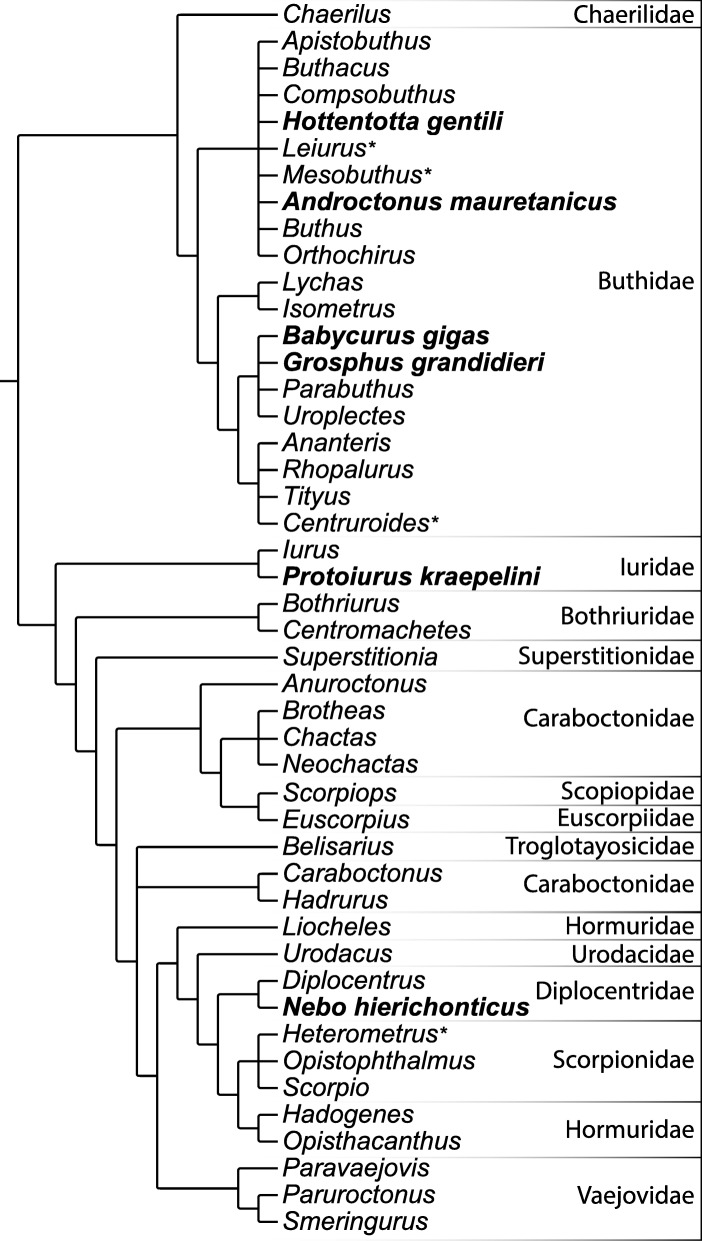
Venom has evolved in parallel in multiple animals for the purpose of self-defense, prey capture or both. These venoms typically consist of highly complex mixtures of toxins: diverse bioactive peptides and/or proteins each with a specific pharmacological activity. Because of their specificity, they can be used as experimental tools to study cell mechanisms and develop novel medicines and drugs. It is therefore potentially valuable to explore the venoms of various animals to characterize their toxins and identify novel toxin-families. This study focuses on the annotation and exploration of the transcriptomes of six scorpion species from three different families. The transcriptomes were annotated with a custom-built automated pipeline, primarily consisting of Basic Local Alignment Search Tool searches against UniProt databases and filter steps based on transcript coverage.
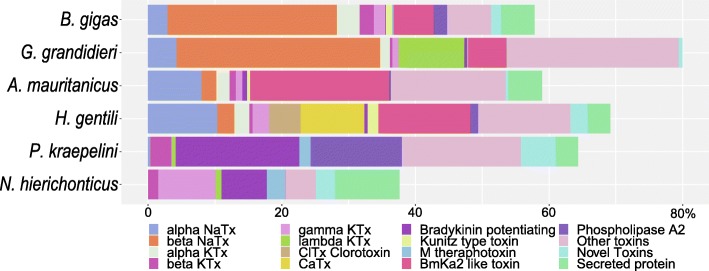
We annotated the transcriptomes of four scorpions from the family Buthidae, one from Iuridae and one from Diplocentridae using our annotation pipeline. We found that the four buthid scorpions primarily produce disulfide-bridged ion-channel targeting toxins, while the non-buthid scorpions have a higher abundance of non-disulfide-bridged toxins. Furthermore, analysis of the "unidentified" transcripts resulted in the discovery of six novel putative toxin families containing a total of 37 novel putative toxins. Additionally, 33 novel toxins in existing toxin-families were found. Lastly, 19 novel putative secreted proteins without toxin-like disulfide bonds were found.
We were able to assign most transcripts to a toxin family and classify the venom composition for all six scorpions. In addition to advancing our fundamental knowledge of scorpion venomics, this study may serve as a starting point for future research by facilitating the identification of the venom composition of scorpions and identifying novel putative toxin families.
毒液在多种动物中为了自卫、捕食或两者兼而有之而进化。这些毒液通常由高度复杂的毒素混合物组成:具有特定药理学活性的各种生物活性肽和/或蛋白质。由于它们的特异性,它们可以用作实验工具来研究细胞机制并开发新的药物和药物。因此,探索各种动物的毒液以表征其毒素并识别新的毒素家族具有潜在价值。本研究重点研究了来自三个不同科的六种蝎子物种的转录组注释和探索。使用定制的自动化管道对转录组进行注释,该管道主要由针对 UniProt 数据库的基本局部比对搜索工具和基于转录覆盖率的过滤步骤组成。
我们使用我们的注释管道注释了来自 Buthidae 家族的四只蝎子、一只来自 Iuridae 家族的蝎子和一只来自 Diplocentridae 家族的蝎子的转录组。我们发现,这四种 Buthidae 蝎子主要产生二硫键桥接的离子通道靶向毒素,而非 Buthidae 蝎子则具有更高丰度的非二硫键桥接毒素。此外,对“未识别”转录本的分析导致发现了六个新的潜在毒素家族,共包含 37 个新的潜在毒素。此外,在现有的毒素家族中发现了 33 种新的毒素。最后,发现了 19 种没有毒素样二硫键的新型潜在分泌蛋白。
我们能够将大多数转录本分配到一个毒素家族,并对所有六种蝎子的毒液成分进行分类。除了推进我们对蝎子毒液组学的基本认识外,这项研究还可以作为未来研究的起点,通过促进蝎子毒液成分的鉴定和识别新的潜在毒素家族,为未来的研究提供便利。