School of Public Administration, Guangxi University, Nanning, Guangxi, China.
Department of City and Regional Planning, University of North Carolina at Chapel Hill, Chapel Hill, USA.
BMC Public Health. 2019 Aug 13;19(1):1093. doi: 10.1186/s12889-019-7416-7.
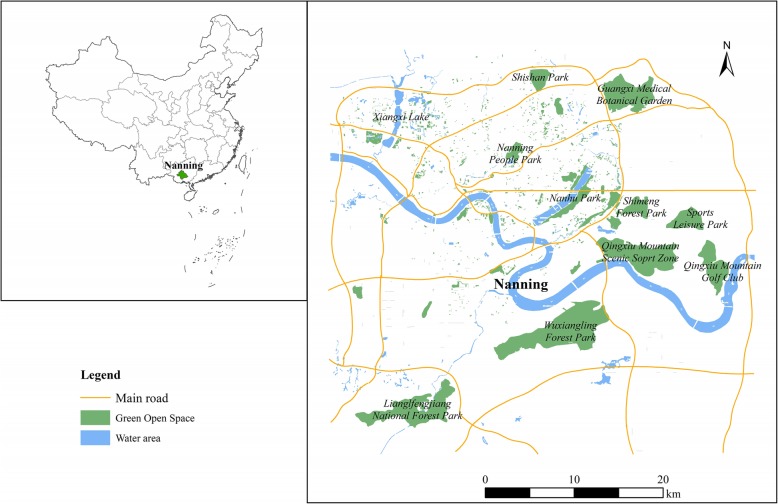
Urban green open space is a valuable resource for physical activities of urban inhabitants and has the potential to reduce chronic illness and improve health. Research on the relationships between green open space and physical activity is incomplete and limited in China. Thus, the study examines how the urban green open space contributes to physical activity.
A questionnaire was designed based on the social ecology theory to investigate the physical activity of 513 residents in urban green open space. We use the time and frequency of residents exercising in urban green space to measure physical activity, and use the factor analysis to synthesize a large number of original factors (i.e., infrastructure, safety, accessibility, landscape quality, and space environment) into relatively few composite indicators. Based on the collected data of the cross-sectional population, the Order Probit regression model was constructed to analyze how urban green open space affects the residents' physical activity from the perspective of social ecology.
① in community factors: accessibility is significantly positive correlation with residents' physical activity, and there is no significant correlation between safety and physical activity; ②in natural factors: space environment and landscape quality are not significantly correlated with residents' physical activity; ③ in built environmental factors: infrastructures, the area of green space, the size of open space, and entertainment facilities are significantly correlated to residents' activity. Basketball courts, volleyball courts, swimming pools, and sports equipment will promote physical activity; ④ apart from the attributes of green open space, other factors are significantly correlated to physical activity in the green open space, e.g. having a companion.
Urban green open space plays an important role in promoting physical activity especially among the women and the old, and improving the attributes (such as accessibility, infrastructures, the area of green space, the size of open space and entertainment facilities) of the urban green open space and trying to set up group sports proper to play with companion (like "square dancing" and "Tai Chi") can promote Chinese residents' physical activity so as to improve public health. The results are significant to facilitate environment health.
城市绿地是城市居民进行体育活动的宝贵资源,具有减少慢性病和改善健康的潜力。关于绿地与体育活动之间关系的研究在中国并不完整且有限。因此,本研究旨在探讨城市绿地如何促进体育活动。
根据社会生态学理论,设计了一份问卷,以调查 513 名城市绿地居民的体育活动情况。我们使用居民在城市绿地中锻炼的时间和频率来衡量体育活动,并使用因子分析将大量原始因素(即基础设施、安全性、可达性、景观质量和空间环境)综合成少数几个综合指标。基于横断面人群收集的数据,构建有序 Probit 回归模型,从社会生态学的角度分析城市绿地如何影响居民的体育活动。
①在社区因素方面:可达性与居民的体育活动呈显著正相关,而安全性与体育活动之间没有显著相关性;②在自然因素方面:空间环境和景观质量与居民的体育活动没有显著相关性;③在建成环境因素方面:基础设施、绿地面积、开放空间大小和娱乐设施与居民的活动呈显著相关。篮球场、排球场、游泳池和体育设备会促进体育活动;④除了绿地的属性外,其他因素与绿地中的体育活动也呈显著相关,例如有同伴陪伴。
城市绿地在促进体育活动方面发挥着重要作用,尤其是对女性和老年人,改善城市绿地的属性(如可达性、基础设施、绿地面积、开放空间大小和娱乐设施),并尝试设置适合与同伴一起进行的团体运动(如“广场舞”和“太极拳”),可以促进中国居民的体育活动,从而改善公众健康。研究结果对促进环境健康具有重要意义。