Malaria Research Program, Center for Vaccine Development and Global Health, University of Maryland School of Medicine, Baltimore, MD, USA.
Malaria Research and Training Center, University of Science, Techniques and Technologies of Bamako, Bamako, Mali.
Malar J. 2019 Aug 13;18(1):273. doi: 10.1186/s12936-019-2905-9.
Plasmodium falciparum erythrocyte membrane protein-1 (PfEMP1) antigens play a critical role in host immune evasion. Serologic responses to these antigens have been associated with protection from clinical malaria, suggesting that antibodies to PfEMP1 antigens may contribute to natural immunity. The first N-terminal constitutive domain in a PfEMP1 is the Duffy binding-like alpha (DBL-α) domain, which contains a 300 to 400 base pair region unique to each particular protein (the DBL-α "tag"). This DBL-α tag has been used as a marker of PfEMP1 diversity and serologic responses in malaria-exposed populations. In this study, using sera from a malaria-endemic region, responses to DBL-α tags were compared to responses to the corresponding entire DBL-α domain (or "parent" domain) coupled with the succeeding cysteine-rich interdomain region (CIDR).
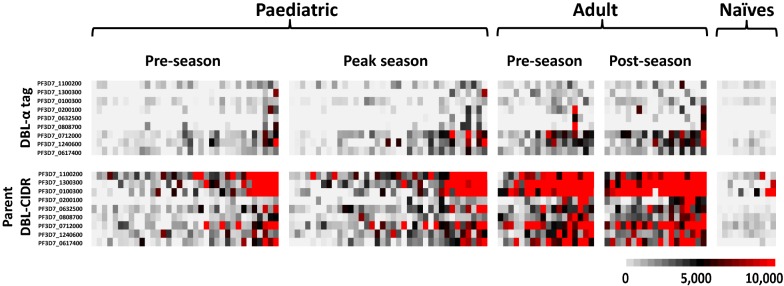
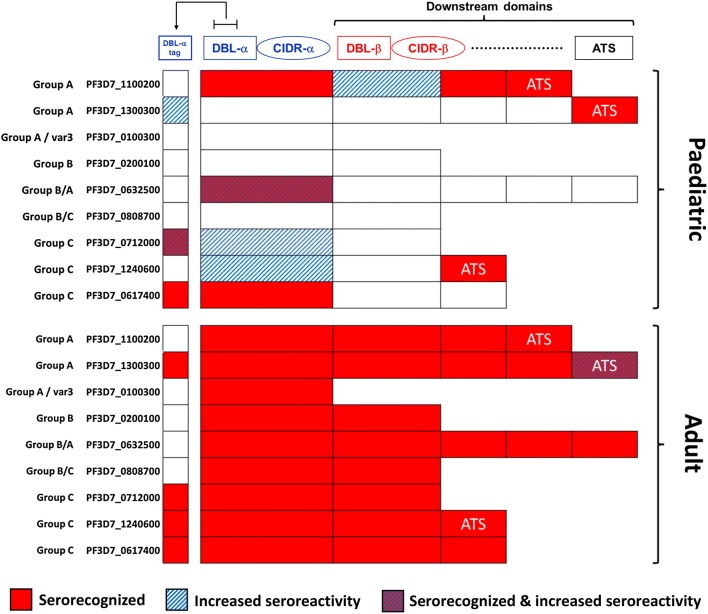
A protein microarray populated with DBL-α tags, the parent DBL-CIDR head structures, and downstream PfEMP1 protein fragments was probed with sera from Malian children (aged 1 to 6 years) and adults from the control arms of apical membrane antigen 1 (AMA1) vaccine clinical trials before and during a malaria transmission season. Serological responses to the DBL-α tag and the DBL-CIDR head structure were measured and compared in children and adults, and throughout the season.
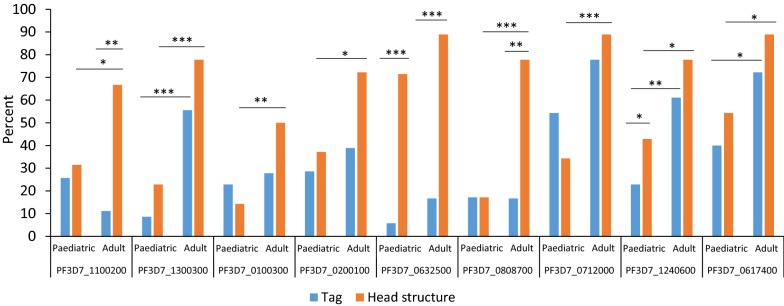
Malian serologic responses to a PfEMP1's DBL-α tag region did not correlate with seasonal malaria exposure, or with responses to the parent DBL-CIDR head structure in either children or adults. Parent DBL-CIDR head structures were better indicators of malaria exposure.
Larger PfEMP1 domains may be better indicators of malaria exposure than short, variable PfEMP1 fragments such as DBL-α tags. PfEMP1 head structures that include conserved sequences appear particularly well suited for study as serologic predictors of malaria exposure.
恶性疟原虫红细胞膜蛋白-1(PfEMP1)抗原在宿主免疫逃避中起着关键作用。针对这些抗原的血清学反应与免受临床疟疾有关,这表明针对 PfEMP1 抗原的抗体可能有助于自然免疫。PfEMP1 的第一个 N 端组成结构域是 Duffy 结合样 alpha(DBL-α)结构域,它包含一个独特的 300 到 400 个碱基对区域,每个特定蛋白都有(DBL-α“标签”)。这个 DBL-α 标签已被用作疟疾暴露人群中 PfEMP1 多样性和血清学反应的标志物。在这项研究中,使用来自疟疾流行地区的血清,比较了对 DBL-α 标签的反应与对相应的整个 DBL-α 结构域(或“父”结构域)以及随后的富含半胱氨酸的结构域间区(CIDR)的反应。
用马里儿童(1 至 6 岁)和对照臂中顶端膜抗原 1(AMA1)疫苗临床试验的成年人的血清探测了一个由 DBL-α 标签、父 DBL-CIDR 头部结构和下游 PfEMP1 蛋白片段组成的蛋白质微阵列。在疟疾传播季节之前和期间,测量并比较了儿童和成年人对 DBL-α 标签和 DBL-CIDR 头部结构的血清学反应,并在整个季节进行比较。
马里人的血清对 PfEMP1 的 DBL-α 标签区域的反应与季节性疟疾暴露无关,也与儿童或成年人对父 DBL-CIDR 头部结构的反应无关。父 DBL-CIDR 头部结构是疟疾暴露的更好指标。
较大的 PfEMP1 结构域可能比短的、可变的 PfEMP1 片段(如 DBL-α 标签)更好地指示疟疾暴露。包含保守序列的 PfEMP1 头部结构特别适合作为疟疾暴露的血清学预测因子进行研究。