Department of Orthopaedics, Shanghai Fengxian District Central Hospital, No. 6600, Nanfeng Highway, Shanghai, 201499 China.
Cell Mol Biol Lett. 2019 Aug 8;24:51. doi: 10.1186/s11658-019-0177-6. eCollection 2019.
MicroRNAs (miRNAs or miRs) serve crucial roles in the progression of osteoporosis. This study investigated the role and specific molecular mechanism of miR-135-5p in regulating osteoblast differentiation and calcification.
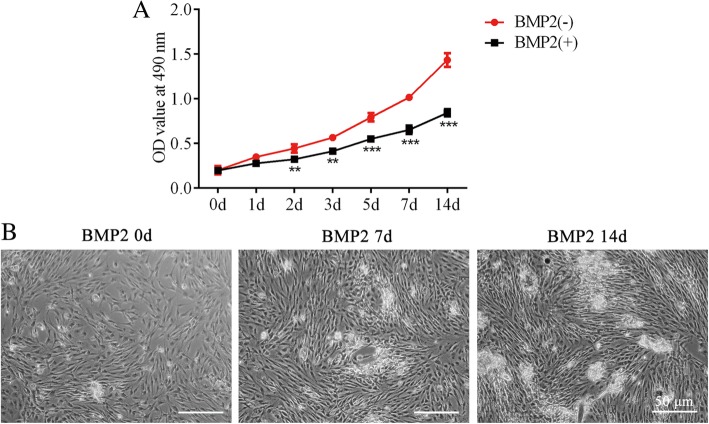
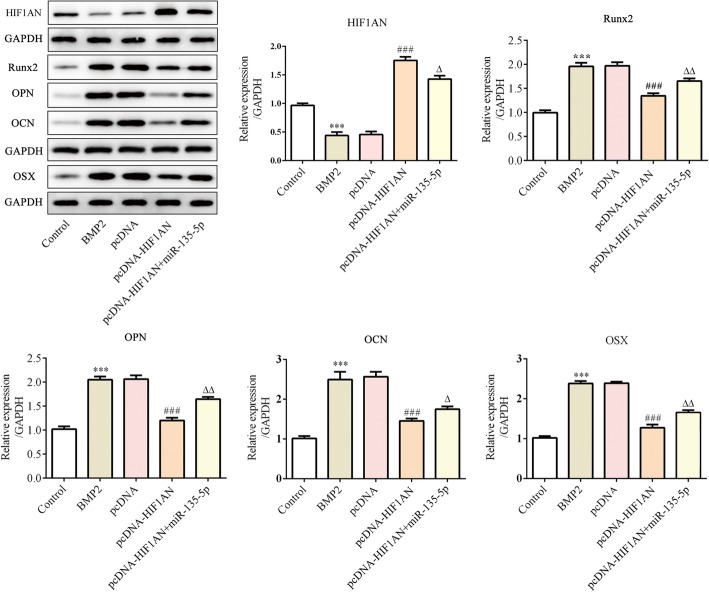
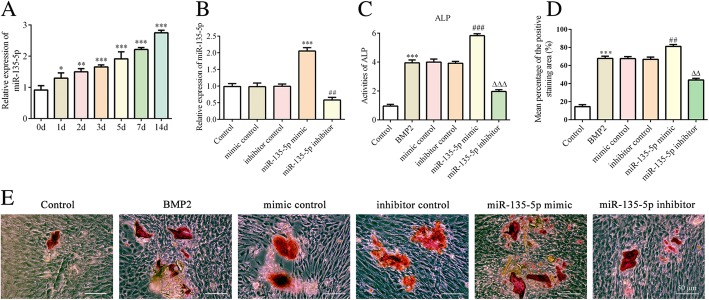
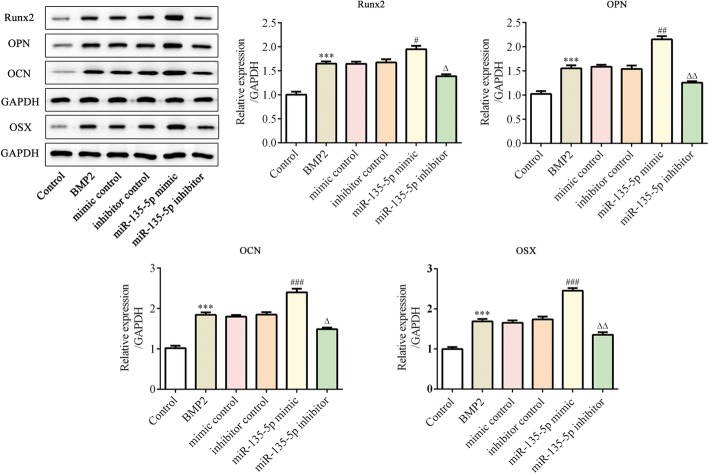
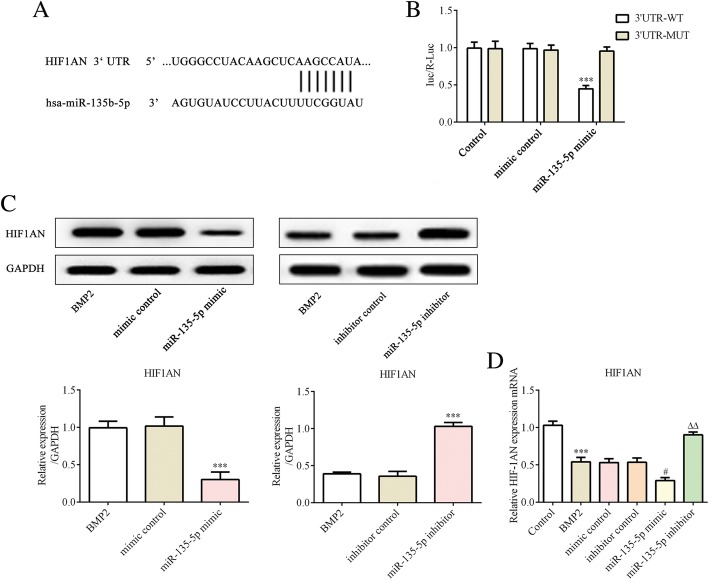
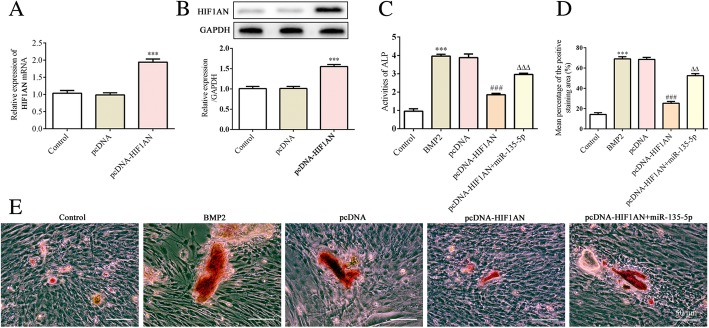
Bone morphogenetic protein 2 (BMP2) was employed to interfere with the differentiation of MC3T3-E1. Then, miR-135-5p mimic or miR-135-5p inhibitor was transfected into MC3T3-E1, and quantitative RT-PCR was used to measure the expression of miR-135-5p. The expressions of runt-related transcription factor 2 (Runx2), osterix (OSX), osteopontin (OPN), and osteocalcin (OCN) were determined using western blot. Alkaline phosphatase (ALP) activity was measured using an appropriate kit assay. Calcium nodule staining was evaluated with alizarin red staining. A luciferase reporter assay was used to verify the target of miR-135-5p. Hypoxia-inducible factor 1 α inhibitor (HIF1AN) overexpression was applied to investigate its own role in the mechanism and a miR-135-5p rescue experiment was also performed.
Overexpression of miR-135-5p promoted osteogenic differentiation and calcification, as shown by the increase in ALP activity, calcification and osteogenic marker levels, including Runx2, OSX, OPN and OCN. Knockdown of miR-135-5p yielded the opposite results. HIF1AN was confirmed as a direct target of miR-135-5p. HIF1AN overexpression inhibited osteogenic differentiation and calcification while miR-135-5p reversed these effects.
These results indicate that miR-135-5p might have a therapeutic application related to its promotion of bone formation through the targeting of HIF1AN.
微小 RNA(miRNA 或 miR)在骨质疏松症的进展中起着至关重要的作用。本研究探讨了 miR-135-5p 在调节成骨细胞分化和钙化中的作用及具体分子机制。
采用骨形态发生蛋白 2(BMP2)干预 MC3T3-E1 的分化。然后,将 miR-135-5p 模拟物或 miR-135-5p 抑制剂转染至 MC3T3-E1,采用定量 RT-PCR 测定 miR-135-5p 的表达。采用 Western blot 测定 runt 相关转录因子 2(Runx2)、osterix(OSX)、骨桥蛋白(OPN)和骨钙素(OCN)的表达。采用适当的试剂盒测定碱性磷酸酶(ALP)活性。采用茜素红染色评估钙结节染色。采用荧光素酶报告基因检测验证 miR-135-5p 的靶基因。应用缺氧诱导因子 1α 抑制剂(HIF1AN)过表达来探讨其在机制中的自身作用,并进行 miR-135-5p 挽救实验。
过表达 miR-135-5p 可增加 ALP 活性、钙化和成骨标志物水平,包括 Runx2、OSX、OPN 和 OCN,从而促进成骨分化和钙化。miR-135-5p 敲低则产生相反的结果。HIF1AN 被证实为 miR-135-5p 的直接靶基因。HIF1AN 过表达抑制成骨分化和钙化,而 miR-135-5p 则逆转这些作用。
这些结果表明,miR-135-5p 可能通过靶向 HIF1AN 促进骨形成而具有治疗应用潜力。