Department of Orthopaedics, Changshu Hospital Affiliated to Nanjing University of Chinese Medicine, Changshu City, Jiangsu Province, China.
Bioengineered. 2021 Dec;12(1):8173-8185. doi: 10.1080/21655979.2021.1977766.
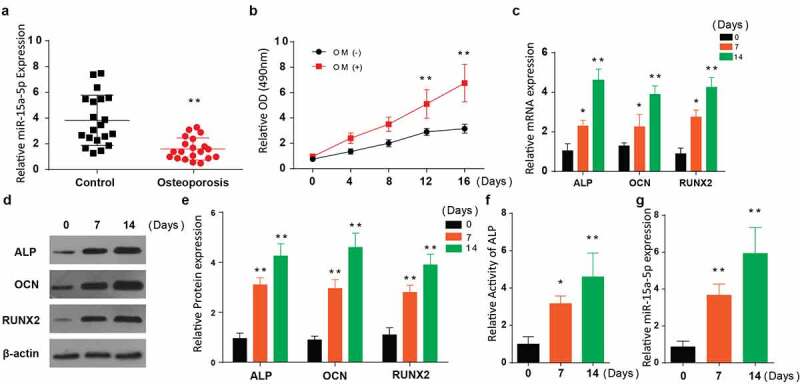
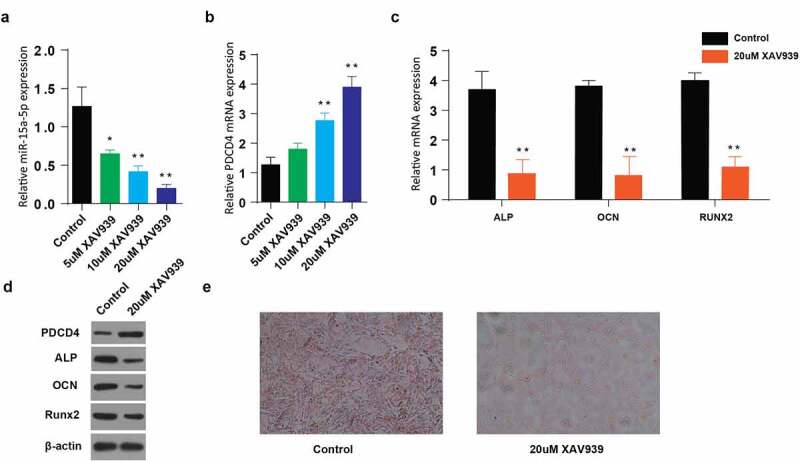
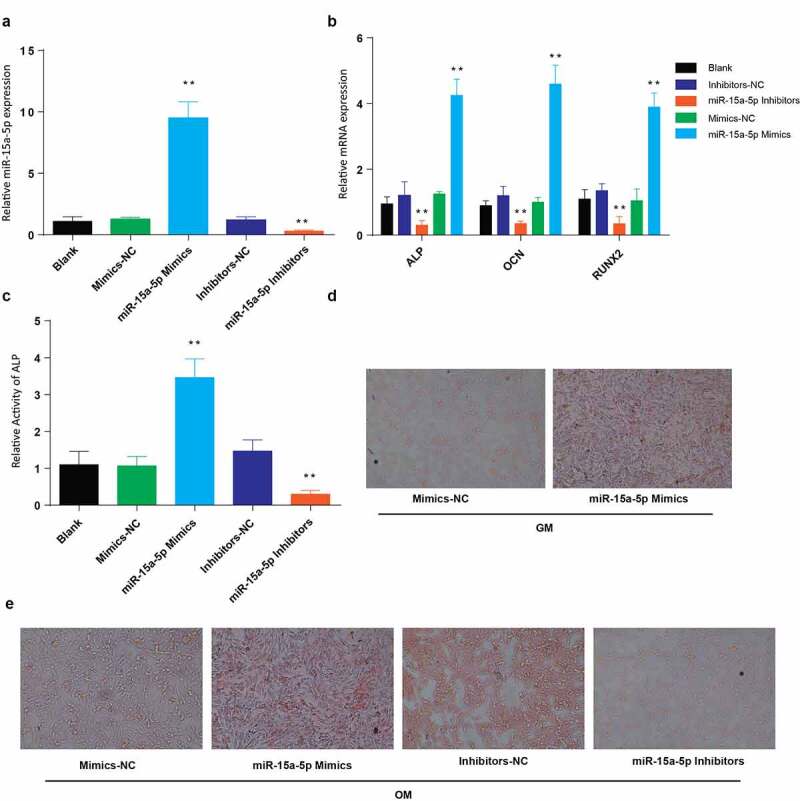
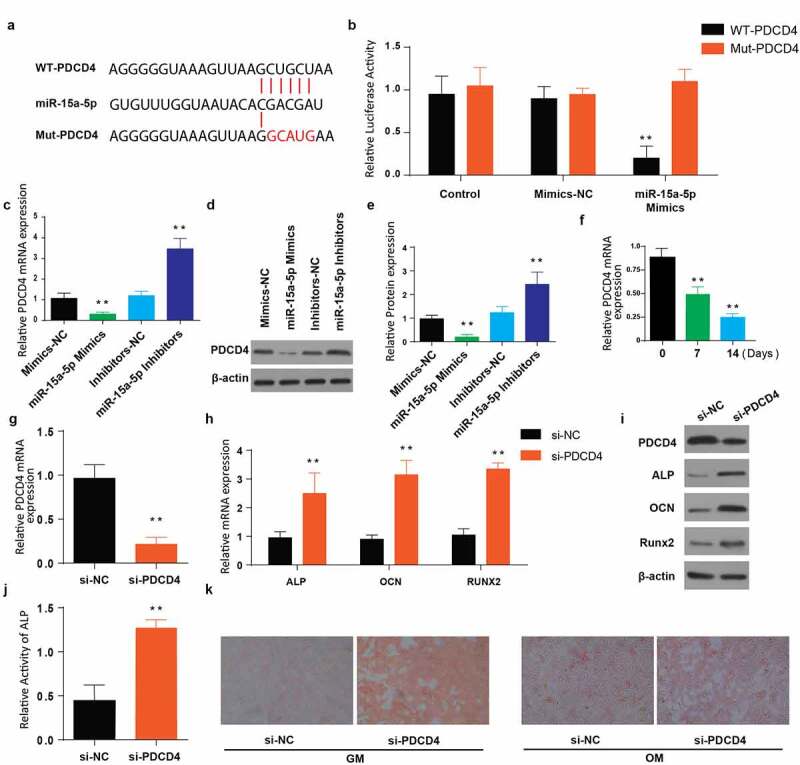
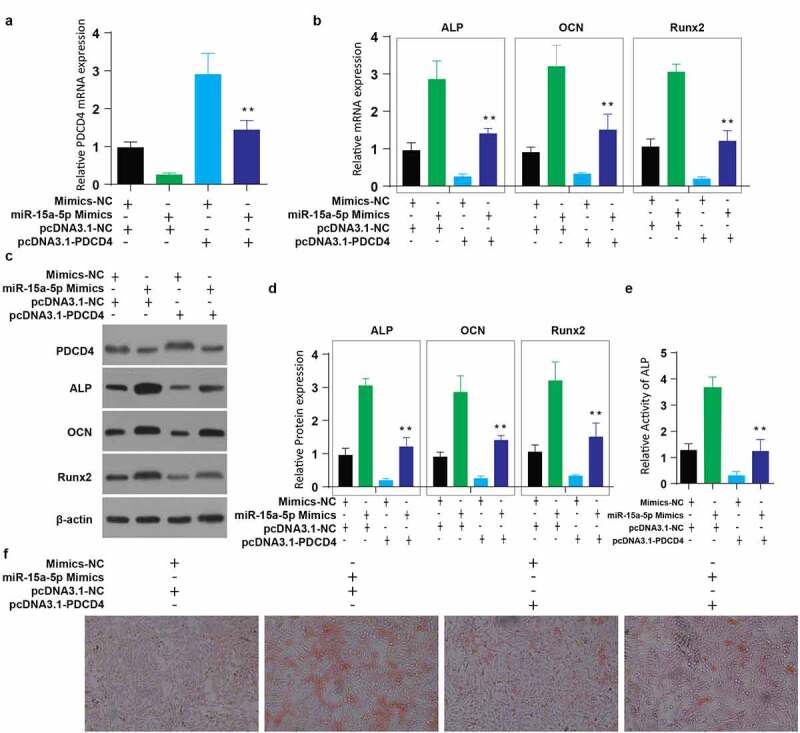
Osteoporosis is defined as a bone condition characterized by bone mass reduction, bone micro-architectural and quality deterioration, leading to compromised strength and increased chances of fracture. Evidence have shown an essential role of microRNAs (miRNAs) in various osteogenic differentiation processes. However, the function of miR-15a-5p in the differentiation of osteogenic cells and possible mechanisms remains unclear. The present study explored the expression of miR-15a-5p in human osteoporosis specimens and during the osteogenic differentiation of MC3T3-E1 cells. Functions of miR-15a-5p were determined using miR-15a-5p mimics and inhibitors. Luciferase assay was used to verify the binding of miR-15a-5p and PDCD4 3'UTR. Alizarin Red Staining (ARS) and Alkaline phosphatase (ALP) activity were used to determine the miR-15a-5p role in osteogenic differentiation. Finally, Wnt pathway inhibitor was used to determine the miR-15a-5p/PDCD4/Wnt signaling pathway in regulating osteogenic differentiation. We found miR-15a-5p expression was increased in human osteoporosis specimens and during differentiation of MC3T3-E1 cells. PDCD4 was also identified as a target of miR-15a-5p and was found to be involved in osteogenic differentiation. Further, miR-15a-5p mimics attenuated the effects of PDCD4 overexpression. Finally, use of XAV939 (Wnt pathway inhibitor) downregulated osteogenic differentiation in miR-15a5p/PDCD4/Wnt-dependent signaling pathway. In conclusion, miR-15a-5p induced differentiation of osteoblasts and mineralization by modulating osteoblast differentiation factors, mainly OSX, ALP, OCN, and RUNX2, by inhibiting PDCD4 and Wnt signaling pathways. This study provides a modality for the future use of miR-15a-5p in the treatment and prevention of osteoporosis.
骨质疏松症被定义为一种以骨量减少、骨微观结构和质量恶化为特征的骨骼疾病,导致骨强度降低和骨折风险增加。有证据表明 microRNAs (miRNAs) 在各种成骨分化过程中起着重要作用。然而,miR-15a-5p 在成骨细胞分化中的功能及其可能的机制尚不清楚。本研究探讨了 miR-15a-5p 在人骨质疏松标本和成骨细胞 MC3T3-E1 分化过程中的表达。通过 miR-15a-5p 模拟物和抑制剂来确定 miR-15a-5p 的功能。荧光素酶报告基因检测用于验证 miR-15a-5p 与 PDCD4 3'UTR 的结合。茜素红染色(ARS)和碱性磷酸酶(ALP)活性用于确定 miR-15a-5p 在成骨分化中的作用。最后,使用 Wnt 通路抑制剂来确定 miR-15a-5p/PDCD4/Wnt 信号通路在调节成骨分化中的作用。我们发现 miR-15a-5p 在人骨质疏松标本和成骨细胞 MC3T3-E1 分化过程中的表达增加。PDCD4 也被确定为 miR-15a-5p 的靶基因,并发现其参与成骨分化。进一步的研究发现,miR-15a-5p 模拟物减弱了 PDCD4 过表达的作用。最后,使用 XAV939(Wnt 通路抑制剂)下调了 miR-15a5p/PDCD4/Wnt 依赖性信号通路中成骨分化。总之,miR-15a-5p 通过抑制 PDCD4 和 Wnt 信号通路,调节成骨分化因子 OSX、ALP、OCN 和 RUNX2,诱导成骨细胞分化和矿化。本研究为 miR-15a-5p 在骨质疏松症的治疗和预防中的未来应用提供了一种新方法。