Drummond Frances J, Reidy Mary, von Wagner Christian, Livingstone Vicki, Drennan Jonathan, Murphy Mike, Fowler Colin, Saab Mohamad M, O'Mahony Mairin, Hegarty Josephine
Health Lit Res Pract. 2019 Jul 19;3(3):e147-e160. doi: 10.3928/24748307-20190430-01. eCollection 2019 Jul.
For cancer prevention information to be effective, it must be accessible to its target populations. Prevalence of inadequate health literacy (HL) is high, but there is a dearth of information on the impact of HL on men's cancer information seeking.
We investigated (1) men's cancer information seeking behaviors, (2) the effect of HL on men's cancer information seeking behavior, and (3) men's preferences for cancer information, considering their HL level. From a national perspective, we investigated men's information seeking behavior from the Irish Cancer Society (ICS), the largest provider of cancer information in Ireland.
Men from adult literacy classes and men's groups were invited to complete a questionnaire. General and ICS-specific cancer information seeking behavior was investigated. Univariate and multivariate logistic regression models were conducted with "ever" seeking cancer information from any source, and actively seeking and passively acquiring ICS information as dependent variables.
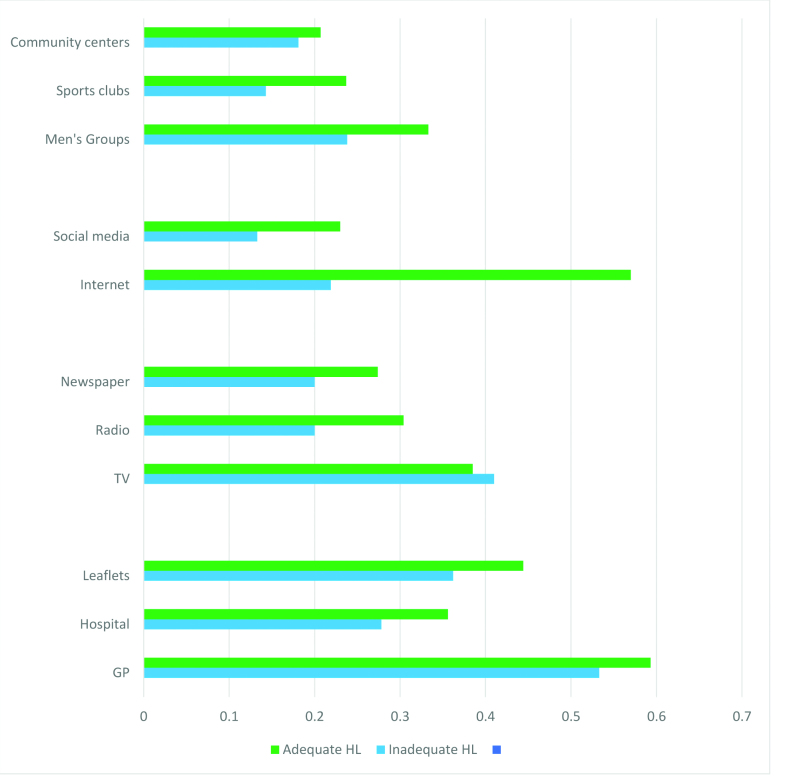
Overall, 259 men completed the questionnaire and 44% had inadequate HL. About one-half of responders reported "ever" actively looking for cancer information. In the study group, 19% actively sought and 67% passively acquired ICS-specific information. In multivariate analysis, the odds of actively seeking (2.93; 95% CI [1.05, 8.15]) or passively acquiring (4.7; 95% CI [1.99, 11.05]) ICS-specific cancer information was significantly higher among those with adequate versus inadequate HL, respectively. HL was not significantly associated with odds of "ever" cancer information seeking in multivariate analysis (odds ratio 1.81; 95% CI [0.90, 3.63]). Men want information about cancer prevention. Suggested future cancer information sources differed by HL levels. General practitioners and the Internet were the preferred source for men with inadequate (53.3%) and adequate HL (57%), respectively.
Men both passively acquire and actively seek cancer prevention information. Multimodal dissemination of cancer prevention information is necessary to reach a wide cross-section of men, including those with inadequate HL. This could potentially lower men's cancer burden and reduce gender inequalities in cancer mortality. .
Most men get cancer prevention information by coming across it passively in their daily lives, instead of actively looking for this information. Men with low health literacy are less likely to obtain cancer information both passively and actively. Men want this information. Organizations need to make this information available in many places and formats (e.g., Internet, doctor, television, sports clubs).
要使癌症预防信息有效,其目标人群必须能够获取这些信息。健康素养(HL)不足的情况很普遍,但关于HL对男性癌症信息寻求行为的影响,相关信息却很匮乏。
我们调查了(1)男性的癌症信息寻求行为,(2)HL对男性癌症信息寻求行为的影响,以及(3)考虑到男性的HL水平,他们对癌症信息的偏好。从全国范围来看,我们调查了男性从爱尔兰癌症协会(ICS)(爱尔兰最大的癌症信息提供者)获取信息的行为。
邀请成人识字班的男性和男性团体成员填写问卷。调查了一般的癌症信息寻求行为以及特定于ICS的癌症信息寻求行为。以“曾经”从任何来源寻求癌症信息,以及主动寻求和被动获取ICS信息作为因变量,进行单变量和多变量逻辑回归模型分析。
总体而言,259名男性完成了问卷,44%的男性HL不足。约一半的受访者表示“曾经”积极寻找癌症信息。在研究组中,19%的人主动寻求,67%的人被动获取特定于ICS的信息。在多变量分析中,HL充足的男性主动寻求(2.93;95%置信区间[1.05, 8.15])或被动获取(4.7;95%置信区间[1.99, 11.05])特定于ICS的癌症信息的几率分别显著高于HL不足的男性。在多变量分析中,HL与“曾经”寻求癌症信息的几率无显著关联(优势比1.81;95%置信区间[0.90, 3.63])。男性希望获得有关癌症预防的信息。建议的未来癌症信息来源因HL水平而异。全科医生和互联网分别是HL不足(53.3%)和HL充足(57%)的男性首选的信息来源。
男性既被动获取又积极寻求癌症预防信息。有必要以多模式传播癌症预防信息,以覆盖广泛的男性群体,包括HL不足的男性。这可能会降低男性的癌症负担,并减少癌症死亡率方面的性别不平等。
大多数男性通过在日常生活中被动接触来获取癌症预防信息,而不是主动寻找这些信息。健康素养低的男性被动和主动获取癌症信息的可能性较小。男性需要这些信息。组织需要在许多地方并以多种形式(如互联网、医生、电视、体育俱乐部)提供这些信息。
