Eating Disorder Unit, Department for Child and Adolescent Psychiatry, Medical University of Vienna, Vienna, Austria.
FernFH Distance Learning University of Applied Sciences, Wr. Neustadt, Austria.
Eur J Public Health. 2020 Feb 1;30(1):179-188. doi: 10.1093/eurpub/ckz130.
Past research has yielded promising results on the effectiveness of Internet-based interventions to prevent eating disorders (EDs) in adolescents, but further information is needed to evaluate the public health impact of their large-scale dissemination. This article used an established framework to systematically review the extent to which indicators of the reach, effectiveness, adoption, implementation and maintenance [cf. Reach-Effectiveness-Adoption-Implementation-Maintenance (RE-AIM)-framework] of universal and targeted online ED prevention programmes are reported in the literature, in order to estimate their future dissemination potential.
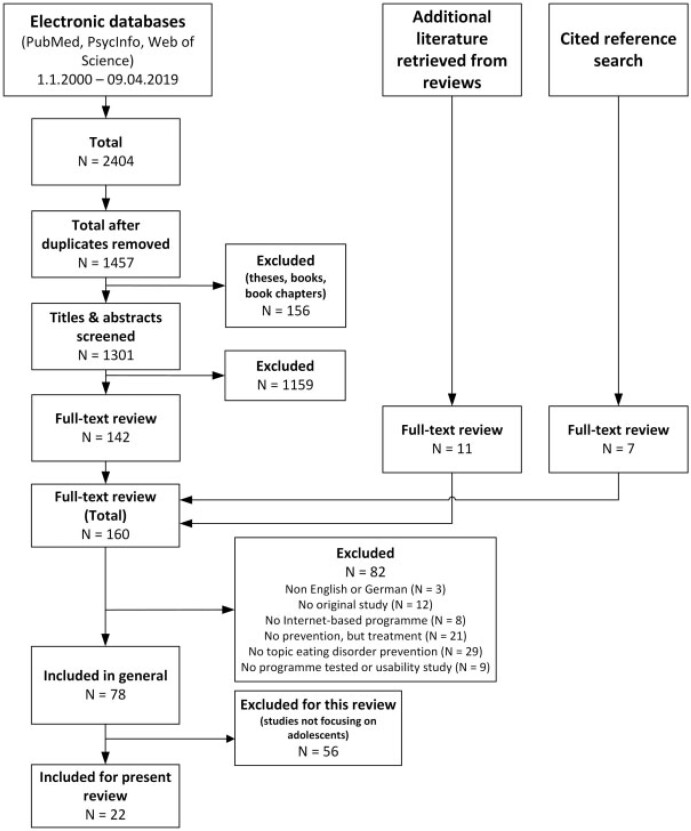
The literature search was conducted on PubMed, Web of Science and PsycINFO, and complemented by searching existing reviews and the reference lists of the studies included. Twenty-two studies published between 2000 and April 2019 met the inclusion criteria. We extracted data on a total of 43 indicators, within RE-AIM dimensions for each article, including qualitative coding of fostering and hindering factors.
Reach (55.0%) and implementation (54.0%) were the dimensions reported on most frequently, followed by effectiveness (46.8%), adoption (34.7%) and maintenance (18.2%). While internal validity indicators were frequently reported (e.g. sample size, effects and intervention intensity), most studies failed to report on elements of external validity, such as representativeness of participants and settings, adoption rates, implementation costs and programme sustainability.
Evidence indicates that Internet-based ED prevention programmes can reach a large number of adolescents and can be feasibly implemented in school settings. However, given the paucity of large-scale dissemination studies available for review, the degree to which schools are willing to adopt preventive interventions, as well as the transferability of programmes to different settings and geographical regions remains unclear.
过去的研究已经在基于互联网的干预措施预防青少年饮食失调症(ED)的有效性方面取得了可喜的成果,但需要进一步的信息来评估其大规模传播的公共卫生影响。本文使用既定框架系统地回顾了普遍性和针对性在线 ED 预防计划的可达性、有效性、采用、实施和维持[参照可达性-有效性-采用-实施-维持(RE-AIM)框架]的指标在文献中报告的程度,以便估计它们未来的传播潜力。
文献检索在 PubMed、Web of Science 和 PsycINFO 上进行,并补充了对现有综述和纳入研究的参考文献列表的搜索。2000 年至 2019 年 4 月期间发表的 22 项研究符合纳入标准。我们共提取了 43 项指标的数据,每项指标均在 RE-AIM 维度内,包括促进和阻碍因素的定性编码。
报告最频繁的维度是可达性(55.0%)和实施(54.0%),其次是有效性(46.8%)、采用(34.7%)和维持(18.2%)。虽然经常报告内部有效性指标(例如样本量、效果和干预强度),但大多数研究未能报告外部有效性的要素,例如参与者和环境的代表性、采用率、实施成本和计划可持续性。
证据表明,基于互联网的 ED 预防计划可以覆盖大量青少年,并且可以在学校环境中可行地实施。然而,鉴于可用于审查的大规模传播研究稀缺,学校愿意采用预防干预措施的程度,以及计划在不同环境和地理区域的可转移性仍然不清楚。