Department of Genetics and Complex Diseases, Harvard T. H. Chan School of Public Health, Boston, United States.
Department of Biomedical Engineering, National Cheng Kung University, Tainan, Taiwan.
Elife. 2019 Aug 14;8:e49158. doi: 10.7554/eLife.49158.
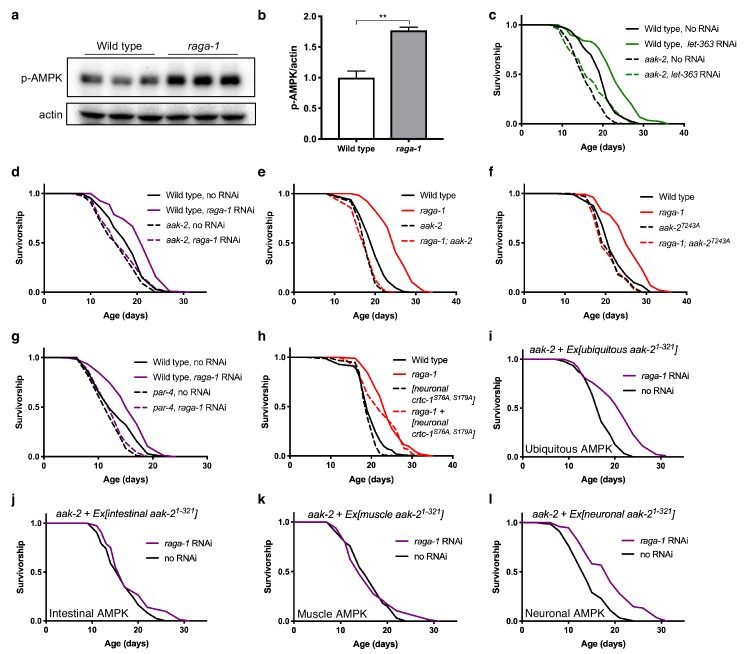
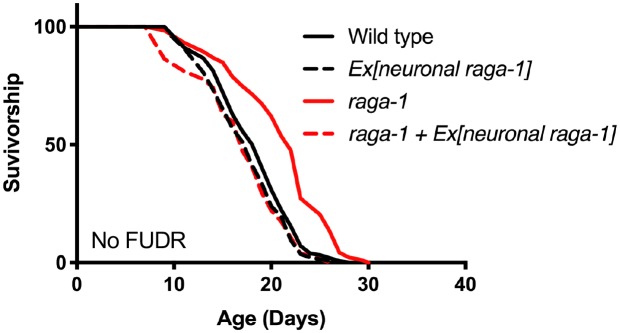
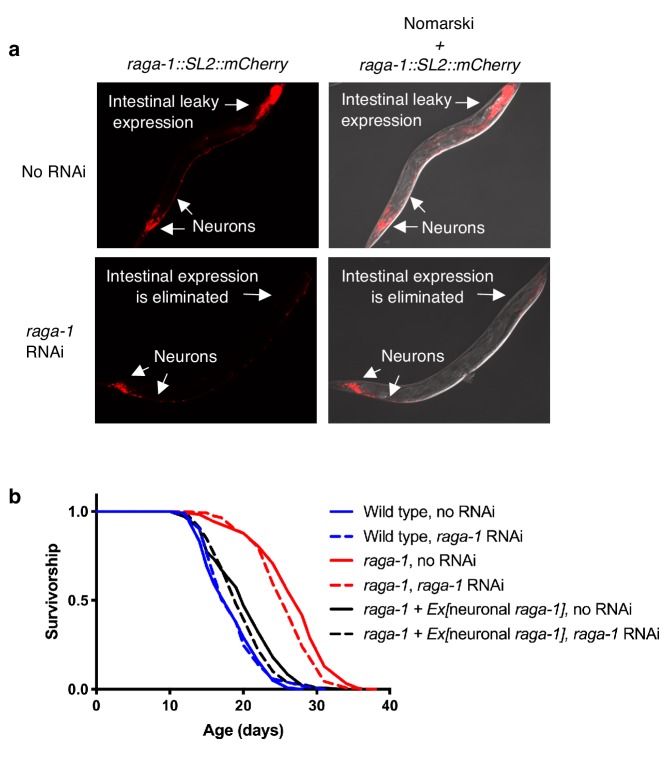
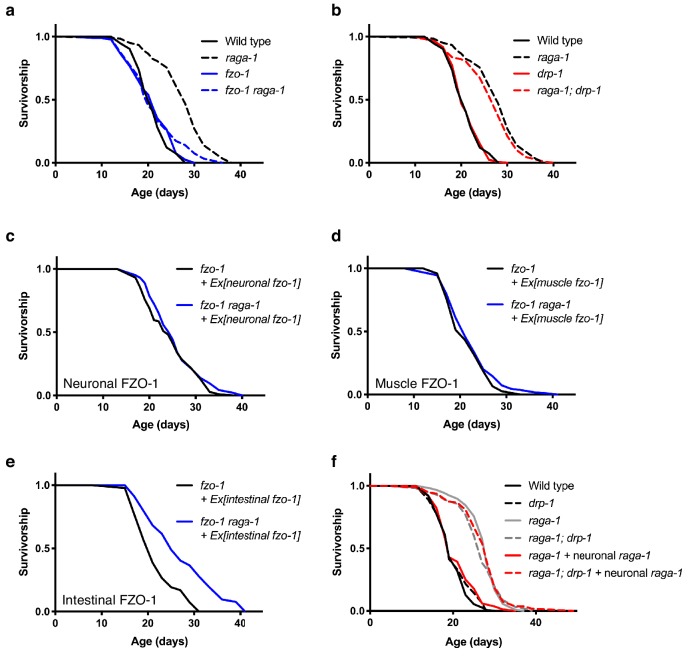
Target of rapamycin complex 1 (TORC1) and AMP-activated protein kinase (AMPK) antagonistically modulate metabolism and aging. However, how they coordinate to determine longevity and if they act via separable mechanisms is unclear. Here, we show that neuronal AMPK is essential for lifespan extension from TORC1 inhibition, and that TORC1 suppression increases lifespan cell non autonomously via distinct mechanisms from global AMPK activation. Lifespan extension by null mutations in genes encoding (RagA) or (S6K) is fully suppressed by neuronal-specific rescues. Loss of RAGA-1 increases lifespan via maintaining mitochondrial fusion. Neuronal RAGA-1 abrogation of mutant longevity requires UNC-64/syntaxin, and promotes mitochondrial fission cell nonautonomously. Finally, deleting the mitochondrial fission factor DRP-1 renders the animal refractory to the pro-aging effects of neuronal RAGA-1. Our results highlight a new role for neuronal TORC1 in cell nonautonomous regulation of longevity, and suggest TORC1 in the central nervous system might be targeted to promote healthy aging.
雷帕霉素靶蛋白复合物 1(TORC1)和 AMP 激活的蛋白激酶(AMPK)拮抗调节代谢和衰老。然而,它们如何协调以确定寿命,以及它们是否通过可分离的机制起作用尚不清楚。在这里,我们表明神经元 AMPK 对于 TORC1 抑制的寿命延长是必不可少的,并且 TORC1 抑制通过与全局 AMPK 激活不同的机制非自主地增加寿命。编码(RagA)或(S6K)的基因缺失突变对寿命的延长作用完全被神经元特异性拯救所抑制。RAGA-1 的缺失通过维持线粒体融合来增加寿命。神经元 RAGA-1 对 突变体寿命的延长作用需要 UNC-64/syntaxin,并促进线粒体裂变非自主地进行。最后,删除线粒体裂变因子 DRP-1 使动物对神经元 RAGA-1 的衰老促进作用产生抗性。我们的研究结果突出了神经元 TORC1 在寿命的非自主调节中的新作用,并表明中枢神经系统中的 TORC1 可能是一个潜在的靶点,以促进健康的衰老。