• 文献检索
  • 文档翻译
  • 深度研究
  • 学术资讯
  • Suppr Zotero 插件Zotero 插件
  • 邀请有礼
  • 套餐&价格
  • 历史记录
应用&插件
Suppr Zotero 插件Zotero 插件浏览器插件Mac 客户端Windows 客户端微信小程序
定价
高级版会员购买积分包购买API积分包
服务
文献检索文档翻译深度研究API 文档MCP 服务
关于我们
关于 Suppr公司介绍联系我们用户协议隐私条款
关注我们

Suppr 超能文献

核心技术专利:CN118964589B侵权必究
粤ICP备2023148730 号-1Suppr @ 2026

文献检索

告别复杂PubMed语法,用中文像聊天一样搜索,搜遍4000万医学文献。AI智能推荐,让科研检索更轻松。

立即免费搜索

文件翻译

保留排版,准确专业,支持PDF/Word/PPT等文件格式,支持 12+语言互译。

免费翻译文档

深度研究

AI帮你快速写综述,25分钟生成高质量综述,智能提取关键信息,辅助科研写作。

立即免费体验

CXCL12 的表达是转移性非精原细胞瘤睾丸生殖细胞肿瘤患者疾病复发的不良预测因子。

CXCL12 expression is an adverse predictor for disease recurrence in patients with metastatic non-seminomatous testicular germ cell tumors.

机构信息

Department of Urology, University Hospital, University of Zurich, Zurich, Switzerland.

Department of Pathology of Molecular Pathology, University Hospital, University of Zurich, Zurich, Switzerland.

出版信息

BMC Cancer. 2019 Aug 14;19(1):802. doi: 10.1186/s12885-019-5961-1.

DOI:10.1186/s12885-019-5961-1
PMID:31412792
原文链接:https://pmc.ncbi.nlm.nih.gov/articles/PMC6693197/
Abstract

BACKGROUND

To validate the utility of the chemokine ligand 12 (CXCL12) as prognostic marker in patients with localized and metastatic germ cell tumors (GCT).

METHODS

CXCL12 expression was analyzed on a tissue microarray consisting of 750 tissue cores of different histological tumor components, Germ cell neoplasia in situ (GCNIS) and adjacent normal tissue of 263 testicular cancer patients using a semi-quantitative score. The association between CXCL12 expression and recurrence-free survival (RFS) as well as overall survival (OS) was assessed using Kaplan-Meier curves with log-rank tests.

RESULTS

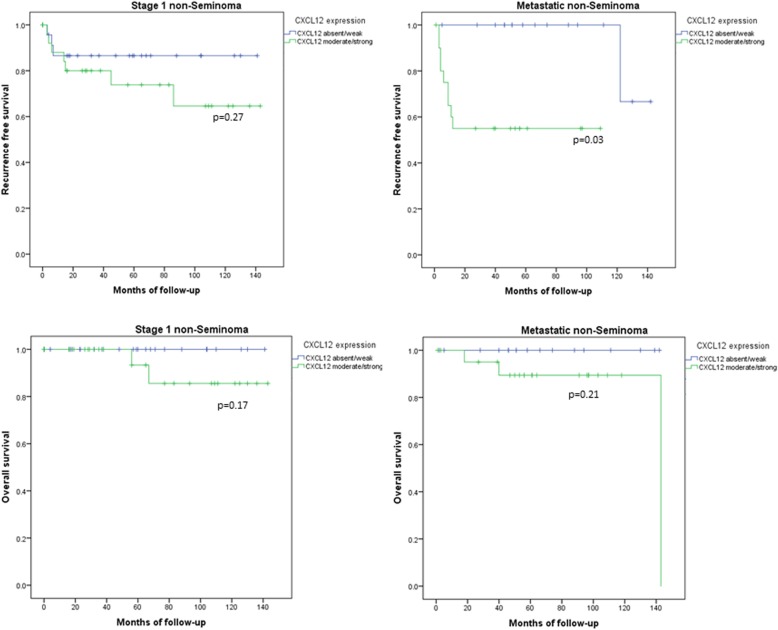
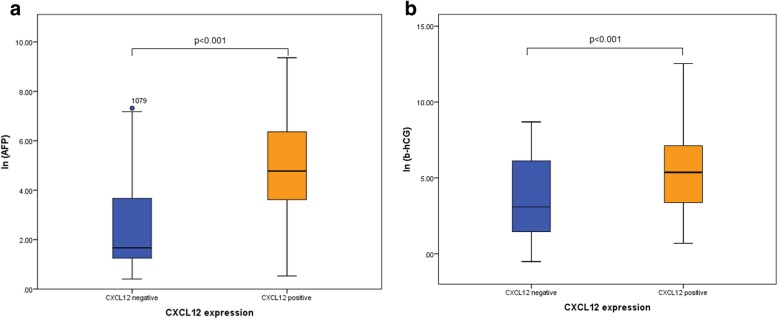
CXCL12 expression was absent in all seminomas but was found in 52 of 99 (52.5%) non-seminomas. Follow-up was available for 260 patients of which 36 (13.8%) recurred. In patients with stage 1 non-seminoma GCT, CXCL12 expression was not associated with higher risk of disease recurrence (p = 0.270). In contrast, post chemotherapy RFS of patients with metastatic non-seminoma and positive CXCL12 expression was significantly shorter compared to CXCL12 negative patients (p = 0.003). OS differences were not statistically different between patients with CXCL12 positive or negative tumors for either localized or metastatic disease.

CONCLUSIONS

CXCL12 is almost exclusively expressed in non-seminoma. Pure seminoma, GCNIS and adjacent normal testicular tissue are CXCL12 negative. Our analysis suggests that patients with metastatic disease and a CXCL12-positive non-seminoma are at higher risk for disease recurrence after first-line chemotherapy and might thus be candidates for more intensive treatment and/or closer follow-up.

摘要

背景

验证趋化因子配体 12(CXCL12)作为局限性和转移性生殖细胞瘤(GCT)患者预后标志物的效用。

方法

使用半定量评分法,对 263 例睾丸癌患者的组织微阵列进行分析,该微阵列包含 750 个不同组织学肿瘤成分、生殖细胞原位肿瘤(GCNIS)和相邻正常组织的组织芯。使用 Kaplan-Meier 曲线和对数秩检验评估 CXCL12 表达与无复发生存(RFS)和总生存(OS)之间的关联。

结果

所有精原细胞瘤均无 CXCL12 表达,但 99 例非精原细胞瘤中有 52 例(52.5%)有 CXCL12 表达。对 260 例患者进行了随访,其中 36 例(13.8%)复发。在 1 期非精原细胞瘤 GCT 患者中,CXCL12 表达与疾病复发风险增加无关(p=0.270)。相比之下,化疗后转移性非精原细胞瘤患者中 CXCL12 阳性患者的 RFS 明显短于 CXCL12 阴性患者(p=0.003)。对于局限性或转移性疾病,CXCL12 阳性或阴性肿瘤的患者 OS 差异无统计学意义。

结论

CXCL12 几乎仅在非精原细胞瘤中表达。纯精原细胞瘤、GCNIS 和相邻正常睾丸组织均为 CXCL12 阴性。我们的分析表明,一线化疗后转移性疾病和 CXCL12 阳性非精原细胞瘤患者疾病复发的风险更高,因此可能是更强化疗和/或更密切随访的候选者。

https://cdn.ncbi.nlm.nih.gov/pmc/blobs/cdc3/6693197/9f8b260c0ef5/12885_2019_5961_Fig3_HTML.jpg
https://cdn.ncbi.nlm.nih.gov/pmc/blobs/cdc3/6693197/efa4e6d555f4/12885_2019_5961_Fig1_HTML.jpg
https://cdn.ncbi.nlm.nih.gov/pmc/blobs/cdc3/6693197/90b096b8d0bc/12885_2019_5961_Fig2_HTML.jpg
https://cdn.ncbi.nlm.nih.gov/pmc/blobs/cdc3/6693197/9f8b260c0ef5/12885_2019_5961_Fig3_HTML.jpg
https://cdn.ncbi.nlm.nih.gov/pmc/blobs/cdc3/6693197/efa4e6d555f4/12885_2019_5961_Fig1_HTML.jpg
https://cdn.ncbi.nlm.nih.gov/pmc/blobs/cdc3/6693197/90b096b8d0bc/12885_2019_5961_Fig2_HTML.jpg
https://cdn.ncbi.nlm.nih.gov/pmc/blobs/cdc3/6693197/9f8b260c0ef5/12885_2019_5961_Fig3_HTML.jpg

相似文献

1
CXCL12 expression is an adverse predictor for disease recurrence in patients with metastatic non-seminomatous testicular germ cell tumors.CXCL12 的表达是转移性非精原细胞瘤睾丸生殖细胞肿瘤患者疾病复发的不良预测因子。
BMC Cancer. 2019 Aug 14;19(1):802. doi: 10.1186/s12885-019-5961-1.
2
Differential expression of preferentially expressed antigen in melanoma (PRAME) in testicular germ cell tumors - A comparative study with SOX17.在睾丸生殖细胞肿瘤中优先表达抗原黑色素瘤(PRAME)的差异表达 - SOX17 的比较研究。
Exp Mol Pathol. 2022 Jun;126:104761. doi: 10.1016/j.yexmp.2022.104761. Epub 2022 Apr 4.
3
Wnt suppressor and stem cell regulator TCF7L1 is a sensitive immunohistochemical marker to differentiate testicular seminoma from non-seminomatous germ cell tumor.Wnt 抑制因子和干细胞调节因子 TCF7L1 是一种敏感的免疫组织化学标志物,可用于区分睾丸精原细胞瘤与非精原细胞瘤生殖细胞肿瘤。
Exp Mol Pathol. 2019 Oct;110:104293. doi: 10.1016/j.yexmp.2019.104293. Epub 2019 Aug 2.
4
Cell-to-cell variation of chromosomal number in the adult testicular germ cell tumors: a comparison of chromosomal instability among histological components and its putative role in tumor progression.成人睾丸生殖细胞肿瘤中染色体数目的细胞间变异:组织学成分间染色体不稳定性的比较及其在肿瘤进展中的潜在作用。
Virchows Arch. 2019 Jun;474(6):711-720. doi: 10.1007/s00428-019-02560-6. Epub 2019 Mar 14.
5
Clinical and biological significance of CXCL12 and CXCR4 expression in adult testes and germ cell tumours of adults and adolescents.CXCL12和CXCR4在成人睾丸以及成人和青少年生殖细胞肿瘤中的表达的临床及生物学意义
J Pathol. 2009 Jan;217(1):94-102. doi: 10.1002/path.2436.
6
Prediction of relapse in stage I testicular germ cell tumor patients on surveillance: investigation of biomarkers.I 期睾丸生殖细胞肿瘤患者监测中复发的预测:生物标志物的研究。
BMC Cancer. 2020 Aug 5;20(1):728. doi: 10.1186/s12885-020-07220-6.
7
Spontaneous regression of testicular germ cell tumors: an analysis of 42 cases.睾丸生殖细胞肿瘤的自发消退:42例病例分析。
Am J Surg Pathol. 2006 Jul;30(7):858-65. doi: 10.1097/01.pas.0000209831.24230.56.
8
Defining a New Prognostic Index for Stage I Nonseminomatous Germ Cell Tumors Using CXCL12 Expression and Proportion of Embryonal Carcinoma.利用CXCL12表达和胚胎性癌比例定义I期非精原性生殖细胞肿瘤的新预后指数
Clin Cancer Res. 2016 Mar 1;22(5):1265-73. doi: 10.1158/1078-0432.CCR-15-1186. Epub 2015 Oct 9.
9
Seminoma component of mixed testicular germ cell tumor shows a higher incidence of loss of heterozygosity than pure-type seminoma.混合性生殖细胞肿瘤中精原细胞瘤成分比单纯型精原细胞瘤更易发生杂合性缺失。
Hum Pathol. 2019 Feb;84:71-80. doi: 10.1016/j.humpath.2018.09.007. Epub 2018 Sep 25.
10
The oncogene Gankyrin is expressed in testicular cancer and contributes to cisplatin sensitivity in embryonal carcinoma cells.癌基因 Gankyrin 在睾丸癌中表达,并有助于胚胎癌细胞对顺铂的敏感性。
BMC Cancer. 2019 Nov 19;19(1):1124. doi: 10.1186/s12885-019-6340-7.

引用本文的文献

1
Interactions of the chemokines CXCL11 and CXCL12 in human tumor cells.趋化因子 CXCL11 和 CXCL12 在人类肿瘤细胞中的相互作用。
BMC Cancer. 2022 Dec 20;22(1):1335. doi: 10.1186/s12885-022-10451-4.
2
Biomarkers of disease recurrence in stage I testicular germ cell tumours.I 期睾丸生殖细胞肿瘤疾病复发的生物标志物。
Nat Rev Urol. 2022 Nov;19(11):637-658. doi: 10.1038/s41585-022-00624-y. Epub 2022 Aug 26.
3
CXCL12 Signaling in the Tumor Microenvironment.CXCL12 信号在肿瘤微环境中的作用。

本文引用的文献

1
Testicular Tumour Size and Rete Testis Invasion as Prognostic Factors for the Risk of Relapse of Clinical Stage I Seminoma Testis Patients Under Surveillance: a Systematic Review by the Testicular Cancer Guidelines Panel.睾丸肿瘤大小及睾丸网浸润作为临床I期睾丸精原细胞瘤监测患者复发风险的预后因素:睾丸癌指南小组的系统评价
Eur Urol. 2018 Mar;73(3):394-405. doi: 10.1016/j.eururo.2017.09.025. Epub 2017 Nov 20.
2
A meta-analysis of CXCL12 expression for cancer prognosis.CXCL12表达与癌症预后的荟萃分析。
Br J Cancer. 2017 Jun 27;117(1):124-135. doi: 10.1038/bjc.2017.134. Epub 2017 May 23.
3
Cancer Statistics, 2017.
Adv Exp Med Biol. 2021;1302:51-70. doi: 10.1007/978-3-030-62658-7_5.
4
Prediction of relapse in stage I testicular germ cell tumor patients on surveillance: investigation of biomarkers.I 期睾丸生殖细胞肿瘤患者监测中复发的预测:生物标志物的研究。
BMC Cancer. 2020 Aug 5;20(1):728. doi: 10.1186/s12885-020-07220-6.
《2017 年癌症统计》
CA Cancer J Clin. 2017 Jan;67(1):7-30. doi: 10.3322/caac.21387. Epub 2017 Jan 5.
4
Late Relapses in Stage I Testicular Cancer Patients on Surveillance.Ⅰ期睾丸癌患者在监测中的晚期复发。
Eur Urol. 2016 Aug;70(2):365-71. doi: 10.1016/j.eururo.2016.03.016. Epub 2016 Mar 17.
5
The 2016 WHO Classification of Tumours of the Urinary System and Male Genital Organs-Part A: Renal, Penile, and Testicular Tumours.《2016 年世界卫生组织泌尿系统及男性生殖器官肿瘤分类—第 A 部分:肾脏、阴茎和睾丸肿瘤》。
Eur Urol. 2016 Jul;70(1):93-105. doi: 10.1016/j.eururo.2016.02.029. Epub 2016 Feb 28.
6
Defining a New Prognostic Index for Stage I Nonseminomatous Germ Cell Tumors Using CXCL12 Expression and Proportion of Embryonal Carcinoma.利用CXCL12表达和胚胎性癌比例定义I期非精原性生殖细胞肿瘤的新预后指数
Clin Cancer Res. 2016 Mar 1;22(5):1265-73. doi: 10.1158/1078-0432.CCR-15-1186. Epub 2015 Oct 9.
7
Guidelines on Testicular Cancer: 2015 Update.睾丸癌诊疗指南:2015 年更新版
Eur Urol. 2015 Dec;68(6):1054-68. doi: 10.1016/j.eururo.2015.07.044. Epub 2015 Aug 18.
8
Testicular Cancer, Version 2.2015.睾丸癌临床实践指南(2015 年第 2 版)
J Natl Compr Canc Netw. 2015 Jun;13(6):772-99. doi: 10.6004/jnccn.2015.0092.
9
Surveillance for stage I nonseminoma testicular cancer: outcomes and long-term follow-up in a population-based cohort.基于人群的队列研究:Ⅰ期非精原细胞瘤睾丸生殖细胞肿瘤的监测:结果和长期随访。
J Clin Oncol. 2014 Dec 1;32(34):3817-23. doi: 10.1200/JCO.2013.53.5831. Epub 2014 Sep 29.
10
Evaluation of a prognostic model for risk of relapse in stage I seminoma surveillance.I期精原细胞瘤监测中复发风险的预后模型评估。
Cancer Med. 2015 Jan;4(1):155-60. doi: 10.1002/cam4.324. Epub 2014 Sep 19.