Division of Rheumatology, Department of Internal Medicine, Konkuk University Medical Center, 120-1 Neungdong-ro, Gwangjin-gu, Seoul, 05030, Republic of Korea.
Division of Rheumatology, Department of Internal Medicine, Seoul St. Mary's Hospital, College of Medicine, The Catholic University of Korea, 222 Banpo-daero, Seocho-gu, Seoul, 06591, Republic of Korea.
Arthritis Res Ther. 2019 Aug 14;21(1):187. doi: 10.1186/s13075-019-1970-3.
The purpose of the present study was to demonstrate whether alcohol consumption could predict spinal structural damage in axial spondyloarthritis (axSpA) in a prospective cohort study.
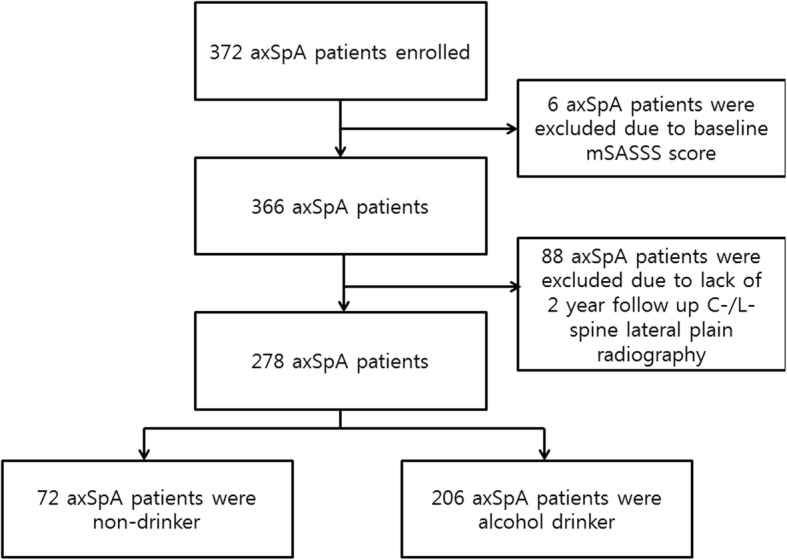
AxSpA patients were enrolled from a single tertiary hospital in a prospective cohort. Baseline data were collected, and 2-year follow-up radiographic data were collected. We analyzed the progression of spinal structural damage in 278 axSpA patients and grouped them into alcohol drinkers and non-drinkers. Baseline and follow-up characteristics were compared between the two groups. Univariable and multivariable logistic regression analyses were performed to reveal predictors of spinal structural damage.
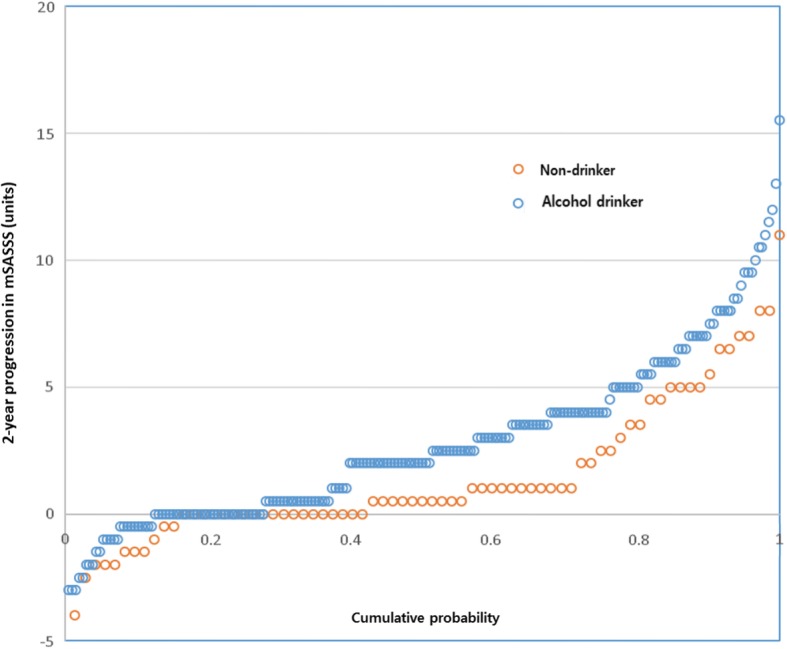
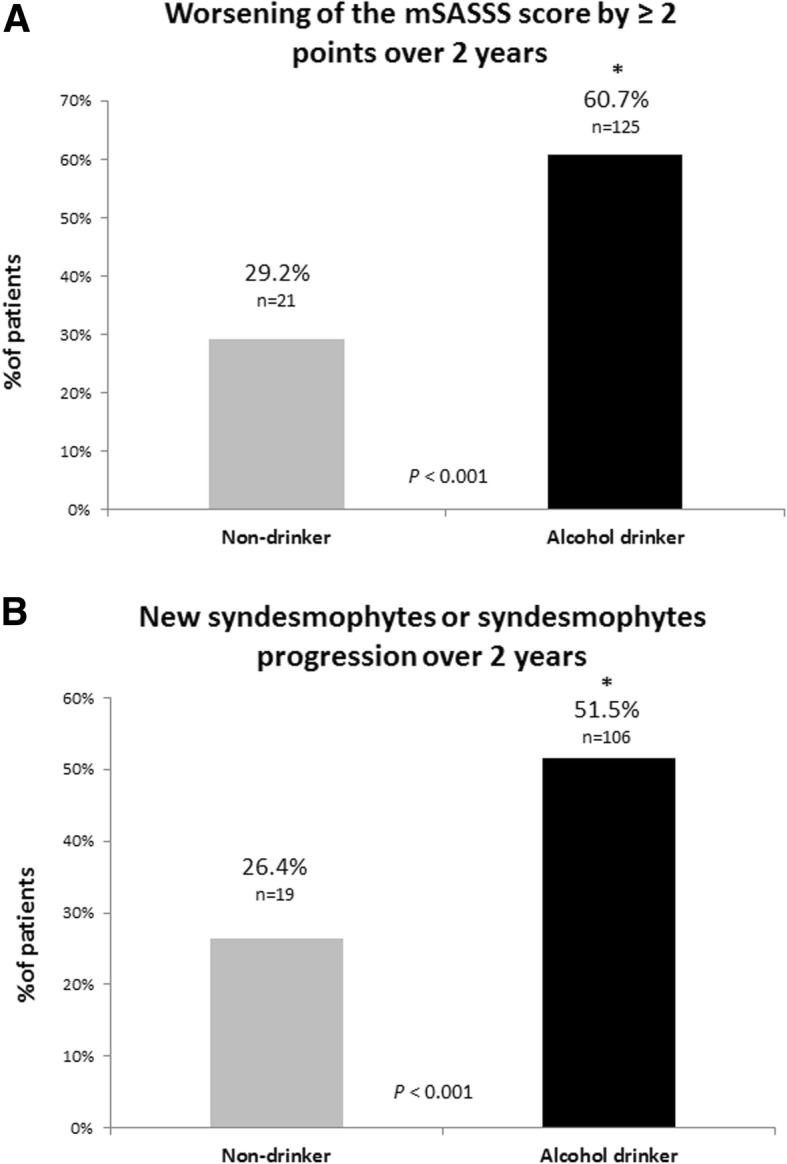
Changes in modified Stoke Ankylosing Spondylitis Spinal Score (mSASSS) and syndesmophyte count over the 2-year period were more prominent in the alcohol drinker group than in the non-drinker group (2.7 ± 3.6 vs 1.5 ± 2.8, P = 0.007, 0.9 ± 1.3 vs 0.4 ± 1.2, P = 0.003). The alcohol drinker group showed more frequent significant mSASSS changes (≥ 2 units for 2 years follow-up) and new syndesmophyte/progression of pre-existing syndesmophytes than the non-drinker group (60.7% vs 29.2%, P < 0.001, 51.5% vs 26.4%, P < 0.001, respectively). On univariable and multivariable regression analyses, drinking alcohol showed a significant relationship with the progression of spinal structural damage for both mSASSS and syndesmophyte progression.
The present study showed the association between alcohol consumption and spinal structural progression in axSpA patients for the first time.
本研究旨在通过前瞻性队列研究证明饮酒是否可预测轴性脊柱关节炎(axSpA)的脊柱结构损伤。
从一家单中心三级医院的前瞻性队列中招募 axSpA 患者。收集基线数据和 2 年随访的影像学数据。我们分析了 278 例 axSpA 患者的脊柱结构损伤进展情况,并将其分为饮酒者和非饮酒者两组。比较两组之间的基线和随访特征。采用单变量和多变量逻辑回归分析揭示脊柱结构损伤的预测因素。
在 2 年期间,与非饮酒者相比,饮酒者的改良 Stoke 强直性脊柱炎脊柱评分(mSASSS)和骨桥计数变化更为明显(2.7±3.6 比 1.5±2.8,P=0.007,0.9±1.3 比 0.4±1.2,P=0.003)。饮酒者更频繁出现显著的 mSASSS 变化(2 年随访时≥2 个单位)和新的骨桥/原有骨桥进展(60.7%比 29.2%,P<0.001,51.5%比 26.4%,P<0.001)。单变量和多变量回归分析显示,饮酒与 mSASSS 和骨桥进展的脊柱结构损伤进展均具有显著相关性。
本研究首次显示了饮酒与 axSpA 患者脊柱结构进展之间的关联。