Wüstner Daniel
Department of Biochemistry and Molecular Biology, VILLUM Center for Bioanalytical Sciences, University of Southern Denmark, Campusvej 55, DK-5230, Odense M, Denmark.
Theor Biol Med Model. 2019 Aug 15;16(1):13. doi: 10.1186/s12976-019-0108-2.
The transbilayer sterol distribution between both plasma membrane (PM) leaflets has long been debated. Recent studies in mammalian cells and in yeast show that the majority of sterol resides in the inner PM leaflet. Since sterol flip-flop in model membranes is rapid and energy-independent, a mechanistic understanding for net enrichment of sterol in one leaflet is lacking. Import of ergosterol in yeast can take place via the ABC transporters Aus1/Pdr11 under anaerobic growth conditions, eventually followed by rapid non-vesicular sterol transport to the endoplasmic reticulum (ER). Little is known about how these transport steps are dynamically coordinated.
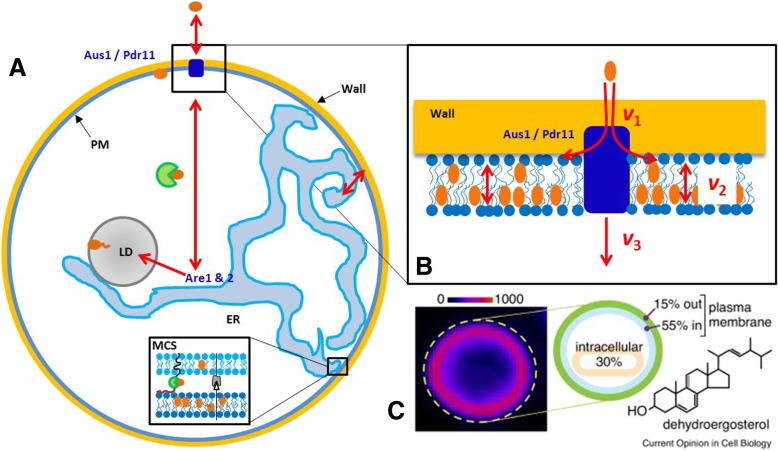
Here, a kinetic steady state model is presented which considers sterol import via Aus1/Pdr11, sterol flip-flop across the PM, bi-molecular complex formation and intracellular sterol release followed by eventual transport to and esterification of sterol in the ER. The steady state flux is calculated, and a thermodynamic analysis of feasibility is presented.
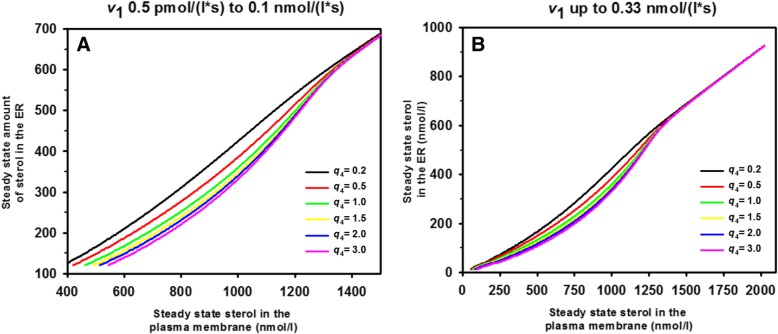
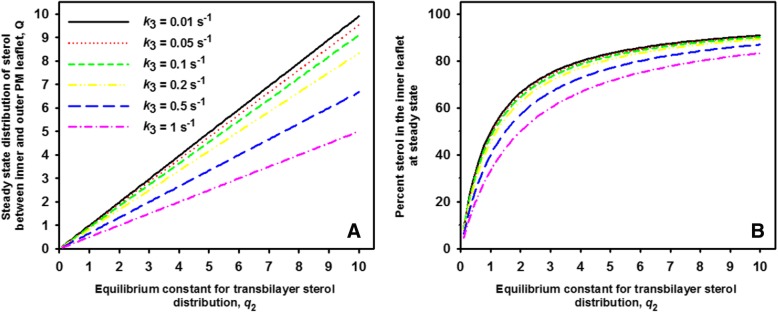
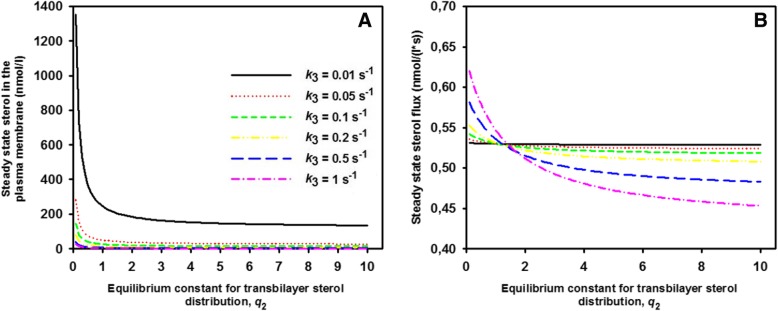
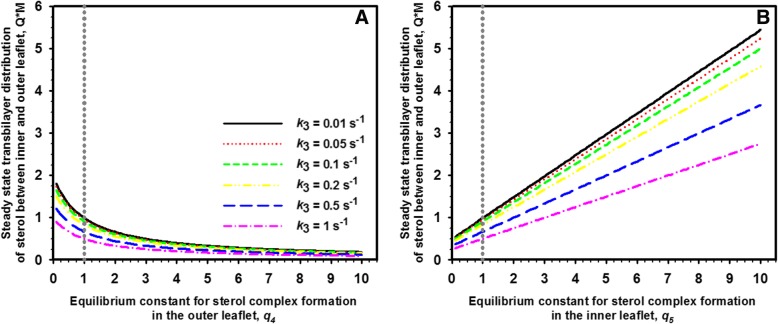
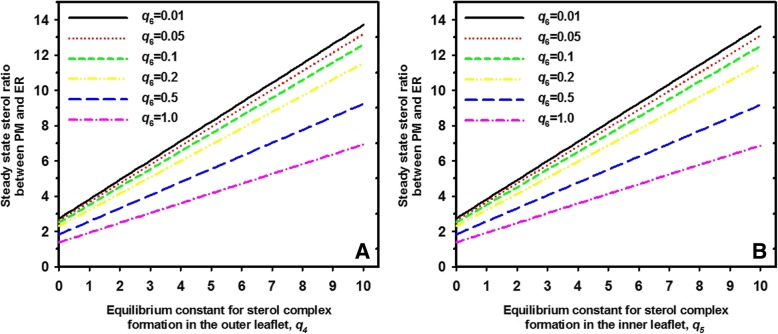
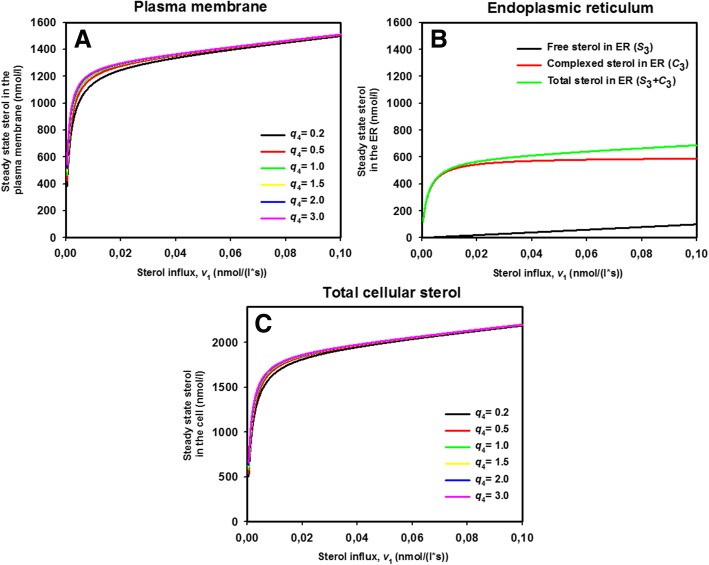
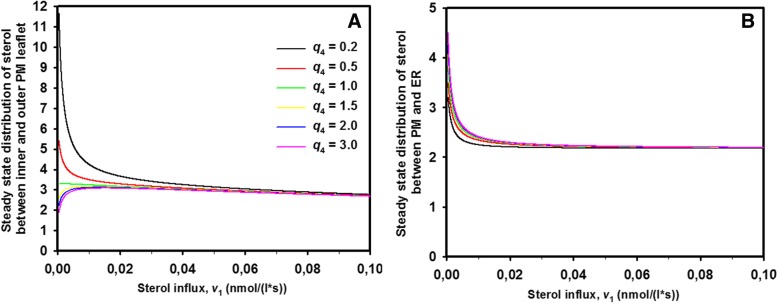
It is shown that the steady state sterol flux across the PM can be entirely controlled by irreversible sterol import via Aus1/Pdr11. The transbilayer sterol flux at steady state is a non-linear function of the chemical potential difference of sterol between both leaflets. Non-vesicular release of sterol on the cytoplasmic side of the PM lowers the attainable sterol enrichment in the inner leaflet. Including complex formation of sterol with phospholipids or proteins can explain several puzzling experimental observations; 1) rapid sterol flip-flop across the PM despite net sterol enrichment in one leaflet, 2) a pronounced steady state sterol gradient between PM and ER despite fast non-vesicular sterol exchange between both compartments and 3) a non-linear dependence of ER sterol on ergosterol abundance in the PM.
A steady state model is presented that can account for the observed sterol asymmetry in the yeast PM, the strong sterol gradient between PM and ER and threshold-like expansion of ER sterol for increasing sterol influx into the PM. The model also provides new insight into selective uptake of cholesterol and its homeostasis in mammalian cells, and it provides testable predictions for future experiments.
长期以来,质膜(PM)两个小叶之间的跨膜甾醇分布一直存在争议。最近在哺乳动物细胞和酵母中的研究表明,大多数甾醇存在于质膜内小叶中。由于甾醇在模型膜中的翻转是快速且不依赖能量的,因此缺乏对甾醇在一个小叶中净富集的机制理解。在厌氧生长条件下,酵母中的麦角甾醇可以通过ABC转运蛋白Aus1/Pdr11导入,最终快速非囊泡甾醇转运至内质网(ER)。对于这些转运步骤如何动态协调知之甚少。
本文提出了一个动力学稳态模型,该模型考虑了通过Aus1/Pdr11的甾醇导入、跨质膜的甾醇翻转、双分子复合物形成以及细胞内甾醇释放,随后最终将甾醇转运至内质网并在内质网中进行酯化。计算了稳态通量,并进行了可行性的热力学分析。
结果表明,跨质膜的稳态甾醇通量可以完全由通过Aus1/Pdr11的不可逆甾醇导入控制。稳态下的跨膜甾醇通量是两个小叶之间甾醇化学势差的非线性函数。质膜细胞质侧甾醇的非囊泡释放降低了内小叶中可达到的甾醇富集。包括甾醇与磷脂或蛋白质的复合物形成可以解释几个令人困惑的实验观察结果;1)尽管甾醇在一个小叶中净富集,但甾醇仍能快速跨质膜翻转;2)尽管两个区室之间存在快速的非囊泡甾醇交换,但质膜和内质网之间仍存在明显的稳态甾醇梯度;3)内质网甾醇对质膜中麦角甾醇丰度的非线性依赖性。
提出了一个稳态模型,该模型可以解释酵母质膜中观察到的甾醇不对称性、质膜和内质网之间强烈的甾醇梯度以及内质网甾醇随进入质膜的甾醇流入增加而出现的阈值样扩张。该模型还为哺乳动物细胞中胆固醇的选择性摄取及其稳态提供了新的见解,并为未来的实验提供了可检验的预测。