Division of Neurology and Program in Genetics and Genome Biology, The Hospital for Sick Children, Toronto, ON M5G 0A4, Canada.
Department of Molecular Genetics, University of Toronto, Toronto, ON M5S 1A8, Canada.
Dis Model Mech. 2019 Aug 13;12(8):dmm038174. doi: 10.1242/dmm.038174.
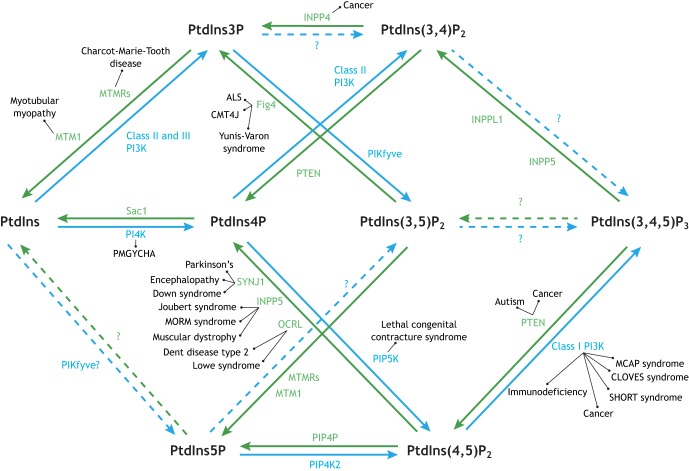
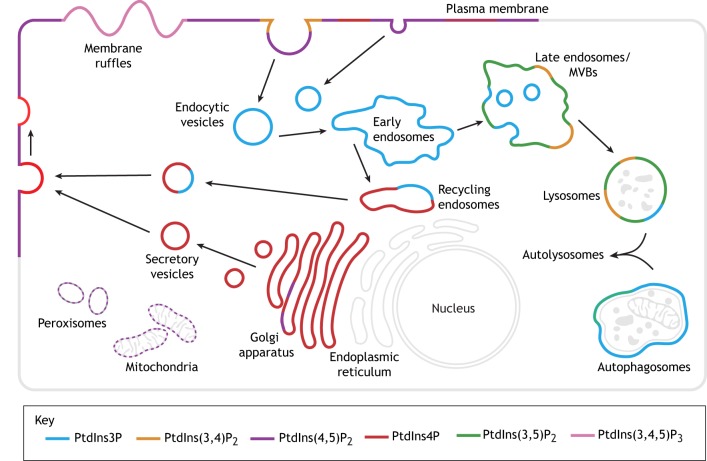
Phosphoinositides (PIPs) are a ubiquitous group of seven low-abundance phospholipids that play a crucial role in defining localized membrane properties and that regulate myriad cellular processes, including cytoskeletal remodeling, cell signaling cascades, ion channel activity and membrane traffic. PIP homeostasis is tightly regulated by numerous inositol kinases and phosphatases, which phosphorylate and dephosphorylate distinct PIP species. The importance of these phospholipids, and of the enzymes that regulate them, is increasingly being recognized, with the identification of human neurological disorders that are caused by mutations in PIP-modulating enzymes. Genetic disorders of PIP metabolism include forms of epilepsy, neurodegenerative disease, brain malformation syndromes, peripheral neuropathy and congenital myopathy. In this Review, we provide an overview of PIP function and regulation, delineate the disorders associated with mutations in genes that modulate or utilize PIPs, and discuss what is understood about gene function and disease pathogenesis as established through animal models of these diseases.
磷脂酰肌醇(PIPs)是一组普遍存在的低丰度磷脂,在定义局部膜性质和调节众多细胞过程中起着至关重要的作用,包括细胞骨架重塑、细胞信号级联、离子通道活性和膜运输。许多肌醇激酶和磷酸酶严格调节 PIP 稳态,它们磷酸化和去磷酸化不同的 PIP 物种。这些磷脂以及调节它们的酶的重要性越来越受到重视,因为已经发现了由 PIP 调节酶突变引起的人类神经紊乱疾病。PIP 代谢的遗传疾病包括癫痫、神经退行性疾病、脑畸形综合征、周围神经病和先天性肌病等形式。在这篇综述中,我们概述了 PIP 的功能和调节,描述了与调节或利用 PIPs 的基因突变相关的疾病,并讨论了通过这些疾病的动物模型所了解的基因功能和疾病发病机制。