He Lingjuan, Li Yinyan, Huang Xin, Cheng Hongqiang, Ke Yuehai, Wang Linrun
Department of Pharmacy, The First Affiliated Hospital, College of Medicine, Zhejiang University, Hangzhou 310000, Zhejiang, People's Republic of China.
Department of Pathology and Pathophysiology, Program in Molecular Cell Biology, Zhejiang University School of Medicine, Hangzhou 310058, People's Republic of China.
Onco Targets Ther. 2019 Jul 22;12:5897-5906. doi: 10.2147/OTT.S210223. eCollection 2019.
We previously reported that Hook1 inhibits the phosphatase activity of SHP2 in the regulation of the epithelial-mesenchymal transition (EMT) in lung cancer. In this study, we performed a comprehensive analysis of SHP2 and Hook1 expression and relationships with the prognosis of patients with non-small cell lung cancer (NSCLC).
A total of 121 patients with NSCLC were included in this study. Expression of SHP2 and Hook1 was assessed by immunohistochemistry and Western blot analysis. The overall survival rate of NSCLC patients was analysed using Cox's ratio hazard multivariate analysis and the log-rank test.
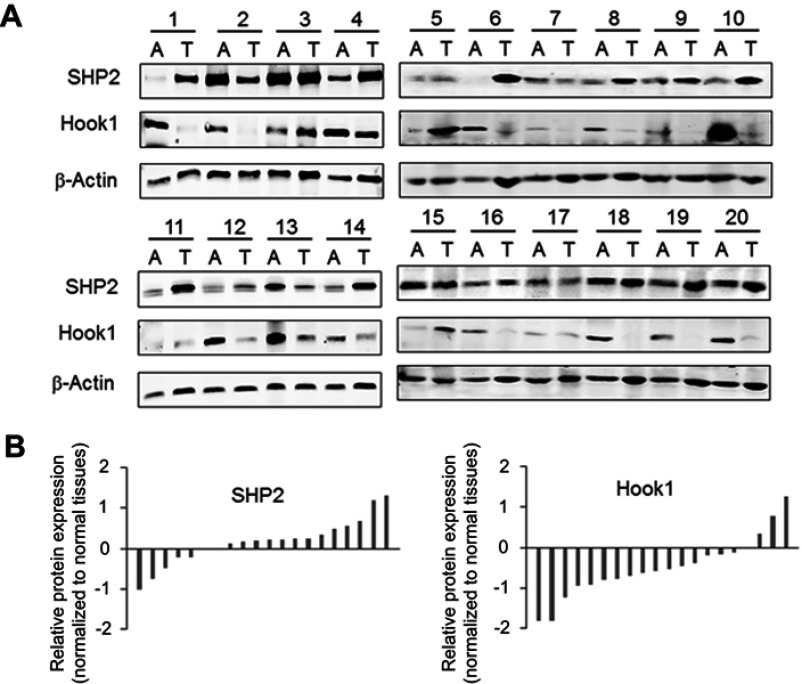
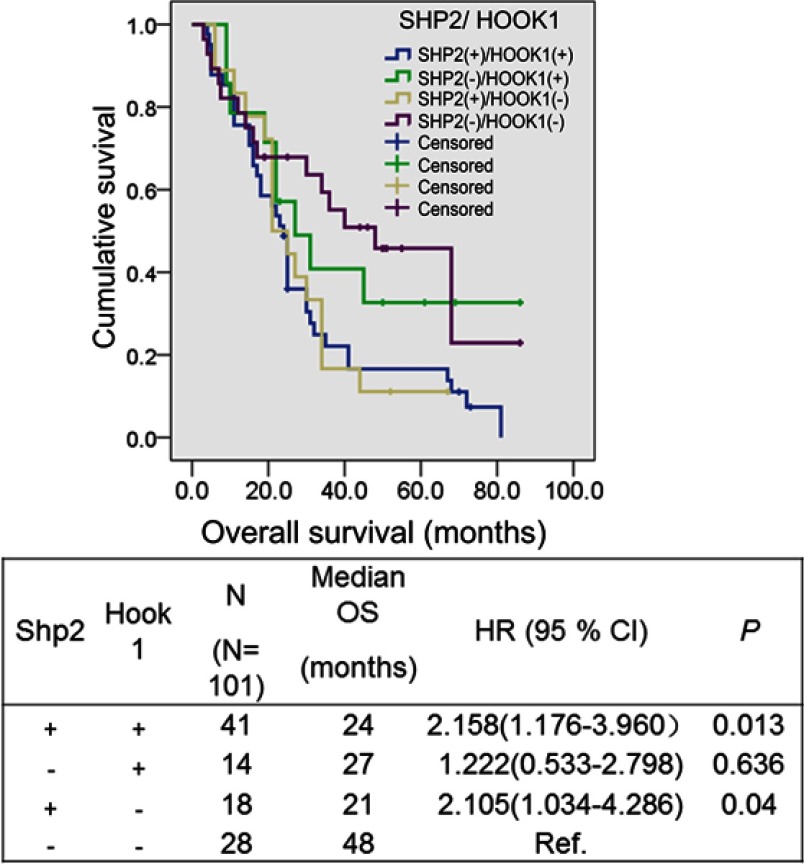
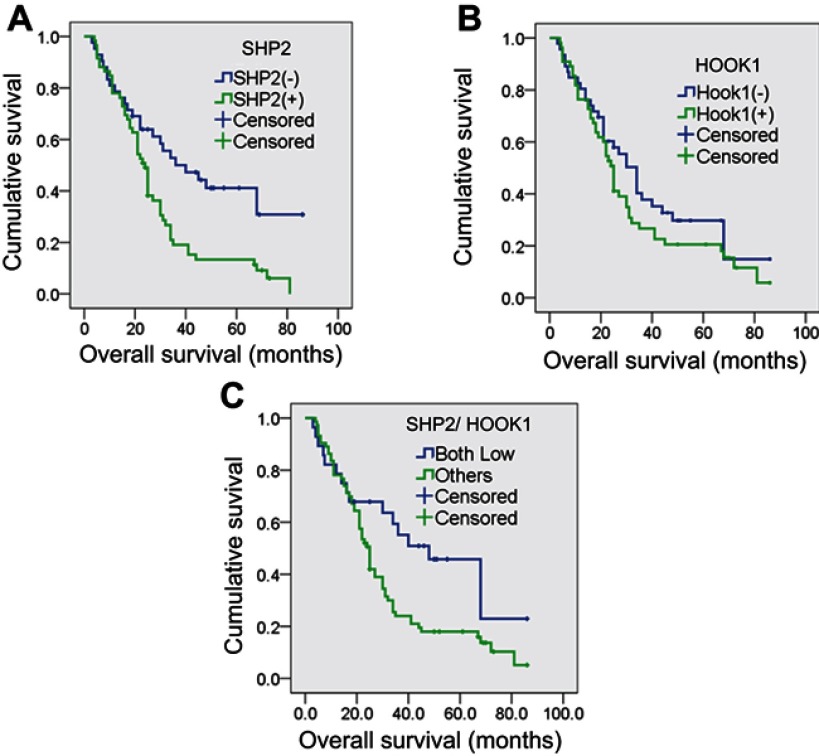
In tumour tissue specimens, positive expression rates of SHP2 proteins were 58.4% by immunohistochemical analysis. A significant correlation between expression of SHP2 and that of Hook1 was observed. Based on Western blot analysis, we found that Hook1 was downregulated and that SHP2 has a tendency to overexpress without statistical significance in NSCLC tissues compared with their levels in normal lung tissues. The median overall survival (OS) of NSCLC patients who presented low levels of SHP2 expression were better (40 vs 24 months, =0.004) than those of patients who exhibited high levels of SHP2 expression. The results of multivariate analysis showed that the level of SHP2 expression was an independent prognostic factor for OS.
SHP2 might play an important role in NSCLC and has the potential to serve as a clinical biomarker or NSCLC.
我们之前报道过,在肺癌上皮-间质转化(EMT)的调控中,Hook1抑制SHP2的磷酸酶活性。在本研究中,我们对非小细胞肺癌(NSCLC)患者的SHP2和Hook1表达及其与预后的关系进行了全面分析。
本研究共纳入121例NSCLC患者。通过免疫组织化学和蛋白质印迹分析评估SHP2和Hook1的表达。采用Cox比例风险多因素分析和对数秩检验分析NSCLC患者的总生存率。
在肿瘤组织标本中,免疫组织化学分析显示SHP2蛋白的阳性表达率为58.4%。观察到SHP2表达与Hook1表达之间存在显著相关性。基于蛋白质印迹分析,我们发现与正常肺组织相比,NSCLC组织中Hook1表达下调,SHP2有过表达趋势但无统计学意义。SHP2低表达的NSCLC患者的中位总生存期(OS)较好(40个月对24个月,P=0.004),高于SHP2高表达的患者。多因素分析结果显示,SHP2表达水平是OS的独立预后因素。
SHP2可能在NSCLC中起重要作用,有潜力作为NSCLC的临床生物标志物。