Department of Psychological Sciences, Kent State University, Kent, Ohio, United States of America.
Behavioral Research Program, National Cancer Institute, Bethesda, Maryland, United States of America.
PLoS One. 2019 Aug 15;14(8):e0219074. doi: 10.1371/journal.pone.0219074. eCollection 2019.
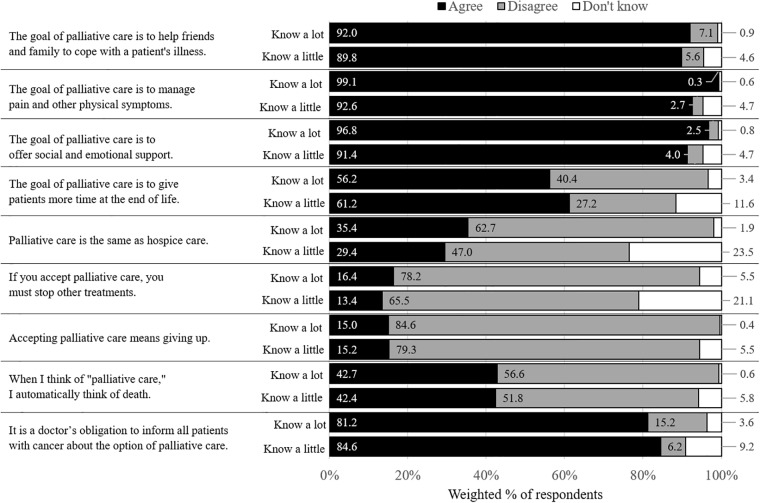
Palliative care aims to improve quality of life for people with serious illness and their families. One potential barrier to palliative care uptake is inaccurate knowledge and/or negative beliefs among the general population, which may inhibit early interest in, communication about, and integration of palliative care following subsequent illness diagnosis. We explored knowledge and beliefs about palliative care among the general public using nationally-representative data collected in 2018 as part of the cross-sectional Health Information National Trends Survey. Only individuals who had heard of palliative care (n = 1,162, Mage = 51.8, 64% female) were queried on knowledge and beliefs. We examined whether self-assessed level of awareness of palliative care (i.e., knowing a little vs. enough to explain it) was associated with the relative likelihood of having accurate/positive beliefs, inaccurate/negative beliefs, or responding "don't know" to questions about palliative care. Respondents who indicated knowing a lot about palliative care had more accurate versus inaccurate knowledge than those who knew a little on only two of six items and more positive attitudes on only one of three items. In particular, respondents with greater awareness were equally likely to report that palliative care is the same as hospice and requires stopping other treatments, and equally likely to believe that palliative care means giving up and to associate palliative care with death. Those with higher awareness were less likely than those with lower awareness to respond "don't know," but greater awareness was not necessarily associated with having accurate or positive beliefs about palliative care as opposed to inaccurate or negative beliefs. Thus, even members of the general public who perceived themselves to know a lot about palliative care were often no less likely to report inaccurate knowledge or negative beliefs (versus accurate and positive, respectively). Findings suggest a need to improve awareness and attitudes about palliative care.
缓和医疗旨在提高患有严重疾病的患者及其家属的生活质量。一般人群对缓和医疗认识不足和/或存在负面观念,可能会影响他们在后续患病后对缓和医疗的早期关注、沟通和整合。我们利用 2018 年全国代表性数据,通过横断面健康信息国家趋势调查,研究了一般人群对缓和医疗的认识和信念。只有听说过缓和医疗的个体(n=1162,Mage=51.8,64%为女性)被问及对缓和医疗的认识和信念。我们考察了自我评估的缓和医疗意识水平(即略知一二与能够解释)是否与准确/积极信念、不准确/消极信念或对缓和医疗问题回答“不知道”的相对可能性相关。与仅略知一二的个体相比,知道很多的个体在六个项目中的两个项目上表现出更准确的知识,在三个项目中的一个项目上表现出更积极的态度。具体而言,具有较高意识的个体与那些认为缓和医疗与临终关怀相同并需要停止其他治疗的个体同样可能报告不准确的知识,与那些认为缓和医疗意味着放弃和与死亡相关的个体同样可能报告消极的态度。与意识程度较低的个体相比,意识程度较高的个体更不可能回答“不知道”,但较高的意识水平并不一定与对缓和医疗的准确或积极信念相关,而与不准确或消极信念相关。因此,即使是那些认为自己对缓和医疗有很多了解的一般人群,也常常不太可能报告准确的知识或积极的信念(分别与不准确和消极的信念相对)。研究结果表明,需要提高对缓和医疗的认识和态度。