Qiu Zhengang, Lin Anqi, Li Kun, Lin Weiyin, Wang Qiongyao, Wei Ting, Zhu Weiliang, Luo Peng, Zhang Jian
Department of Oncology, Zhujiang Hospital, Southern Medical University, Guangzhou 510282, People's Republic of China.
Department of Oncology, First Affiliated Hospital of Gannan Medical University, Ganzhou 341000, People's Republic of China.
Drug Des Devel Ther. 2019 Jun 21;13:2021-2041. doi: 10.2147/DDDT.S205633. eCollection 2019.
Platinum-based chemotherapy, consisting of etoposide and cisplatin (EP), has been the cornerstone of therapy for extensive-stage small-cell lung cancer (ES-SCLC) for decades. Despite the marked initial sensitivity of SCLC to chemotherapy, EP regimens cannot avoid the emergence of drug resistance in clinical practice. With the rise of new chemotherapy regimens in recent years and the primary resistance or insensitivity of ES-SCLC to EP regimens, it is desirable to be able to identify patients with resistant or insensitive ES-SCLC.
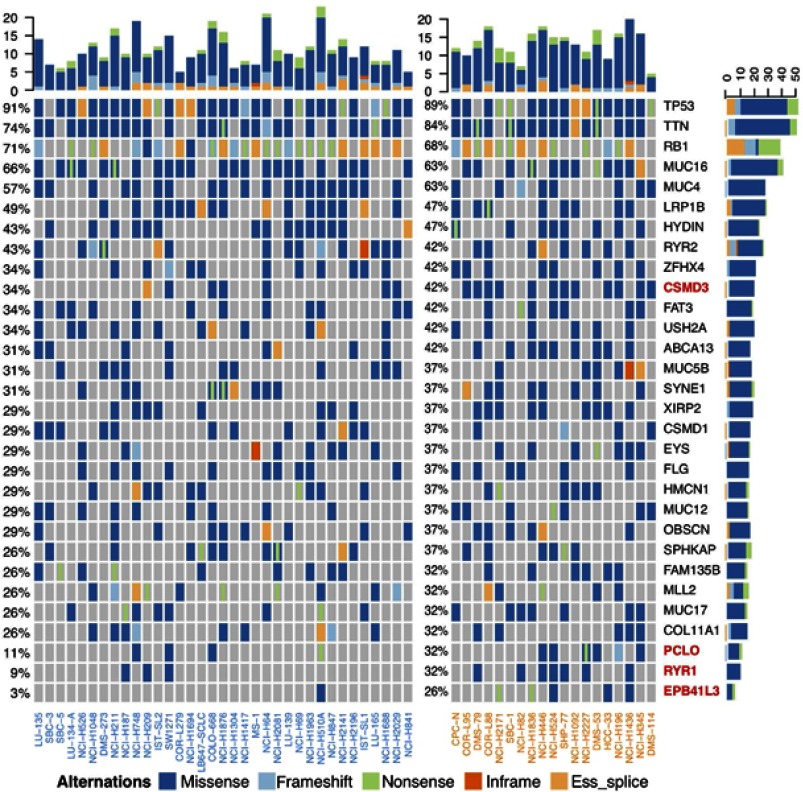
The sequencing and drug sensitivity data of SCLC cell lines were provided by The Genomics of Drug Sensitivity in Cancer Project (GDSC). The data regarding sensitivity to etoposide of 54 SCLC cell lines were analyzed, and etoposide-sensitive cell lines and etoposide-resistant cell lines were differentiated according to the IC50 values defined by the GDSC. ROC curve analysis was performed on all mutations and combinations of mutations to select the optimal panel to predict resistance to etoposide.
ROC analysis of etoposide resistance revealed that the most significant single gene mutation indicating resistance to etoposide was , and the accuracy of predicting resistance to etoposide proved to be the highest when there was any mutation in , area under the curve =0.804 (95% confidence interval: 0.679-0.930, ).
This study found that a panel with four genes () can accurately predict sensitivity to etoposide. These findings provide new insights into the overall treatment for patients with ES-SCLC that is resistant or insensitive to etoposide.
几十年来,由依托泊苷和顺铂(EP)组成的铂类化疗一直是广泛期小细胞肺癌(ES-SCLC)治疗的基石。尽管小细胞肺癌对化疗最初具有明显的敏感性,但在临床实践中,EP方案无法避免耐药性的出现。近年来,随着新化疗方案的兴起以及ES-SCLC对EP方案的原发性耐药或不敏感,能够识别耐药或不敏感的ES-SCLC患者变得很有必要。
小细胞肺癌细胞系的测序和药敏数据由癌症药物敏感性基因组学项目(GDSC)提供。分析了54个小细胞肺癌细胞系对依托泊苷的敏感性数据,并根据GDSC定义的IC50值区分依托泊苷敏感细胞系和依托泊苷耐药细胞系。对所有突变及突变组合进行ROC曲线分析,以选择预测对依托泊苷耐药的最佳基因组合。
依托泊苷耐药的ROC分析显示,表明对依托泊苷耐药的最显著单基因突变是 ,当 存在任何突变时,预测对依托泊苷耐药的准确性最高,曲线下面积=0.804(95%置信区间:0.679 - 0.930, )。
本研究发现一个包含四个基因( )的基因组合可以准确预测对依托泊苷的敏感性。这些发现为对依托泊苷耐药或不敏感的ES-SCLC患者的整体治疗提供了新的见解。