Gates Evan D H, Yang Jie, Fukumura Kazutaka, Lin Jonathan S, Weinberg Jeffrey S, Prabhu Sujit S, Long Lihong, Fuentes David, Sulman Erik P, Huse Jason T, Schellingerhout Dawid
Department of Imaging Physics, The University of Texas MD Anderson Cancer Center, Houston, TX, United States.
Graduate School of Biomedical Sciences, The University of Texas MD Anderson Cancer Center UTHealth, Houston, TX, United States.
Front Oncol. 2019 Jul 30;9:676. doi: 10.3389/fonc.2019.00676. eCollection 2019.
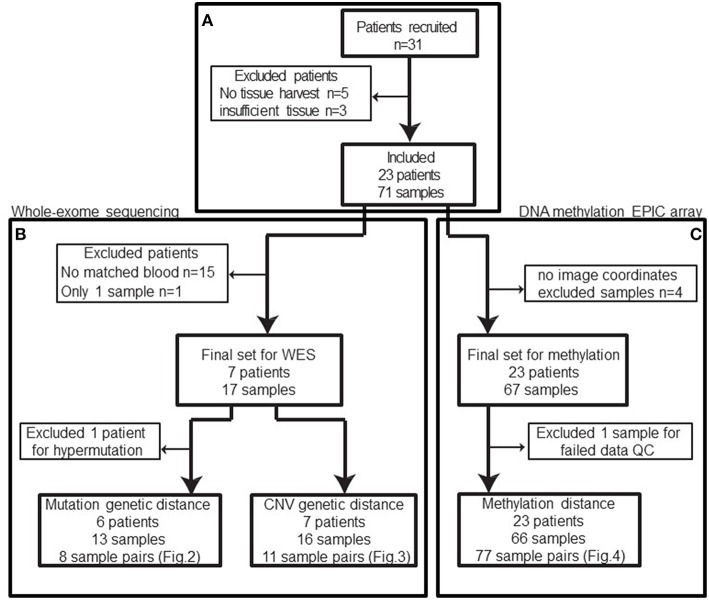
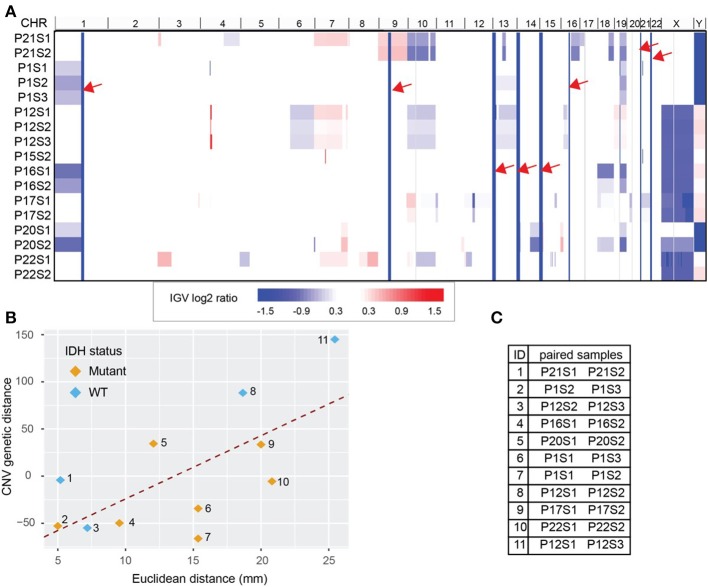
Treatment effectiveness and overall prognosis for glioma patients depend heavily on the genetic and epigenetic factors in each individual tumor. However, intra-tumoral genetic heterogeneity is known to exist and needs to be managed. Currently, evidence for genetic changes varying spatially within the tumor is qualitative, and quantitative data is lacking. We hypothesized that a greater genetic diversity or "genetic distance" would be observed for distinct tumor samples taken with larger physical distances between them. Stereotactic biopsies were obtained from untreated primary glioma patients as part of a clinical trial between 2011 and 2016, with at least one biopsy pair collected in each case. The physical (Euclidean) distance between biopsy sites was determined using coordinates from imaging studies. The tissue samples underwent whole exome DNA sequencing and epigenetic methylation profiling and genomic distances were defined in three separate ways derived from differences in number of genes, copy number variations (CNV), and methylation profiles. Of the 31 patients recruited to the trial, 23 were included in DNA methylation analysis, for a total of 71 tissue samples (14 female, 9 male patients, age range 21-80). Samples from an 8 patient subset of the 23 evaluated patients were further included in whole exome and copy number variation analysis. Physical and genomic distances were found to be independently and positively correlated for each of the three genomic distance measures. The correlation coefficients were 0.63, 0.65, and 0.35, respectively for (a) gene level mutations, (b) copy number variation, and (c) methylation status. We also derived quantitative linear relationships between physical and genomic distances. Primary brain tumors are genetically heterogeneous, and the physical distance within a given glioma correlates to genomic distance using multiple orthogonal genomic assessments. These data should be helpful in the clinical diagnostic and therapeutic management of glioma, for example by: managing sampling error, and estimating genetic heterogeneity using simple imaging inputs.
胶质瘤患者的治疗效果和总体预后在很大程度上取决于每个肿瘤个体的遗传和表观遗传因素。然而,肿瘤内的遗传异质性是已知存在的,需要加以处理。目前,关于肿瘤内遗传变化在空间上不同的证据是定性的,缺乏定量数据。我们假设,对于在空间上距离较大的不同肿瘤样本,会观察到更大的遗传多样性或“遗传距离”。作为2011年至2016年一项临床试验的一部分,从未经治疗的原发性胶质瘤患者中获取立体定向活检样本,每个病例至少收集一对活检样本。活检部位之间的物理(欧几里得)距离通过影像学研究的坐标来确定。组织样本进行了全外显子组DNA测序和表观遗传甲基化分析,并通过三种不同方式根据基因数量差异、拷贝数变异(CNV)和甲基化谱定义基因组距离。在招募到该试验的31名患者中,23名纳入了DNA甲基化分析,共71个组织样本(14名女性、9名男性患者,年龄范围21 - 80岁)。对23名评估患者中的8名患者子集的样本进一步进行了全外显子组和拷贝数变异分析。对于三种基因组距离测量中的每一种,都发现物理距离和基因组距离独立且呈正相关。对于(a)基因水平突变、(b)拷贝数变异和(c)甲基化状态,相关系数分别为0.63、0.65和0.35。我们还得出了物理距离和基因组距离之间的定量线性关系。原发性脑肿瘤具有遗传异质性,给定胶质瘤内的物理距离通过多种正交基因组评估与基因组距离相关。这些数据应有助于胶质瘤的临床诊断和治疗管理,例如通过:管理采样误差,以及使用简单的影像学输入估计遗传异质性。